- Fungi Including Lichens
- ›Basidiomycete Fungi
- ›Higher Basidiomycetes
- ›Mushrooms, Bracket Fungi, Puffballs, and Allies
- ›Agaricomycetidae
- ›Common Gilled Mushrooms and Allies
- ›Pluteineae
- ›amanita mushrooms and allies
- ›Amaniteae
- ›Amanita
- ›Amanita
- ›Amanita
- ›Amanitella
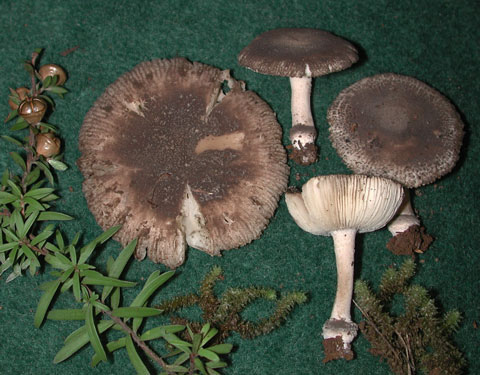
Amanita nehuta
Amanita nehuta, also called Maori dust amanita, is a species of fungus in the family Amanitaceae. It was first described by New Zealand mycologist Geoff Ridley in 1991. It occurs in New Zealand in large number. It has only a dark ring rather than a universal veil and white spores. It is found under leptospermum and Nothofagus. It grows on ground usually in late summer. Its height is 110 mm and width is 100 mm.
From the article Amanita nehuta on Wikipedia (CC BY-SA), quoted section by section
Description
Growing on the ground usually in late summer, the cap is 2.5–6.5 centimetres (1–2+1⁄2 inches) wide, plano-convex to plano-depressed, buff, non-viscid, with a striate margin. The volval remnants are pulverulent on the center raised into wart-like peaksor warts or radial ridges, colored pale sepia. Gills are crowded and free, measure 6–7 millimetres (1⁄4–9⁄32 in) wide, and appear white to pale buff. The short gills are subtruncate. Its stipe is 20–75 × 4–11 mm, hollow, exannulate, with a smooth to subfloccose upper stem and smooth lower stem. The surface is white, pale buff, or very pale grayish sepia in color like the cap. The basal bulb is clavate to bulbous, 10–16 mm in diameter. The base has a rim or band of powdery volva, the same color as on the cap. The stem has no ring. The spores measure 6.5–9 × 5.5–8 (-8.5) μm and are subglobose to broadly ellipsoid to ellipsoid and inamyloid. They are white in color. Clamps are absent at the bases of the basidia. The flesh is white, with a very pale area under the skin in the center.
Similar species. Amanita nehuta is said to be similar to A. farinosa, A. obsita, A. subvaginata and A. xerocybe. All these species appear to have a cap surface that gelatinizes late in development so that the volva remains intimately connected to the cap skin well into maturity of the fruiting body. …
Range & habitat
This species was originally described from Wellington, New Zealand, associated with many types of Nothofagus, Leptospermum, and Kunzea. It is also known from the South Island of New Zealand.
Wikipedia: “Distribution and habitat”
Where it lives
Recorded sightings
—
geo-referenced records in GBIF, from museums, herbaria and field observers.
Drag the globe to turn it. Dots are where records exist, not a range map; darker means more records.
In the stacks
Searching the stacks…
Every page naming Amanita nehuta in the Biodiversity Heritage Library →
This page is assembled live from iNaturalist, GBIF, Wikipedia, the Source Library and the Internet Archive. It is not yet part of the hand-edited codex. iNaturalist taxon 381216.