- Fungi Including Lichens
- ›Basidiomycete Fungi
- ›Higher Basidiomycetes
- ›Mushrooms, Bracket Fungi, Puffballs, and Allies
- ›Agaricomycetidae
- ›Common Gilled Mushrooms and Allies
- ›Pluteineae
- ›amanita mushrooms and allies
- ›Amaniteae
- ›Amanita
- ›Amanita
- ›Vaginatae
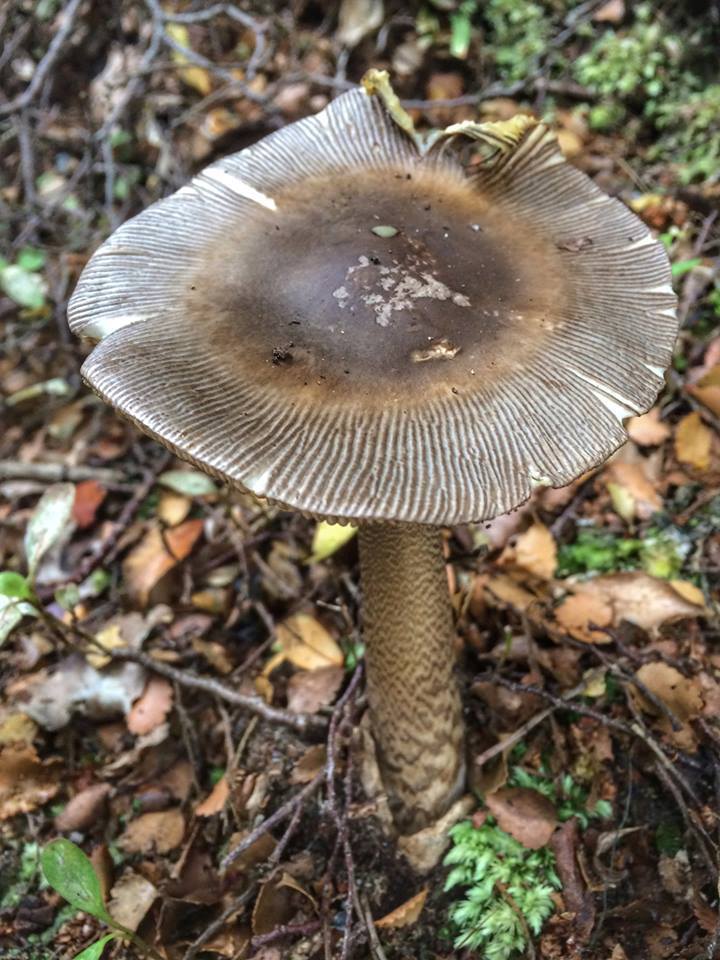
Amanita pekeoides
Amanita pekeoides is a species of fungus in the family Amanitaceae. It was first described scientifically by New Zealand mycologist Geoff Ridley in 1991.
From the article Amanita pekeoides on Wikipedia (CC BY-SA), quoted section by section
Description
Ridley described Amanita pekeoides as a “typical member of the Vaginatae” due to the “non-bulbous stipe, saccate volva, and inamyloid basidiospores”. The pileus of A. pekeoides is described as being between 32–82 millimetres (1+1⁄2–3 inches) and convex in shape when immature, gradually becoming plano-convex then plano-depressed as the fruiting body matures. The margin of the pileus is sulcate, with the grooves being greyish sepia while the disc and ridges are hazel to dark greyish sepia, paling at the margin. The pileus is viscid when wet but dries quickly. The lamellae are crowded but free; usually 6–10 mm wide, pale buff to buff with a complete margin that is brown vinaceous to dark grey sepia, and truncated lamellulae. The stipe is typically 7–12 centimetres (3–4+1⁄2 in) high, 7–10 mm in diameter, hollow, tapering apically, and the surface is white to pale greyish sepia, with hazel to greyish sepia striate bands, which become finer and more numerous towards the apex. A notable distinction of A. pekeoides from many other Amanita species is its lack of annulus. A. pekeoides exhibits a whitish to pale sepia or pale brown vinaceous, 30–58 mm volva which is often hidden under substrate. The volva starts out fleshy but becomes membranous with age, is saccate and usually bilabiate. …
Range & habitat
A. pekeoides occurs in the North and South Islands of New Zealand, and is primarily associated with Nothofagus species.
Wikipedia: “Distribution and habitat”
Where it lives
Recorded sightings
—
geo-referenced records in GBIF, from museums, herbaria and field observers.
Drag the globe to turn it. Dots are where records exist, not a range map; darker means more records.
In the stacks
Searching the stacks…
Every page naming Amanita pekeoides in the Biodiversity Heritage Library →
This page is assembled live from iNaturalist, GBIF, Wikipedia, the Source Library and the Internet Archive. It is not yet part of the hand-edited codex. iNaturalist taxon 381220.