- Fungi Including Lichens
- ›Basidiomycete Fungi
- ›Higher Basidiomycetes
- ›Mushrooms, Bracket Fungi, Puffballs, and Allies
- ›Phallomycetidae
- ›stinkhorns and allies
- ›Clathraceae
- ›Aseroe
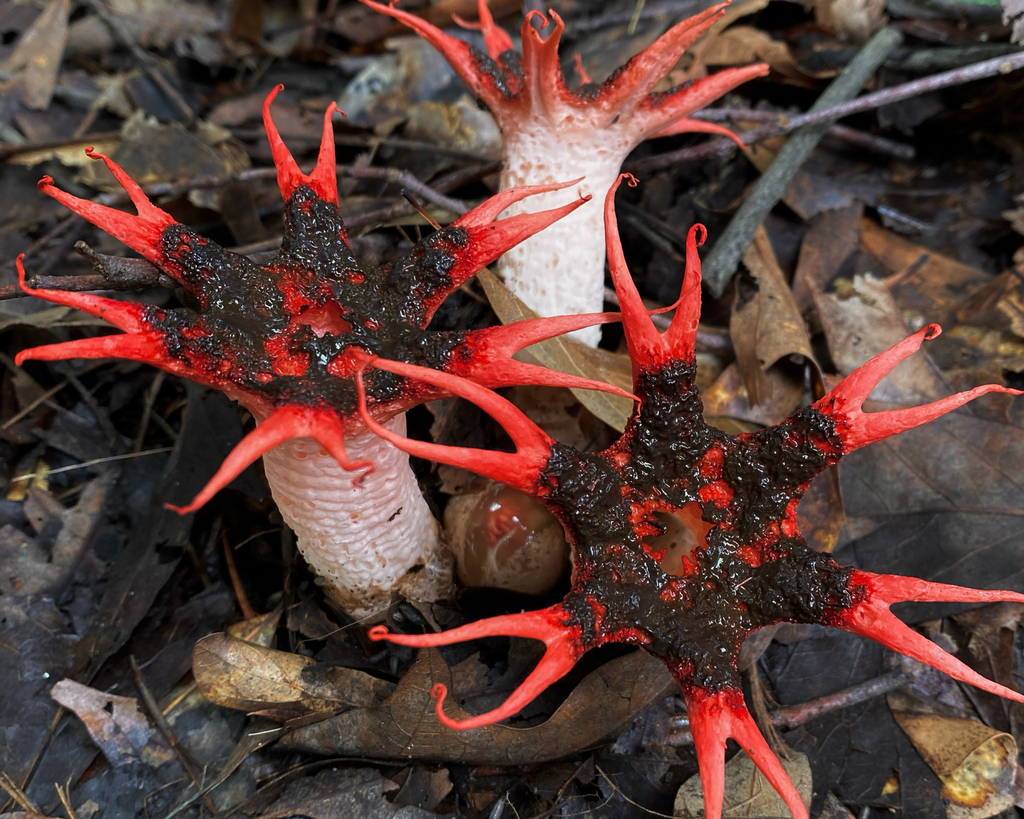
anemone stinkhorn fungus
Aseroe rubra
Aseroe rubra, commonly known as the anemone stinkhorn, sea anemone fungus and starfish fungus, is a common and widespread basidiomycete fungus recognizable for its foul odour of carrion and its sea anemone shape when mature. Found in gardens on mulch and in grassy areas, it resembles a red star-shaped structure covered in brownish slime called gleba on a white stalk. It attracts flies, which spread its spores.
From the article Aseroe rubra on Wikipedia (CC BY-SA), quoted section by section
Description
Aseroe rubra begins as a partly buried whitish egg-shaped structure 3 cm (1+1⁄4 in) in diameter, which bursts open as a hollow white stalk with reddish arms erupts and grows to a height of 10 cm (3.9 in). It matures into a reddish star-shaped structure with six to ten arms up to 4 cm (1+1⁄2 in) long radiating from the central area. These arms are bifid (deeply divided into two limbs). The top of the fungus is covered with dark olive-brown slime or gleba, which smells of rotting meat. There is a cup-shaped volva at the base that is the remnants of the original egg.
Range & habitat
This fairly common fungus is widely distributed in Australia from southeastern Queensland through New South Wales and eastern Victoria and Tasmania. It is also found across many islands in the Pacific Ocean, including New Zealand. A saprotroph, it is found on decomposing plant matter as well as on woodchips and mulch and is common in gardens and amenities plantings. It also occurs in alpine grasslands and woodlands. From its natural habitat, it appears to have traveled to other parts of the world in garden or soil products; it was recorded growing on soil transported from Australia in a glasshouse in Kew Gardens in 1829 and later in California in North America. Transport in garden or soil products does not explain its presence on remote and uninhabited Pacific islands nor its occurrence in South Africa, Kangaita, and Kirinyaga (a small village in Kenya) in localities remote from any garden. These unexplained localities cast doubt on the assumption that the species was spread from Australia and New Zealand by humans. Recently, A. rubra var. zeylanica which differ in size (3-4.5 cm diam.) and salmon pink to reddish-orange unbranched arms or tentacles, has been reported from the Western Ghats, Kerala, India. This fungus is distributed in the semi-evergreen to evergreen forests and Eucalyptus stands at high ranges.
Wikipedia: “Distribution and habitat”
In human culture
Aseroe rubra is known as puapua-a-Autahi in Māori, or the "blossom of Canopus", a name which refers to the fact that the fungus is seen typically after Canopus rises in New Zealand. While the fungus is a traditional food in Māori culture, only young specimens can be harvested, and the fruiting body is cooked for extended periods of time, to remove toxins.
Wikipedia: “In Māori culture”
Where it lives
Recorded sightings
—
geo-referenced records in GBIF, from museums, herbaria and field observers.
Drag the globe to turn it. Dots are where records exist, not a range map; darker means more records.
In the stacks
Searching the stacks…
Every page naming Aseroe rubra in the Biodiversity Heritage Library →
This page is assembled live from iNaturalist, GBIF, Wikipedia, the Source Library and the Internet Archive. It is not yet part of the hand-edited codex. iNaturalist taxon 381310.