- Fungi Including Lichens
- ›Basidiomycete Fungi
- ›Higher Basidiomycetes
- ›Mushrooms, Bracket Fungi, Puffballs, and Allies
- ›Agaricomycetidae
- ›Common Gilled Mushrooms and Allies
- ›Agaricineae
- ›Webcaps
- ›Cortinarius
- ›Camphorati
- ›Camphorati
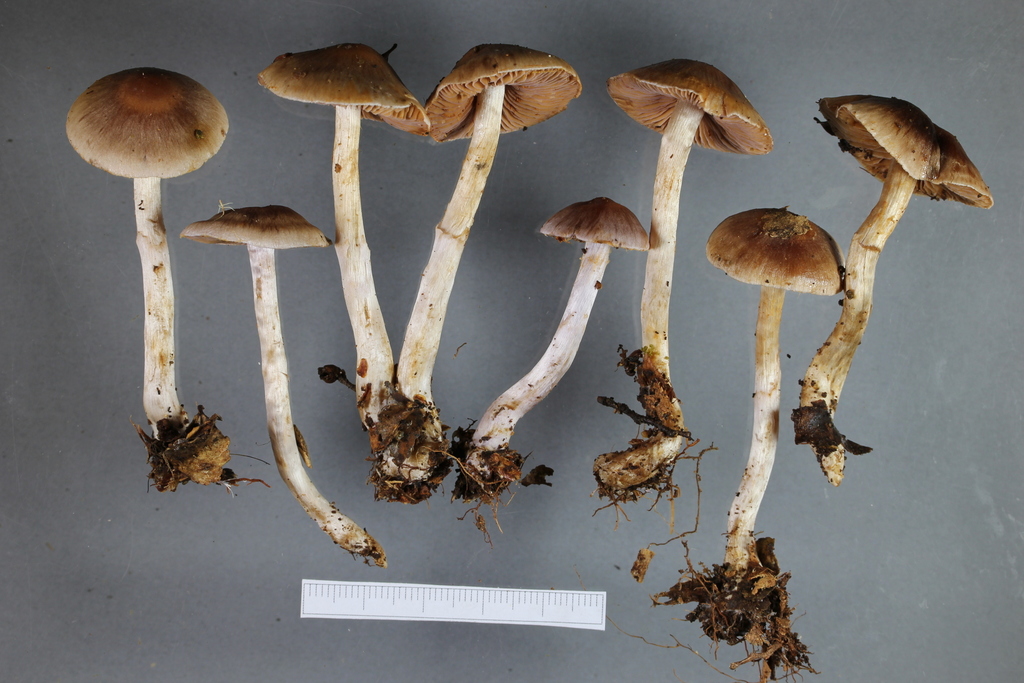
Cortinarius dysodes
Cortinarius dysodes is a species of agaricoid fungus in the genus Cortinarius. It is endemic to Aotearoa New Zealand.
From the article Cortinarius dysodes on Wikipedia (CC BY-SA), quoted section by section
Description
This species produces agaricoid fruit bodies that are often clumped (fasciculate). The pileus is up to 60 mm in diameter, dry, hygrophanous, brown with a purple tinge and yellowing with age, and a conspicuous white rim. The lamellae are violet to reddish lilac. The stipe ranges from cylindrical to slightly club-shaped, white (appearing dirty white towards the base) and with whitish bands. The veil and cortina are described as sparse and white with a violet tinge. The flesh is pale grey-brown, and when young has a violet tinge, often becoming marbled violaceous with age. A distinctive feature of this species is that the odour is very strong and unpleasant, according to Soop to be more or less "gas-like (cooking-gas or acetylene) or of rotting vegetables; taste similar". Tissues of the fruit bodies have no notable reactions with sodium hydroxide. Cortinarius dysodes is in Cortinarius section Camphorati along with C. tasmacamphoratus, C. camphoratus and C. putorius, a relationship supported by ITS/LSU phylogenetic analysis.
Range & habitat
Cortinarius dysodes occurs in forests and is found in both the North and South Island of New Zealand. It is an ectomycorrhizal fungus, associated with Nothofagus species.
Wikipedia: “Habitat and distribution”
In human culture
The specific epithet dysodes derives from the Greek dysodes meaning pestilential. This refers to the disgusting smell of the fruit bodies, even when young and fresh.
Wikipedia: “Etymology”
Where it lives
Recorded sightings
—
geo-referenced records in GBIF, from museums, herbaria and field observers.
Drag the globe to turn it. Dots are where records exist, not a range map; darker means more records.
In the stacks
Searching the stacks…
Every page naming Cortinarius dysodes in the Biodiversity Heritage Library →
This page is assembled live from iNaturalist, GBIF, Wikipedia, the Source Library and the Internet Archive. It is not yet part of the hand-edited codex. iNaturalist taxon 381902.