- Fungi Including Lichens
- ›Ascomycete Fungi
- ›Sac Fungi and Lichens
- ›Dothideomycetes
- ›Pleosporomycetidae
- ›Pleosporales
- ›Didymellaceae
- ›Epicoccum
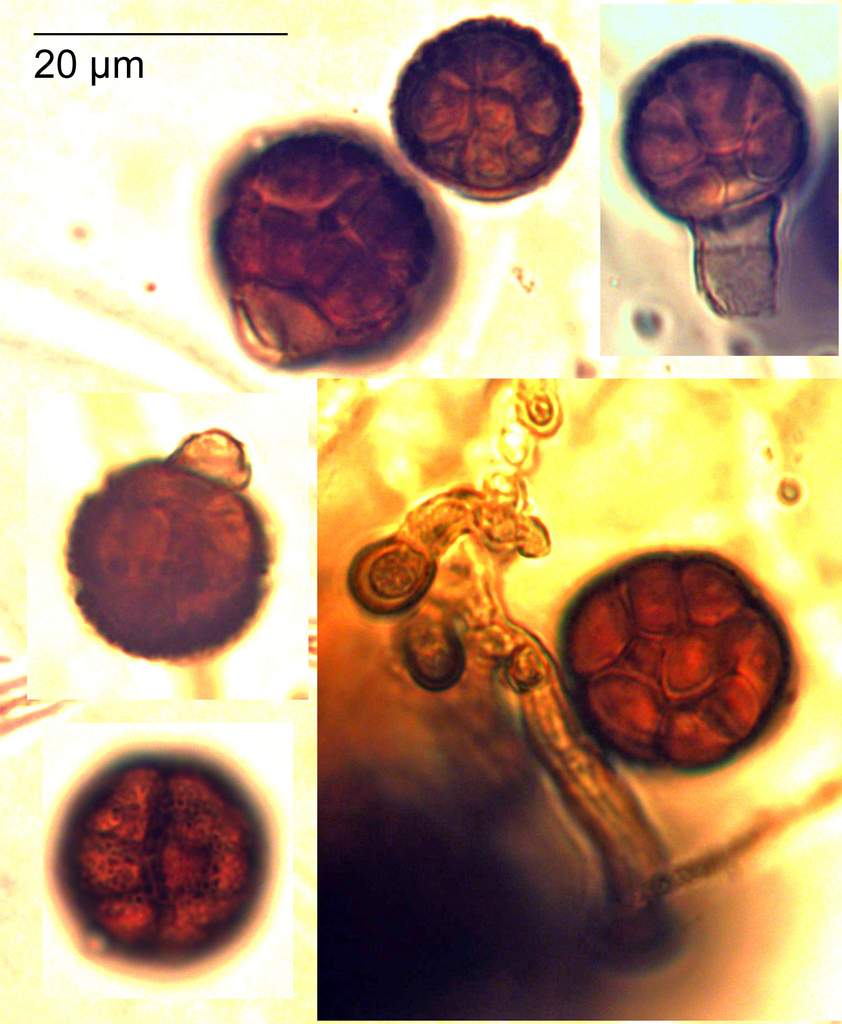
Epicoccum purpurascens
Epicoccum nigrum is a species of fungus, in the phylum Ascomycota. A plant pathogen and endophyte, it is a widespread fungus which produces coloured pigments that can be used as antifungal agents against other pathogenic fungi. The fluorescent stain, epicocconone is extracted from it.
From the article Epicoccum nigrum on Wikipedia (CC BY-SA), quoted section by section
Range & habitat
A highly robust and ubiquitous fungus, E. nigrum has an almost global spread, occurring in the Americas, Asia, and Europe. Spores of E. nigrum have been cultured from a variety of environments, predominantly soil (i.e. peat, forest floor, raw humus, compost, tundra, sewage) and sand (e.g., dunes, saline sands). It is a saprophytic fungus, forming pustules (composed of sporodochia and conidia) on dead and dying plants. This species is commonly found growing on cereals and seeds, as well as other crops including corn, beans, potatoes, peas and peaches. It has been found to grow colonies on leaves submersed in water as cold as 0 °C (32 °F), and is considered a facultative marine fungus. It is capable of colonizing algae and marsh grasses. In indoor environments, E. nigrum has been found on paintings and wallpaper, cotton and textiles, in dust, and in air. It is tolerant of changes in water availability, and hyphal growth has been found to resume within an hour of exposure to water.
Wikipedia: “Habitat and ecology”
At the table
Epicoccum nigrum has a wide array of medical, industrial, and agricultural applications. It produces a variety of pigmented and non-pigmented antifungal and antibacterial compounds. These antimicrobial compounds are effective against other fungi and bacteria present in soil. Flavipin, and epirodins A and B are pigmented antifungal agents; non-pigmented compounds include epicorazines A and B. Endophytic fungi such as E. nigrum are being explored as alternative sources of antibiotics to treat important resistant infections. Polysaccharide antioxidants are also produced by E. nigrum. Epicocconone is a fluorescent pigment unique to E. nigrum. Epicocconone is valuable in terms of its ability to pigment cells orange, which then fluoresce red without impacting cell structure or function. Industrially, E. nigrum has a variety of broad applications. It has demonstrated a capacity to biosynthesize nanoparticles from silver and gold, which have applications in chemical, industrial, and medical processes. It has been applied as biological treatment for mechanical oily effluent, reducing the content of hydrogen peroxide, phenols, and chemical oxygen demand in the oily effluent. Epicoccum nigrum pigments have been considered as natural replacements for artificial pigments currently used in food. It produces a variety of pigments, ranging from darker oranges to yellows and greens. …
Wikipedia: “Biomedical, industrial, and agricultural uses”
In human culture
Epicoccum nigrum has been treated under a variety of names in the genus Epicoccum. It was first identified in 1815 by botanist Johaan Heinrich Friedrich Link. Today, all previously identified species are considered to be different variants of the species E. nigrum. These include: E. purpurascens, E. diversisporum, E. versicolor, E. vulgare, E. granulatum, E. menispermi, and E. neglectum. More recently, two distinct genotypes for E. nigrum have been identified with the combined use of DNA sequencing, morphology, physiology, and recombination factors. This indicates the existence of cryptic species, and a subsequent call to re-classify E. nigrum into more than one species.
== References ==
Wikipedia: “History and reclassification”
Where it lives
Recorded sightings
—
geo-referenced records in GBIF, from museums, herbaria and field observers.
Drag the globe to turn it. Dots are where records exist, not a range map; darker means more records.
In the stacks
Searching the stacks…
Every page naming Epicoccum purpurascens in the Biodiversity Heritage Library →
This page is assembled live from iNaturalist, GBIF, Wikipedia, the Source Library and the Internet Archive. It is not yet part of the hand-edited codex. iNaturalist taxon 382333.