- Fungi Including Lichens
- ›Ascomycete Fungi
- ›Sac Fungi and Lichens
- ›Operculate Ascomycetes
- ›Pezizales
- ›Tarzettaceae
- ›Paurocotylis
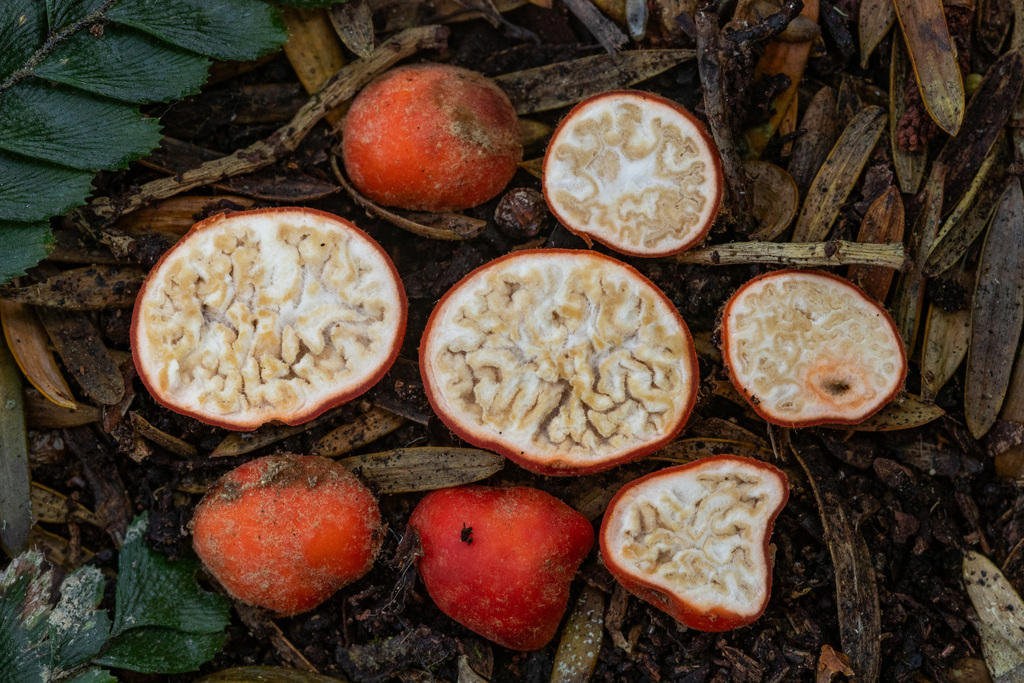
scarlet berry truffle
Paurocotylis pila
Paurocotylis pila, commonly known as the scarlet berry truffle, is an ascomycete fungus in the genus Paurocotylis. It was first described by Miles Joseph Berkley in 1855.
This species is native to New Zealand and Australia and is naturalized in the United Kingdom. It often appears in forests under podocarp trees such as tōtara; however, it also occurs in gardens, forest tracks, and parks.
From the article Paurocotylis pila on Wikipedia (CC BY-SA), quoted section by section
Description
This truffle-like fungus produces a spherical to tuber-shaped fruit body (ascoma) with a smooth surface, which can be lobed or wrinkled. Paurocotylis pila's fruiting body is ball shaped, with a thin, matte red-orange outer rind and has no stalk. Often the rind is creased, but occasionally is smooth. Varying in size, it ranges from 10-30mm across, and is found half buried in soil, or under leaf litter. The fruit body is made of yellow-brown tissue, with multiple hollow chambers. Inside the chambers, the asci break up to leave round, cream or yellow ascospores. Once collected and dried, the rind's colour changes to a dull red-brown. P. pila fruit bodies usually range from 10–40 millimetres (1⁄2–1+1⁄2 in) in diameter, although some in the UK are up to 60 mm. The fruit body does not have a stipe. There is no odour noted and it is regarded as non-edible.
Range & habitat
DNA barcode (internal transcribed spacer) sequences in the National Center for Biotechnology Information database indicate a distribution in New Zealand, Australia and the United Kingdom.
Natural global range. This species is native to New Zealand, however, it has been introduced to England. In England, it has spread to Nottingham, Yorkshire, Sheffield, and more. Paurocotylis pila is also native to Tasmania, and has been found in Australia.
New Zealand range. Paurocotylis pila is found all across New Zealand; often appearing in forests under podocarp trees such as totara. However, it also occurs in gardens, forest tracks, and parks.
Wikipedia: “Range”
What it does
Paurocotylis pila is a saprobic species that grows underground. The fruiting bodies emerge after warm rain, mainly in autumn. After emerging from underground, Paurocotylis pila often remains partially covered by soil or leaf litter. From there, it is presumed to be dispersed by ground-foraging birds looking for fallen fruit. Fruiting in autumn, Paurocotylis pila coincides with podocarp trees fruiting in the forest. As its colour resembles the fruit, it attracts birds. Bird dispersal has likely assisted it in its spread throughout England, with specimens found in England with damage from birds pecking.
Wikipedia: “Life cycle/Phenology”
In human culture
Greek, pauro means few and cotylis means cavity, possibly referring to the observed interior of the type specimen. Latin, pila means sphere, presumably referring to the shape of the fruit body.
Wikipedia: “Etymology”
Where it lives
Recorded sightings
—
geo-referenced records in GBIF, from museums, herbaria and field observers.
Drag the globe to turn it. Dots are where records exist, not a range map; darker means more records.
In the stacks
Searching the stacks…
Every page naming Paurocotylis pila in the Biodiversity Heritage Library →
This page is assembled live from iNaturalist, GBIF, Wikipedia, the Source Library and the Internet Archive. It is not yet part of the hand-edited codex. iNaturalist taxon 383403.