- Fungi Including Lichens
- ›Basidiomycete Fungi
- ›Higher Basidiomycetes
- ›Mushrooms, Bracket Fungi, Puffballs, and Allies
- ›Agaricomycetidae
- ›Common Gilled Mushrooms and Allies
- ›Agaricineae
- ›Hymenogastraceae
- ›Psilocybe
- ›Zapotecorum
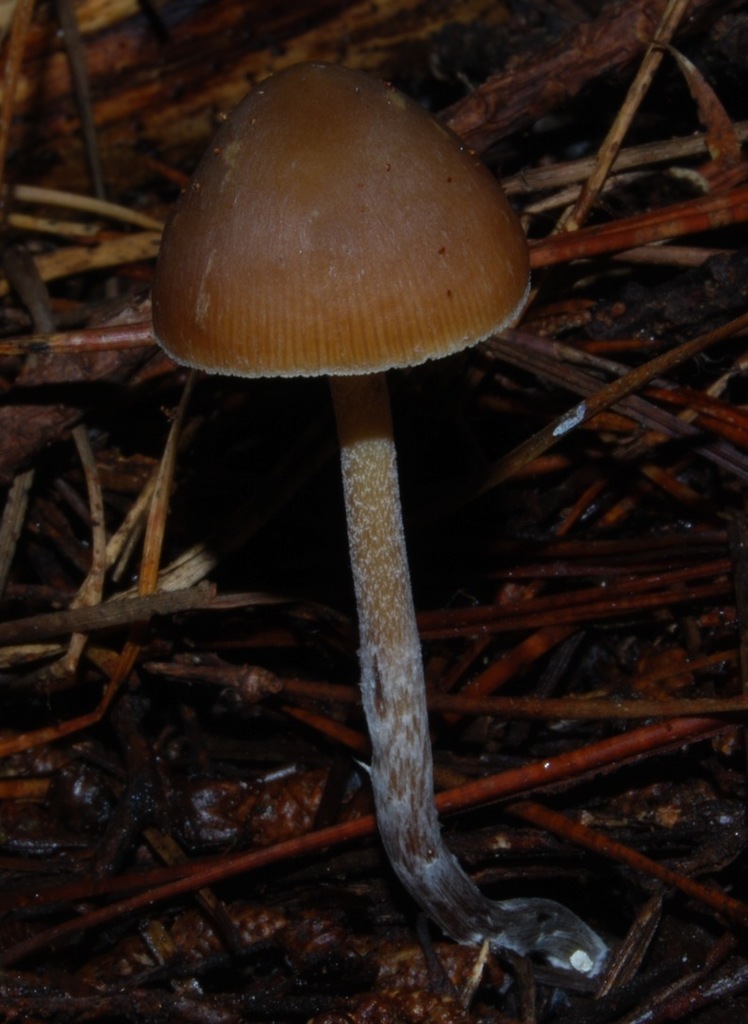
Psilocybe aucklandiae
Psilocybe aucklandii is a psychedelic mushroom, which has psilocybin and psilocin as main active compounds. It is in the section Zapotecorum of the genus Psilocybe, other members of this section include Psilocybe muliercula, Psilocybe angustipleurocystidiata, Psilocybe collybioides, Psilocybe graveolens, Psilocybe kumaenorum, Psilocybe zapotecorum, Psilocybe pintonii, Psilocybe subcaerulipes, Psilocybe moseri, Psilocybe zapotecoantillarum, Psilocybe zapotecocaribaea, and Psilocybe antioquiensis.
From the article Psilocybe aucklandiae on Wikipedia (CC BY-SA), quoted section by section
Description
The cap is 15–55 mm diam., broadly conic, expanding to broadly umbonate to more or less flattened, with edges becoming slightly upturned and often splitting; dry; lacking veil remnants; dark brown to yellow-brown, striate (radially lined) to edge, hygrophanous, drying to pale yellow-brown to straw-coloured; staining greenish-blue with damage or age; flesh white. The gills are adnate (broadly attached to the stem), close, greyish yellow-brown, maturing dark violaceous, with a conspicuous pale narrow margin. The stipe is 35-100 x 1.5–5 mm, cylindric, finely pruinose in the upper part and silky-fibrillose near the base, white, yellow or pinkish purple brown, with brownish flesh. Veil cortinoid and poorly developed, disappearing as caps mature. All parts staining deep greenish-blue or blackish-blue with damage. Spore print violet brown. Spores measure (6.5-)7-9.5 x 4–5.5 x 3.5-4.5 μm, 8.1 x 4.9 x 4.3 μm average, ovate in face view, elliptic-ovate in side view; brown-walled and smooth, 0.5 μm thick with apical pore; Basidia 20-28 x 4.5-6 μm, cylindric, with 4 spores, clamped; Cheilocystidia 15-32 x 4-8 μm, ventricose-rostrate (swollen and uneven with a beak), with long, tapering, flexuous and sometimes bifurcate neck (forked in two), transparent, thin-walled, up to 12 μm long; Pleurocystidia 13-19 x 4.5-6 μm, scattered, similar to cheilocystidia but with shorter neck, up to 4.5 μm. …
Range & habitat
On soil and litter, especially clay soils, in native forests and pine plantations, almost always in the wider Auckland Region. Commonly found in the exotic pine plantation of Riverhead. Has been recorded from Waipoua in Northland, and in Australia as Psilocybe sect. Zapotecorum, which is likely phylogenetically similar or the same. Specimens examined for the description: Auckland: Woodhill State Forest, on ground in litter of mixed pine and native forest, C. C. King, Jun 1989 PDD 57236 (holotype). Waitakere Ranges: Sharps Bush, in litter under Leptospermum and Dacrydium: PDD 43043; Atkinson Park, Titirangi Beach on soil under Leptospermum: PDD 49789; Quarry Track, Piha Valley Forest, on litter: PDD 58423. Hunua Ranges: Orere, on ground: PDD 34593; Mangatangi Valley, on rotten wood: PDD 34594.
Wikipedia: “Distribution and habitat”
Where it lives
Recorded sightings
—
geo-referenced records in GBIF, from museums, herbaria and field observers.
Drag the globe to turn it. Dots are where records exist, not a range map; darker means more records.
In the stacks
Searching the stacks…
Every page naming Psilocybe aucklandiae in the Biodiversity Heritage Library →
This page is assembled live from iNaturalist, GBIF, Wikipedia, the Source Library and the Internet Archive. It is not yet part of the hand-edited codex. iNaturalist taxon 383900.