- Fungi Including Lichens
- ›Basidiomycete Fungi
- ›Higher Basidiomycetes
- ›Tremellomycetes
- ›Tremellales
- ›Sirobasidiaceae
- ›Sirobasidium
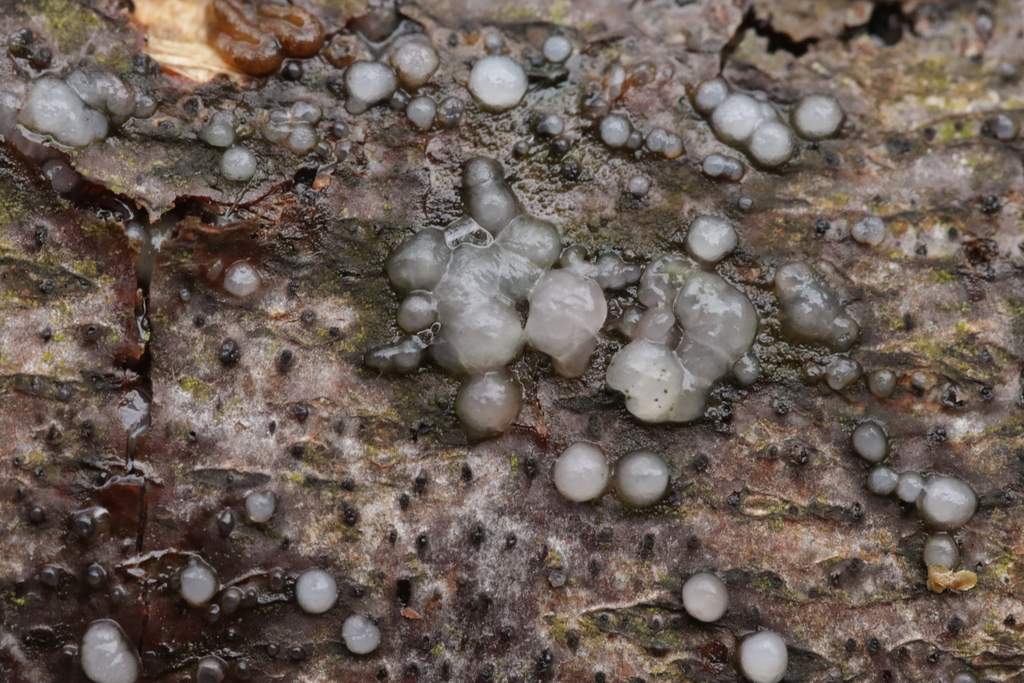
Sirobasidium brefeldianum
Sirobasidium brefeldianum is a species of fungus in the order Tremellales. Basidiocarps (fruit bodies) are gelatinous and appear to be parasitic on ascomycetous fungi on wood. The species was originally described from Brazil, but has also been reported from Asia and Europe.
From the article Sirobasidium brefeldianum on Wikipedia (CC BY-SA), quoted section by section
Description
Fruit bodies are gelatinous, pustular, and whitish, typically occurring in groups. Each measures up to 3 mm across. Basidia are catenulate (formed in chains), with up to 12 basidia in each chain. Individual basidia are ellipsoid to fusiform and transversely biseptate. The sterigmata are deciduous, fusiform, 22-24 x 7-8 μm. The basidiospores are globose, 6-8 μm across.
Range & habitat
Sirobasidium brefeldianum was originally described on rotten wood, but European collections are associated with and possibly parasitic on fungi in the Diatrypaceae, including species of Eutypella, growing on dead attached or fallen wood. Sirobasidium brefeldianum has been reported not only from South America, but also Europe (Belgium, England, France, Germany), Asia (Brunei, Ceylon, India), and Macaronesia (Canary Islands), though it is not clear that all these reports refer to the same species.
== References ==
Wikipedia: “Habitat and distribution”
Where it lives
Recorded sightings
—
geo-referenced records in GBIF, from museums, herbaria and field observers.
Drag the globe to turn it. Dots are where records exist, not a range map; darker means more records.
In the stacks
Searching the stacks…
Every page naming Sirobasidium brefeldianum in the Biodiversity Heritage Library →
This page is assembled live from iNaturalist, GBIF, Wikipedia, the Source Library and the Internet Archive. It is not yet part of the hand-edited codex. iNaturalist taxon 384328.