On eBird ↗
Semipalmated Sandpiper
Live sightings near you, the range map, bar charts of when it is seen, and Macaulay Library photos and recordings.
Semipalmated Sandpiper
Calidris pusilla
The semipalmated sandpiper (Calidris pusilla) is a very small shorebird. The genus name is from Ancient Greek kalidris or skalidris, a term used by Aristotle for some grey-coloured waterside birds. The specific pusilla is Latin for "very small".
Within the genus Calidris, the semipalmated sandpiper is most closely related to the western sandpiper (Calidris mauri). It was formerly sometimes separated with some other stints in either Ereunetes or Erolia, but these placements would leave the rest of Calidris a paraphyletic group.
From the article Semipalmated sandpiper on Wikipedia (CC BY-SA), quoted section by section
Description
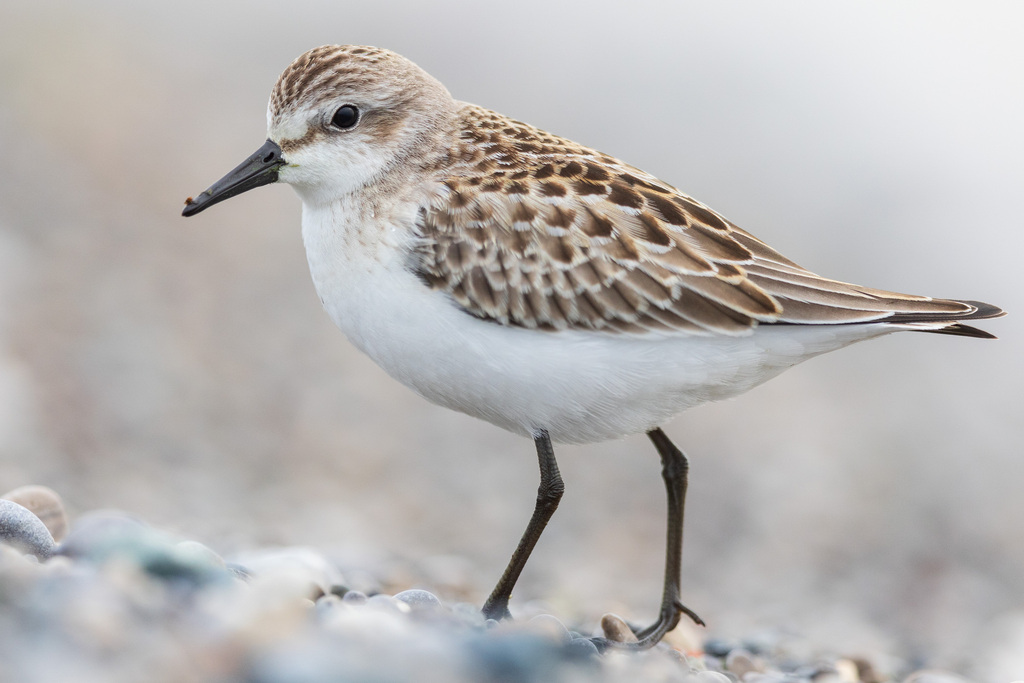
It is a small sandpiper, 15–18 centimetres (6–7 inches) long and weighing around 18–51.5 grams (0.63–1.82 ounces). Wingspan ranges from 13.8 to 14.6 in (35 to 37 cm). Adults have black legs and a short, stout, straight dark bill. The body is dark grey-brown on top and white underneath. The head and neck are tinged light grey-brown. This bird can be difficult to distinguish from other similar tiny shorebirds, in particular the western sandpiper; these are known collectively as "peeps" or "stints".
Range & habitat
Their breeding habitat is the southern tundra in Canada and Alaska near water. They nest on the ground. The male makes several shallow scrapes; the female chooses one and adds grass and other material to line the nest. The female lays 4 eggs; the male assists in incubation. After a few days, the female leaves the young with the male; the young feed themselves. These birds forage on mudflats, picking up food by sight and feel (bill). They mainly eat aquatic insects and their larvae, spiders, marine worms, snails, and crustaceans. Semipalmated sandpipers rely heavily on horseshoe crab eggs during spring migration. Females will also eat small mammal bones as an extra source of calcium during egg laying.
Wikipedia: “Breeding and habitat”
Listen
Looking for field recordings…
Where it lives
Recorded sightings
—
geo-referenced records in GBIF, from museums, herbaria and field observers.
Drag the globe to turn it. Dots are where records exist, not a range map; darker means more records.
In the stacks
Searching the stacks…
Every page naming Calidris pusilla in the Biodiversity Heritage Library →
This page is assembled live from iNaturalist, GBIF, Wikipedia, the Source Library and the Internet Archive. It is not yet part of the hand-edited codex. iNaturalist taxon 3862.