On eBird ↗
Curlew Sandpiper
Live sightings near you, the range map, bar charts of when it is seen, and Macaulay Library photos and recordings.
Curlew Sandpiper
Calidris ferruginea
The curlew sandpiper (Calidris ferruginea) is a small wader. It is a long-distance migrant, breeding in the bogs and coastal lowlands of the Siberian Arctic, arriving there in June and staying until August or September. After the breeding season, it migrates south to spend the winter in Africa and along the coasts of Oceania and southern Eurasia, occupying tidal mudflats and saltpans.
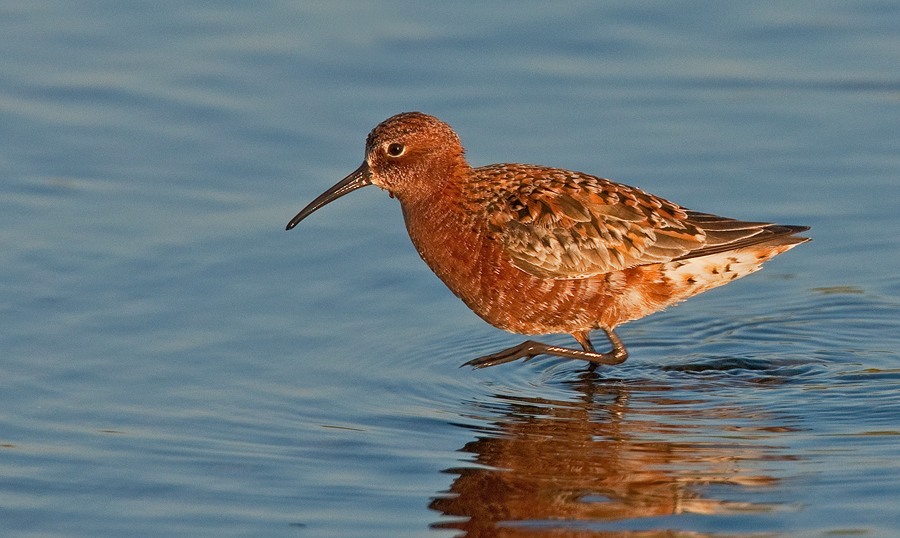
It has three main plumages that change with maturity and season. The non-breeding plumage shows brown-greyish upperparts and white underparts. The breeding plumage is much more striking, with the entire front tinted a deep rusty colour, more intensely so in males. The first-year bird does not migrate or breed, instead remaining in its overwintering range throughout the breeding season. It may occasionally moult into its breeding plumage, which is largely similar to that of an adult but with white spots on the chest. The non-breeding juvenile plumage is also like that of an adult, except with creamy-coloured streaking on the breast and pale fringes on some of the wing feathers, leading to a scaly appearance. Adults superficially resemble the larger but shorter-billed red knot and the red phalarope in breeding plumage, and the dunlin and stilt sandpiper while not breeding. Juveniles may be confused with the larger and yellow-legged juvenile ruff, or the juvenile dunlin, which has a streaked chest.
From the article Curlew sandpiper on Wikipedia (CC BY-SA), quoted section by section
Description
The curlew sandpiper is a small wader 18–23 cm in length and weighing 44–117 g. It has a wingspan of 38–46 cm, a bill length of 32–44 mm, and a tarsus (the bone between the "knee" and the "ankle") length of 26–34 mm. It has a black bill, dark brown irises, and dark grey to black feet. All plumages have a large white patch on the rump, occasionally barred with red in some adults, and in flight show a distinctive white stripe going across the wing. Like most waders, the curlew sandpiper has seasonal plumages and moults yearly, shedding its old feathers and growing new ones. For example, to attain its breeding plumage, it will have to first complete the pre-breeding moult; to attain its non-breeding plumage, it will have to complete the post-breeding moult. The non-breeding plumage has greyish upperparts and white underparts with some pale grey streaks; however, as feather wear increases, it slowly becomes browner. The centres of its upperpart feathers are darker, especially on the top of the head, causing its upperparts to look mottled. The tail's underside and the rump are white, with broad, pale grey tail feathers. The largest feathers on its wing are dusky with white streaks along the shaft and a white tip. It has a distinctively white eyebrow, with grey-brown feathers between the base of the bill and the eyes and around the ear. …
Range & habitat
The curlew sandpiper can occur throughout large swathes of Afro-Eurasia during migration. It is notably missing east of the Verkhoyansk Range in eastern Siberia during migration, along with southern inland Asia. It breeds exclusively in the Siberian extreme high Arctic tundra from the Yamal Peninsula to Kolyuchin Bay. It breeds in coastal lowlands and offshore islands, where the severe climate with harsh cold winds and short growing period prevents the growth of shrubs, and melting snow overlying the permafrost creates boggy conditions. The nest is typically placed on the margins of wet hollows or pools, or on the gentle slopes of hummocks, often close to the nests of Pluvialis plovers like grey plover or Pacific golden plover. Its non-breeding range includes coastal regions of west Africa (from Mauritania to Gabon and including Cape Verde) and southern Africa (inland throughout Mozambique to Namibia to South Africa, and north through Uganda to Kenya). It is additionally present, albeit more rarely, inland from Niger to Chad, along the Republic of the Congo to Angola, and the Nile from Sudan to Egypt and southeastern Tunisia. It is rarer along the coasts of Australasia, as well as inland Victoria and New South Wales. In New Zealand, it can be found on the southeastern coast of the South Island and the entire coastline of the North Island. …
Wikipedia: “Distribution and habitat”
What it does
The curlew sandpiper appears to be largely monogamous; however, its breeding habits are not well studied. Its ground movements are similar to those of other waders: walking, running, and wading. Its flight speed during migration has been estimated to be around 70–75 km/h. It practices preening and bathing, sometimes scratching its head with its claws and dipping its head in the water to clean it. It mainly roosts at high tide in large mixed-species flocks on sandbars, lagoon islets, and occasionally dunes, reefs, or beach wrack. If disturbed while resting, it will often stretch its wings over its back before hopping on one leg or walking away.
Breeding. The curlew sandpiper forms pairs during northward migration. Pairs usually arrive at their breeding site in early June and perform courtship in mid-June. The female moves around an area of a few hectares, feeding, and the male follows her attentively, trailing her 3–6 m away, occasionally giving partial or complete songs and conducting various types of courtship behaviour. During aerial courtship, the male pursues the female in long chases, occasionally catching up. When he catches up, he lifts his wings horizontally and glides towards the female while warbling and occasionally performing his chase call (the female also, although more rarely, performs the chase call). …
Wikipedia: “Behaviour”
In human culture
The curlew sandpiper was formally described in 1763 by the Danish ornithologist Erik Pontoppidan under the binomial name Tringa ferrugineus, later designated Tringa ferruginea by Morten Thrane Brünnich in 1764. Historically, it was often placed in the genus Tringa along with other small sandpipers; in 1816, Louis Pierre Vieillot even considered it the type species of that genus. It was later moved to the genus Calidris. The genus name is from Ancient Greek kalidris or skalidris, a term used by Aristotle for some grey waterside birds. The specific epithet ferruginea is from Latin ferrugo, ferruginis, "iron rust", referring to the bird's colour in breeding plumage. The curlew sandpiper has no recognised subspecies. Within the genus Calidris, the curlew sandpiper is most closely related to the stilt sandpiper; together, they form part of a small clade that also includes the spoon-billed sandpiper, Temminck's stint, red-necked stint, and long-toed stint. The curlew sandpiper occasionally hybridises with sharp-tailed and pectoral sandpipers, producing the hybrids Cooper's sandpiper and Cox's sandpiper, respectively. Hybrids with the dunlin and white-rumped sandpiper have also been observed, though they are rare.
Wikipedia: “Taxonomy and etymology”
Listen
Looking for field recordings…
Where it lives
Recorded sightings
—
geo-referenced records in GBIF, from museums, herbaria and field observers.
Drag the globe to turn it. Dots are where records exist, not a range map; darker means more records.
In the stacks
Searching the stacks…
Every page naming Calidris ferruginea in the Biodiversity Heritage Library →
This page is assembled live from iNaturalist, GBIF, Wikipedia, the Source Library and the Internet Archive. It is not yet part of the hand-edited codex. iNaturalist taxon 3863.