- Animals
- ›Arthropods
- ›Hexapods
- ›Insects
- ›Winged and Once-winged Insects
- ›Flies
- ›Brachyceran Flies
- ›Cyclorrhaphan Flies
- ›Schizophoran Flies
- ›Calyptrate Flies
- ›Bot Flies, Blow Flies, and Allies
- ›Blow Flies
- ›Calliphorinae
- ›Calliphora
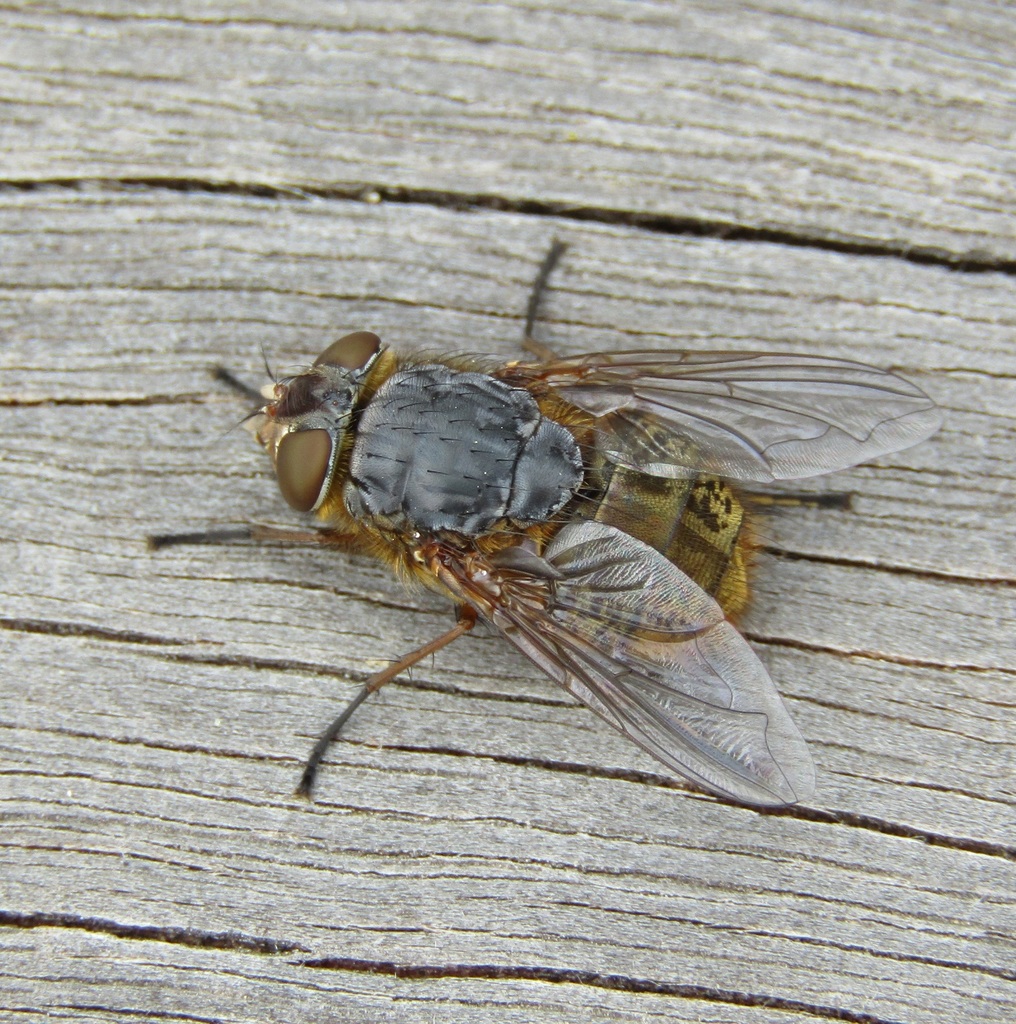
Brown Blowfly
Calliphora stygia
Calliphora stygia, commonly known as the brown blowfly, or rango tumaro in Māori, is a species of blow-fly that is found in Australia and New Zealand. The brown blowfly has a grey thorax and yellow-brown abdomen.
This fly is typically one of the first and primary colonizers on corpses, and are considered to be necrophagous and parasitic. It is able to colonize a body within hours after death, when it is considered to be in the "fresh" stage of decomposition. Regardless of the environment a body is in, adult C. stygia will lay eggs in any, and all orifices such as, but not limited to eyes, nose, mouth, and wounds that occur before and after death.
From the article Calliphora stygia on Wikipedia (CC BY-SA), quoted section by section
Description
Calliphora stygia has a brassy abdomen with a dense, tessellate golden dusting. The underside of the body and the femora and tibiae of the legs are yellow. Males are holoptic, meaning the eyes cover much of the head and almost meet dorsally, whereas females are dichoptic, meaning the eyes are separated from each other. This species resembles C. albifrontalis, another Australian species of Calliphora, but that species occurs in Western Australia whereas C. stygia occurs in the east. Other differences are that the upper third of the fore femora is orange in C. stygia but darkened in C. albifrontalis, and the minimum frons width of males is less than the anterior ocellus width in C. stygia but greater than it in C. albifrontalis.
In human culture
Calliphora stygia has three life stages; 3 larval instars, pupa, and adult. In the larval stage, it is very difficult to determine the species; most entomologists wait until the adult emerges to identify specimens. Larvae feed on the soft tissues of a corpse or host that they were placed on by their parent. Due to their main source of food, C. stygia bioaccumulate toxins and heavy metals that may be present in the flesh. Insects can hold these toxins for months after the tissues disappear. These flies are also affected by weather conditions. The third instar is extremely tolerant to wet conditions, but perish at temperatures greater than 35 degree Celsius. Pupation, on average, take around 32 hours, but can take up to 48. This state can last as long as 3 weeks in wet, dark, and highly oxygenated conditions. Dry conditions tend to increase mortality rates. Emergence typically happens at dawn when environmental conditions are more humid, and more favorable to young flies. C. stygia don't appear to have a seasonal dependence for emergence; however they do have light and temperature cues. These flies are capable of emerging in the absence of those cues, and this is thought to be done with circadian rhythms that are set during the last instar before pupation. C. …
Wikipedia: “Life history”
Listen
Looking for field recordings…
Where it lives
Recorded sightings
—
geo-referenced records in GBIF, from museums, herbaria and field observers.
Drag the globe to turn it. Dots are where records exist, not a range map; darker means more records.
In the stacks
Searching the stacks…
Every page naming Calliphora stygia in the Biodiversity Heritage Library →
This page is assembled live from iNaturalist, GBIF, Wikipedia, the Source Library and the Internet Archive. It is not yet part of the hand-edited codex. iNaturalist taxon 387009.