- Animals
- ›Arthropods
- ›Hexapods
- ›Insects
- ›Winged and Once-winged Insects
- ›Flies
- ›Brachyceran Flies
- ›Cyclorrhaphan Flies
- ›Schizophoran Flies
- ›Calyptrate Flies
- ›Bot Flies, Blow Flies, and Allies
- ›Blow Flies
- ›Calliphorinae
- ›Calliphora
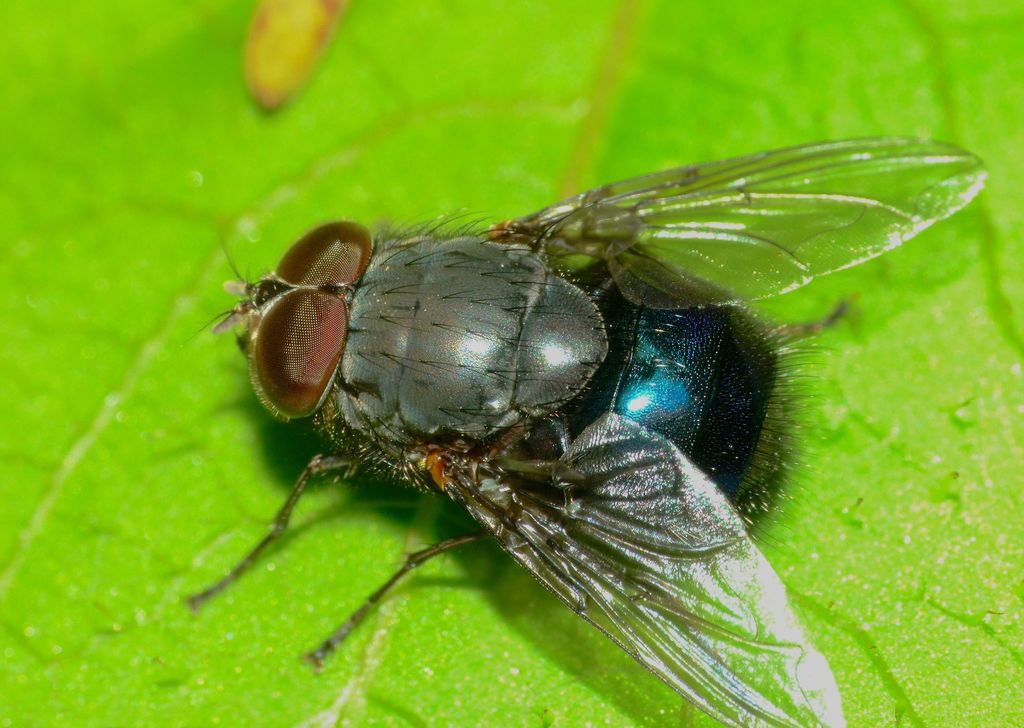
New Zealand Blue Blowfly
Calliphora quadrimaculata
Calliphora quadrimaculata, commonly known as the New Zealand blue blowfly and by its Māori name rango pango, is a fly in the family Calliphoridae. This particular blowfly is found throughout Aotearoa New Zealand as well as on Chatham, Auckland, Stewart and Campbell Islands that surround it. Generally blowfly maggots in New Zealand have to feed on animal tissue or faeces to develop into adult blowflies. However the New Zealand blue blowfly larvae can survive on decaying leaves of snow tussock in alpine regions and reach adult maturity without feeding on any animal tissue.
From the article Calliphora quadrimaculata on Wikipedia (CC BY-SA), quoted section by section
Range & habitat
The New Zealand blue blowfly is endemic to New Zealand. It is found throughout mainland New Zealand as well as on Chatham, Auckland, Stewart and Campbell Islands that surround New Zealand. The specimens found on Auckland and Campbell Islands differed slightly from the mainland species by having a blue green metallic sheen instead of a violet metallic sheen on the abdomen.
Habitat preferences. This species is found throughout New Zealand, although it does have a preference for alpine areas where snow tussock is present, in particular in the South Island mountain ranges and Stewart Island. It is also known to be a species that contributes to fly strike in sheep. While it is not a species that initiates fly-strike, it can be a secondary candidate so may be found on farmland areas as well. This particular species is hardly ever found indoors.
Wikipedia: “Distribution”
What it does
New Zealand blowflies have a relatively short life cycle. The female deposits her eggs in a decaying medium, which for this blowfly species can include decaying leaf matter as well as decaying carcasses. After 24 hours the eggs hatch into larvae; there are three growth stages of larval development and during this period the larvae feed on either plant or animal tissues. After a period of eight days the larva stops feeding and is ready to develop into a pupa underground; this occurs approximately 3 cm into the soil where conditions are dry, either where the larvae were feeding or a close distance away. The larvae empty what contents they have in their stomachs and contract to form pupae. Approximately two weeks after pupa development an adult fly is formed that is ready to mate. Female blowflies have a pre-egg laying period of 4–7 days and only live for approximately 2–3 weeks; in this time around 600–800 eggs are deposited, in total the entire cycle is about 20–25 days in length from egg to egg. The New Zealand blue blowfly predominately mates over the summer months, in particular February, because it relies on warmer temperatures for egg-to-adult development.
Wikipedia: “Life cycle and phenology”
Listen
Looking for field recordings…
Where it lives
Recorded sightings
—
geo-referenced records in GBIF, from museums, herbaria and field observers.
Drag the globe to turn it. Dots are where records exist, not a range map; darker means more records.
In the stacks
Searching the stacks…
Every page naming Calliphora quadrimaculata in the Biodiversity Heritage Library →
This page is assembled live from iNaturalist, GBIF, Wikipedia, the Source Library and the Internet Archive. It is not yet part of the hand-edited codex. iNaturalist taxon 387011.