- Animals
- ›Arthropods
- ›Hexapods
- ›Insects
- ›Winged and Once-winged Insects
- ›True Bugs, Hoppers, Aphids, and allies
- ›Plant-parasitic Hemipterans
- ›Scale Insects
- ›Armored Scale Insects
- ›Diaspidinae
- ›Diaspidini
- ›Diaspidina
- ›Carulaspis
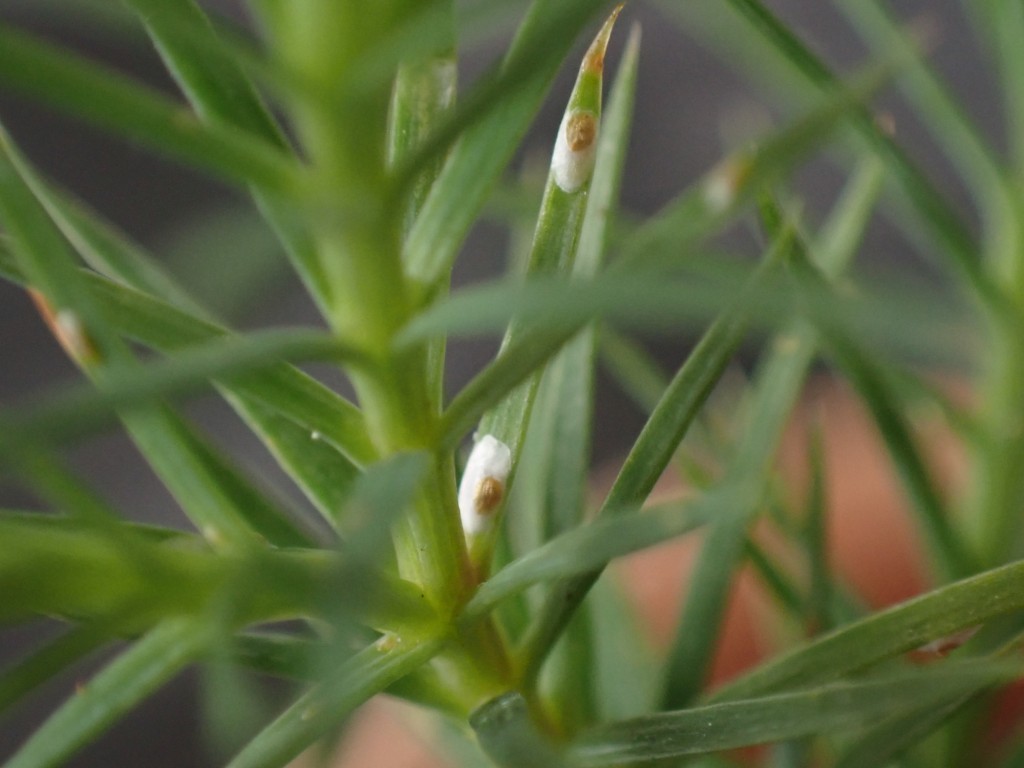
minute cypress scale
Carulaspis minima
Carulaspis minima is an armoured scale insect, in the subtribe Diaspidina of the family Diaspididae, and is commonly known as the minute cypress scale. It was first described in 1869 by the French entomologist Victor Antoine Signoret. It feeds on evergreen conifers in the families Cephalotaxaceae, Cupressaceae and Taxodiaceae.
From the article Carulaspis minima on Wikipedia (CC BY-SA), quoted section by section
Description
Carulaspis minima grows to a maximum length of about 1.8 mm (0.07 in). The scale covering the adult female is circular and convex, white with a yellowish-brown central portion; the female nymph is similar, but smaller. The adult male has an elongate whitish scale with the yellowish-brown remnants of the exuviae on the posterior end. The male nymph has a whitish felt-like appearance with longitudinal ridges. It is very difficult to distinguish it from the juniper scale (Carulaspis juniperi).
What it does
The adult female scale overwinters on the host tree and lays a batch of eggs which are retained under the scale. These hatch into "crawlers", nymphs which are mobile and move to other parts of the plant. After shedding their skin for the first time, the nymphs settle down and grow through the summer. After reaching adulthood they mate, after which the males die. In California there are one or two generations in the year.
Wikipedia: “Life cycle”
Listen
Looking for field recordings…
Where it lives
Recorded sightings
—
geo-referenced records in GBIF, from museums, herbaria and field observers.
Drag the globe to turn it. Dots are where records exist, not a range map; darker means more records.
In the stacks
Searching the stacks…
Every page naming Carulaspis minima in the Biodiversity Heritage Library →
This page is assembled live from iNaturalist, GBIF, Wikipedia, the Source Library and the Internet Archive. It is not yet part of the hand-edited codex. iNaturalist taxon 387187.