- Animals
- ›Arthropods
- ›Hexapods
- ›Insects
- ›Winged and Once-winged Insects
- ›Beetles
- ›Ground and Water Beetles
- ›Ground beetles and allies
- ›Tiger Beetles
- ›Cicindelini
- ›Cicindelina
- ›Neocicindela
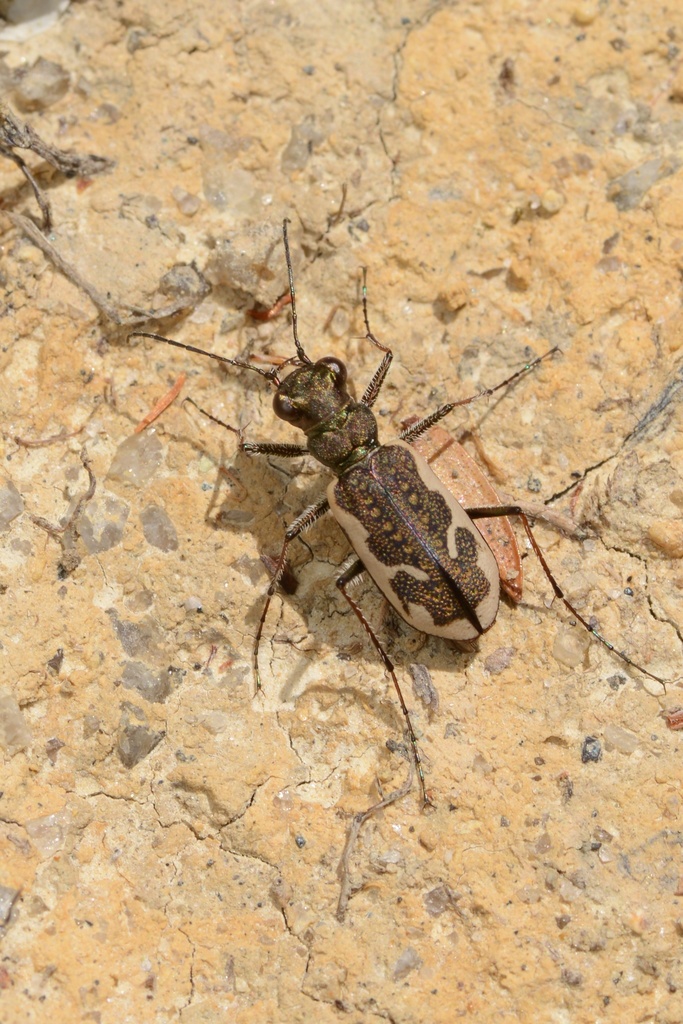
New Zealand Common Tiger Beetle
Neocicindela tuberculata
Neocicindela tuberculata is a species of tiger beetle endemic to New Zealand and is sometimes referred to as the tuberculate tiger beetle or the common tiger beetle. It was first described in 1775 by Johan Christian Fabricius from specimens collected during Captain Cook's first voyage, making it the first ground beetle to be described from New Zealand. The species has been suggested to be roughly 0.92 million years old. It can be distinguished from other species in Neocicindela by the colour pattern of its elytra. It is widespread throughout most of New Zealand, and occurs as adults from September to July. As larvae, they live in burrows in dry clay banks. Both the adult and the larvae are predators that eat other insects. In the Māori language they are sometimes referred to as moeone, among other names.
From the article Neocicindela tuberculata on Wikipedia (CC BY-SA), quoted section by section
Description
As adults, Neocicindela tuberculata are best distinguished from all other species of Neocicindela by the combination of a single setiferous pore (one pore with a long hair sticking out of it) on the first antenna segment, and by the colour pattern of the abdomen. The beetle is about 9–12 millimetres (350–470 mils) in length with a dark brown head and pronotum. The antennae and femora are dark, whilst the tibia and tarsi are pale. The first antennal segment also has anywhere between five and nine setiferous pores. The elytra (wing coverings or hardened forewings) are moderately wide and have a dark brown background with some tinges of velvet black. The dark areas of the elytra are shiny, somewhat metallic and are covered in small, green, metallic punctures. The elytra have numerous distinctive pale yellow markings. The humeral lunule (marking at the upper corner of the elytra) is fused with a marking along the middle margin of the elytra called the marginal line. The middle band (Band sticking out from the marginal line) distinctly sticks out and is angled towards the apical lunule (part of the yellow marking sticking out near the tip of the abdomen). The marginal line is separated from the apical lunule. The shape of the elytra also begin to widen behind the middle.
Larvae. The larvae are 20 millimetres (790 mils) in length when in their final instar before moulting. …
Range & habitat
Neocicindela tuberculata are found endemic to New Zealand where they are found across all regions of the North Island as well as in the Marlborough and Tasman districts of the South Island. They can be found from lowland to montane altitudes. These beetles are found in most habitats but generally prefers open areas such as tussock grasslands and dry clay banks, as well as modified habitat such as roadsides and gardens. They also sometimes occur on dark ironsand beaches, where they have been seen co-occurring with the tiger beetle Zecicindela perhispida. Because they favour open habitat, it has been suggested that extensive deforestation in New Zealand has caused them to become more abundant and widespread.
Wikipedia: “Distribution and habitat”
In human culture
This species has been referred to as several Māori names, which are applied to tiger beetles in general. One such term is moeone, which may refer to the adult or larvae. Other terms exist such as muremure, pāpapa, kapuku, kurikuri and hāpuku. In Māori tradition, moeone larvae are reportedly pests of kumara crops. However, since these larvae are predatory, it is possible this term includes other larvae that are the true pests of kumara. In Ngati Whatua culture, Kui (a demigoddess) is said to manifest as a tiger beetle.
Wikipedia: “In Māori culture”
Listen
Looking for field recordings…
Where it lives
Recorded sightings
—
geo-referenced records in GBIF, from museums, herbaria and field observers.
Drag the globe to turn it. Dots are where records exist, not a range map; darker means more records.
In the stacks
Searching the stacks…
Every page naming Neocicindela tuberculata in the Biodiversity Heritage Library →
This page is assembled live from iNaturalist, GBIF, Wikipedia, the Source Library and the Internet Archive. It is not yet part of the hand-edited codex. iNaturalist taxon 387613.