On eBird ↗
Common Redshank
Live sightings near you, the range map, bar charts of when it is seen, and Macaulay Library photos and recordings.
Common Redshank
Tringa totanus
The common redshank or simply redshank (Tringa totanus) is a Eurasian wader in the large family Scolopacidae. The genus name Tringa is the New Latin name given to the green sandpiper by Aldrovandus in 1599 based on Ancient Greek trungas, a thrush-sized, white-rumped, tail-bobbing wading bird mentioned by Aristotle. The specific totanus is from Tótano, the Italian name for this bird.
From the article Common redshank on Wikipedia (CC BY-SA), quoted section by section
Description
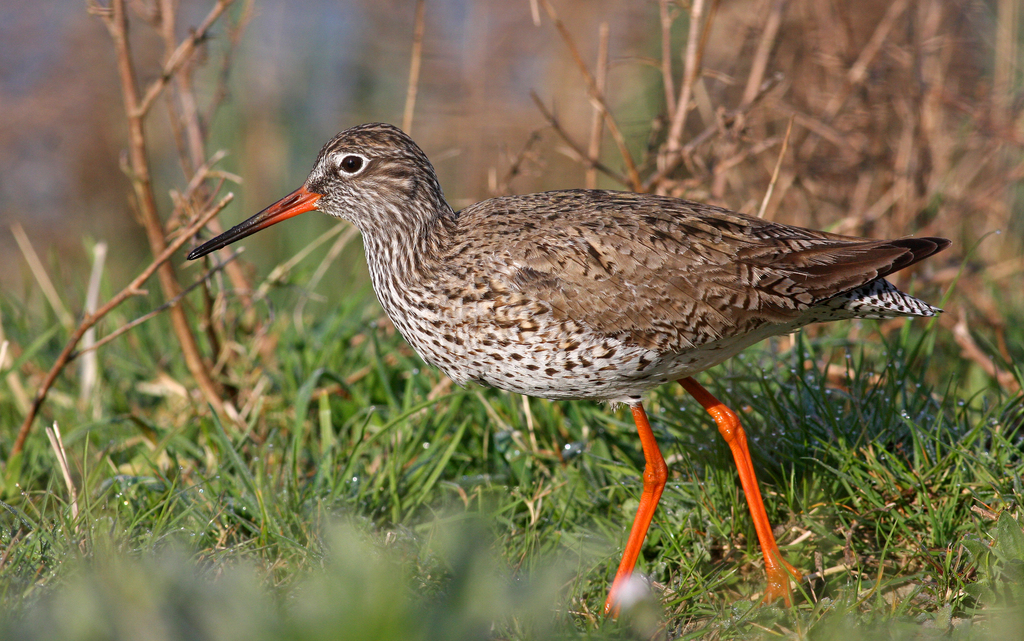
Common redshanks in breeding plumage are a marbled brown color, slightly lighter below. In winter plumage they become somewhat lighter-toned and less patterned, being rather plain greyish-brown above and whitish below. They have red legs and a black-tipped red bill, and show white up the back and on the wings in flight. The spotted redshank (T. erythropus), which breeds in the Arctic, has a longer bill and legs; it is almost entirely black in breeding plumage and very pale in winter. It is not a particularly close relative of the common redshank, but rather belongs to a high-latitude lineage of largish shanks. T. totanus on the other hand is closely related to the marsh sandpiper (T. stagnatilis), and closer still to the small wood sandpiper (T. glareola). The ancestors of the latter and the common redshank seem to have diverged around the Miocene-Pliocene boundary, about 5–6 million years ago. These three subarctic- to temperate-region species form a group of smallish shanks which have red or yellowish legs, and in breeding plumage are generally a subdued light brown above with some darker mottling, and have somewhat diffuse small brownish spots on the breast and neck.
Range & habitat
The common redshank is a widespread breeding bird across temperate Eurasia. It is a migratory species, wintering on coasts around the Mediterranean, on the Atlantic coast of Europe from Ireland and Great Britain southwards, and in South Asia. They are uncommon vagrants outside these areas; on Palau in Micronesia for example, the species was recorded in the mid-1970s and in 2000. A tagged redshank was spotted at Manakudi Bird Sanctuary, Kanniyakumari District of Tamil Nadu, India in the month of April 2021. They have been rarely observed in North America. In the Caribbean, there is one record of a common redshank in Guadeloupe. They have also been observed in South America, primarily in Brazil, with an additional record of the species in Colombia.
Wikipedia: “Distribution and habitat”
What it does
Redshanks are wary and loud birds that draw the attention of others using their loud, piping call.
Breeding. Redshanks nest in wetlands, from damp meadows to saltmarsh, often at high densities. They lay three to five eggs.
Wikipedia: “Behaviour and ecology”
Listen
Looking for field recordings…
Where it lives
Recorded sightings
—
geo-referenced records in GBIF, from museums, herbaria and field observers.
Drag the globe to turn it. Dots are where records exist, not a range map; darker means more records.
In the stacks
Searching the stacks…
Every page naming Tringa totanus in the Biodiversity Heritage Library →
This page is assembled live from iNaturalist, GBIF, Wikipedia, the Source Library and the Internet Archive. It is not yet part of the hand-edited codex. iNaturalist taxon 3879.