On eBird ↗
Spotted Redshank
Live sightings near you, the range map, bar charts of when it is seen, and Macaulay Library photos and recordings.
Spotted Redshank
Tringa erythropus
The spotted redshank (Tringa erythropus) is a wader (shorebird) in the large bird family Scolopacidae. The genus name Tringa is the New Latin name given to the green sandpiper by Aldrovandus in 1599 based on Ancient Greek trungas, a thrush-sized, white-rumped, tail-bobbing wading bird mentioned by Aristotle. The specific erythropus is from Ancient Greek eruthros, "red", and pous, "foot".
From the article Spotted redshank on Wikipedia (CC BY-SA), quoted section by section
Description
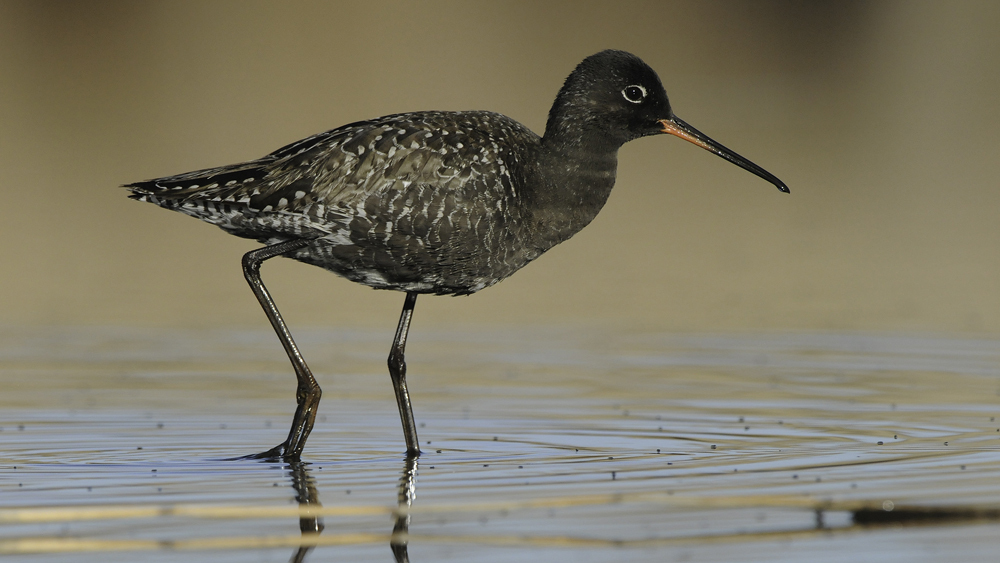
This is a large wader (shorebird), measuring 29–31 cm (11–12 in) long, with a wingspan of 61–67 cm (24–26 in) and a weight ranging from 121 to 205 g (4.3 to 7.2 oz). It is black in breeding plumage, and very pale in winter. It has a red legs and bill, and shows a white oval on the back in flight. Juveniles are grey-brown finely speckled white above, and have pale, finely barred underparts. Adults moult completely between July and October. In spring, the body plumage is moulted between March and May. Juveniles have a partial moult between August and February. The call is a creaking whistle teu-it (somewhat similar to the call of a roseate tern), the alarm call a kyip-kyip-kyip.
Range & habitat
The spotted redshank breeds in the Arctic across much of the Palearctic, from Lapland in the west to Chukotskaya in the east.
Wikipedia: “Habitat and range”
Listen
Looking for field recordings…
Where it lives
Recorded sightings
—
geo-referenced records in GBIF, from museums, herbaria and field observers.
Drag the globe to turn it. Dots are where records exist, not a range map; darker means more records.
In the stacks
Searching the stacks…
Every page naming Tringa erythropus in the Biodiversity Heritage Library →
This page is assembled live from iNaturalist, GBIF, Wikipedia, the Source Library and the Internet Archive. It is not yet part of the hand-edited codex. iNaturalist taxon 3882.