- Animals
- ›Arthropods
- ›Hexapods
- ›Insects
- ›Winged and Once-winged Insects
- ›True Bugs, Hoppers, Aphids, and allies
- ›Plant-parasitic Hemipterans
- ›Aphids and Allies
- ›Aphidoidea
- ›Aphids
- ›Aphidinae
- ›Macrosiphini
- ›Elatobium
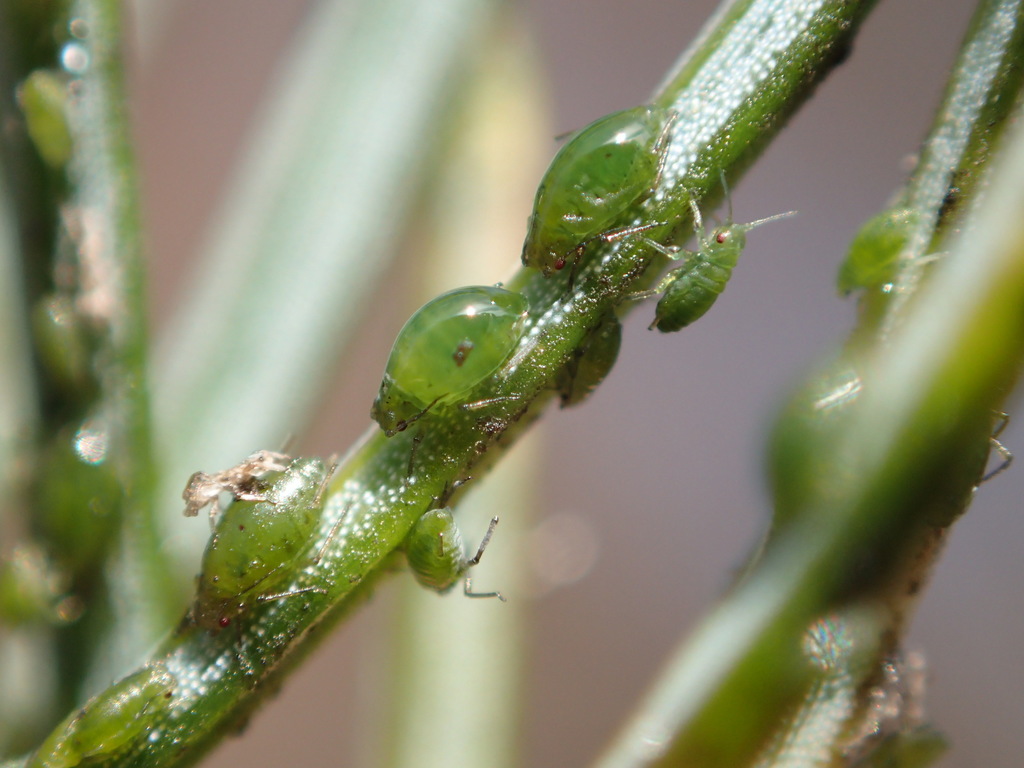
Spruce Aphid
Elatobium abietinum
Elatobium abietinum, commonly known as the spruce aphid or green spruce aphid, is a species of aphid in the subfamily Aphidinae that feeds on spruce (Picea spp.), and occasionally fir (Abies spp.). It is native to Northern, Central and Eastern Europe and has spread to Western Europe, North America and elsewhere.
From the article Elatobium abietinum on Wikipedia (CC BY-SA), quoted section by section
Description
Wingless adults are some shade of green, sometimes with a slight waxy covering, and grow to a length of about 2 mm (0.1 in). The siphunculi (slender tubes on the fifth abdominal segment) are cylindrical, pale and slightly S-shaped, and are much longer than the cauda (tail-like protrusion).
Range & habitat
Elatobium abietinum was first discovered by Francis Walker in 1846 at Southgate near London on cultivated spruces; it was subsequently found to be native to northern, central and eastern Europe where its original host is Picea abies. From this range it has spread to western Europe where plantations of P. abies have been established, and expanded its host range to include Picea sitchensis and other Picea species, and occasionally on fir (Abies species). It has been introduced into Iceland, New Zealand, Tasmania, Chile and other regions where P. abies is grown in plantations. In North America it has become established and further extended its host range from P. sitchensis on the Pacific coast to Picea engelmannii and Picea pungens inland. Altogether it has been recorded feeding on 14 species of Picea and on 5 species of Abies.
Wikipedia: “Distribution and host range”
What it does
Elatobium abietinum has an unusual life cycle and feeds solely on coniferous trees. Wingless adult females often continue feeding and producing young parthenogenetically throughout the winter. In spring, winged aphids are produced and fly to other trees. Young nymphs enter diapause during the summer, recommencing development in the autumn. In Europe, males occur and there is a sexual phase, but in the other parts of the world, only females are known. Invertebrate predators of this aphid in Wales include brown lacewings (Hemerobiidae), soldier beetles (Malthodes and Rhagonycha, Cantharidae), ladybirds (Coccinellidae) and hoverfly larvae (Syrphidae). Many small passerine birds feed on aphids, especially when they are feeding their young; they include goldcrests, warblers, sparrows, tits and chickadees, some finches, and woodpeckers.
Wikipedia: “Ecology”
Listen
Looking for field recordings…
Where it lives
Recorded sightings
—
geo-referenced records in GBIF, from museums, herbaria and field observers.
Drag the globe to turn it. Dots are where records exist, not a range map; darker means more records.
In the stacks
Searching the stacks…
Every page naming Elatobium abietinum in the Biodiversity Heritage Library →
This page is assembled live from iNaturalist, GBIF, Wikipedia, the Source Library and the Internet Archive. It is not yet part of the hand-edited codex. iNaturalist taxon 388940.