On eBird ↗
Eskimo Curlew
Live sightings near you, the range map, bar charts of when it is seen, and Macaulay Library photos and recordings.
Eskimo Curlew
Numenius borealis
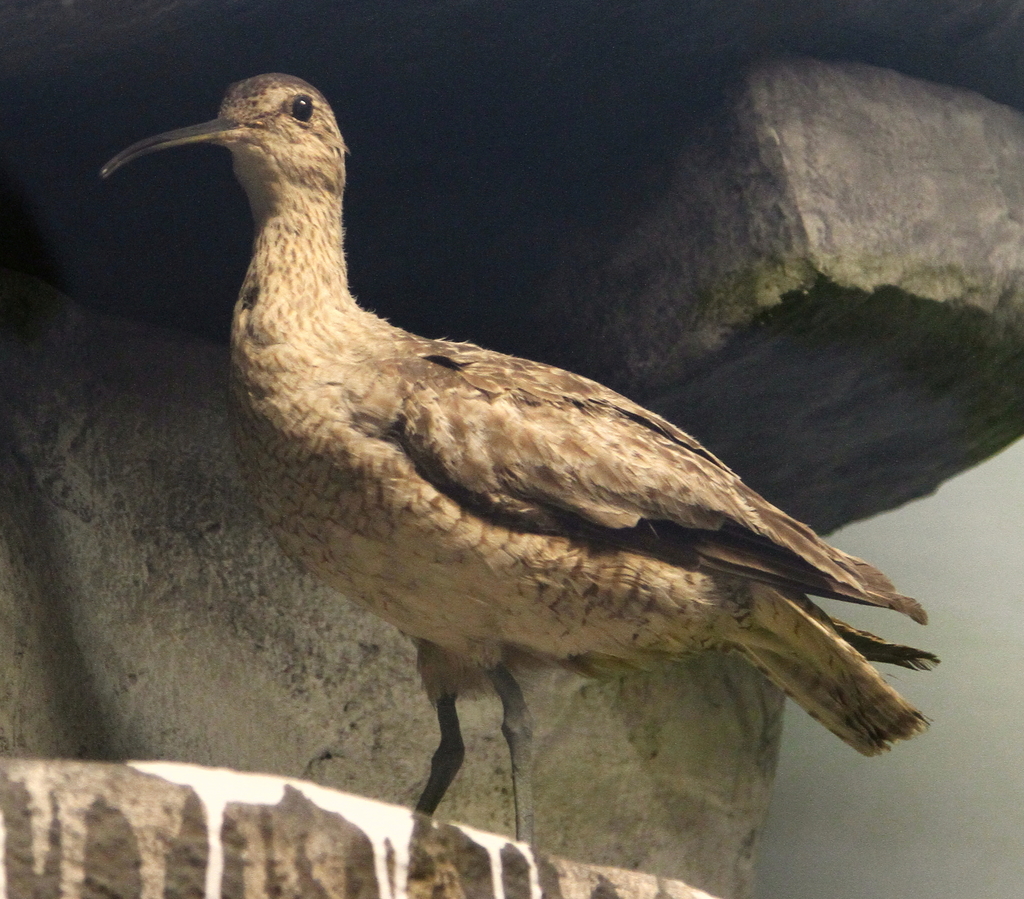
The Eskimo curlew (Numenius borealis), also known as northern curlew, is a species of curlew in the family Scolopacidae. It was one of the most numerous shorebirds in the tundra of western Arctic Canada and Alaska. Thousands of birds were then killed per year in the late 1800s. As there has not been a reliable sighting since 1987 or a confirmed sighting since 1963, the Eskimo curlew is considered Critically Endangered or possibly extinct. The bird is about 30 cm (12 in) long and feeds mostly on insects and berries.
From the article Eskimo curlew on Wikipedia (CC BY-SA), quoted section by section
Description
Eskimo curlews are small curlews, about 30 centimetres (12 in) in length, weighing approximately 360 g (13 oz), and having a wingspan of 70 cm (28 in). Adults have long dark greyish legs and a long bill curved slightly downward. The upperparts are mottled brown and the underparts are light brown. They show cinnamon wing linings in flight. They are similar in appearance to the Hudsonian whimbrel, but smaller in size. In the field, the only certain way to distinguish the Eskimo curlew is confirmation of its unbarred undersides of the primaries. The call is poorly understood, but includes clear whistling sounds. The Eskimo curlew forms a species pair with the Asian little curlew (Numenius minutus), but is slightly larger, longer-winged, shorter legged, and warmer in plumage tone than its Asian relative.
Range & habitat
The Eskimo curlew is a New World bird. Members of this species bred on the tundra of western Arctic Canada and Alaska. Eskimo curlews migrated to the Pampas of Argentina in the late summer and returned in February. They used to be very rare vagrants to western Europe, but there have been no recent records. In Britain, there are four records, all from the nineteenth century. A comparison of dates and migratory patterns has led some to conjecture that Eskimo curlews and American golden plover are the shorebirds that attracted the attention of Christopher Columbus to nearby land after 65 days at sea and out of sight of land on his first voyage. In the 1800s, millions of Eskimo curlews followed migration routes from the present Yukon and Northwest Territories, flying east along the northern shore of Canada, then south over the Atlantic Ocean to South America in the winter. When returning to North America, they would fly north through the Great Plains.
Wikipedia: “Distribution and habitat”
What it does
Eskimo curlews pick up food by sight, and feed by probing. They eat mostly berries while on the fall migration in Canada. During the rest of their migration and on the breeding grounds, they eat insects. Snails and other invertebrates (including the extinct Rocky Mountain locust) also are part of their diet during migration.
Wikipedia: “Diet”
In human culture
The plight of this bird inspired the novel (and subsequent Emmy Award-winning 1972 ABC Afterschool Special) Last of the Curlews. The "Esquimaux Curlew" appears as plate CCCLVII of Audubon's Birds of America.
Wikipedia: “In popular culture”
Listen
Looking for field recordings…
Where it lives
Recorded sightings
—
geo-referenced records in GBIF, from museums, herbaria and field observers.
Drag the globe to turn it. Dots are where records exist, not a range map; darker means more records.
In the stacks
Searching the stacks…
Every page naming Numenius borealis in the Biodiversity Heritage Library →
This page is assembled live from iNaturalist, GBIF, Wikipedia, the Source Library and the Internet Archive. It is not yet part of the hand-edited codex. iNaturalist taxon 3895.