- Animals
- ›Arthropods
- ›Hexapods
- ›Insects
- ›Winged and Once-winged Insects
- ›Beetles
- ›Water, Rove, Scarab, Long-horned, Leaf, and Snout Beetles
- ›Scarabaeiform Beetles
- ›Scarabs, Stag Beetles, and Allies
- ›Stag Beetles
- ›Lucaninae
- ›Lissapterini
- ›Geodorcus
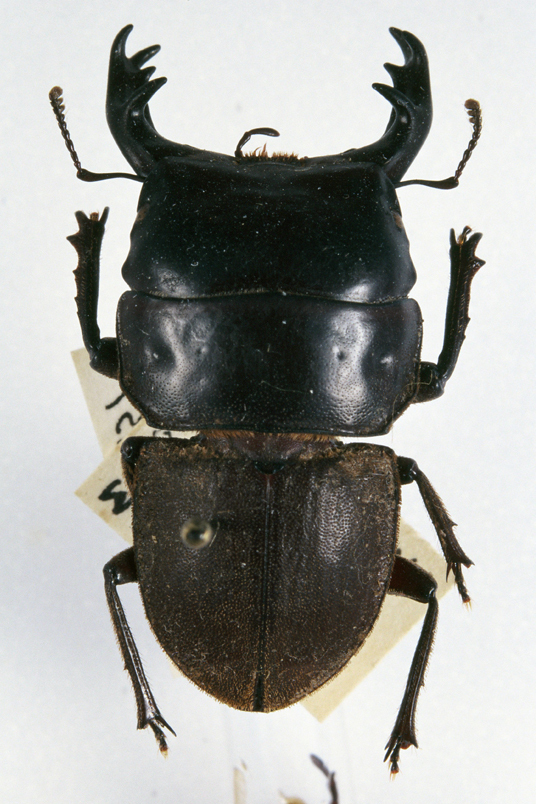
Geodorcus ithaginis
Geodorcus ithaginis, the Mokohinau stag beetle, is a large flightless species of stag beetle in the family Lucanidae. It was described by Thomas Broun in 1893 after being discovered in the Mokohinau Islands by Andreas Stewart Sandager, a lighthouse keeper on the islands. The species survives only on the small unnamed island "Stack H", in a patch of vegetation the size of a living room, and is in extreme danger of extinction.
From the article Geodorcus ithaginis on Wikipedia (CC BY-SA), quoted section by section
Description
Including their large mandibles (used for fighting over mates), male specimens range in length from 25.5 to 32.8 mm and are 10.4–12.4 mm wide. Females range in length from 20.0–22.5 mm. Their exoskeleton is black and ranges from dull to moderately glossy. The thorax is back, glossy, and wider than it is long. The elytra are rounded at the posterior, almost equally long and wide, and covered in short branching hairs. Male beetles have three teeth at the apex of the mandibles; females have two. What distinguishes this species from all other New Zealand stag beetles is a long conical vertical tooth, on the top of the mandible, in both sexes.
Range & habitat
This species is only known from the Mokohinau Islands in New Zealand. It was one of 130 beetle species collected on the Mokohinaus by lighthouse keeper Andreas Stewart Sandager (stationed on Burgess Island 1883–1889); a third of these species turned out to be new to science, and were described by Thomas Broun. The stag beetle's type locality was given by Broun as "Halodroma Islet", but there is no island by that name. "Halodroma" may be another name for Lizard Island, a small flat island southeast of Burgess Island; Halodroma urinatrix is the former name of Pelacanoides urinatrix, the diving petrel, which used to nest in burrows on Lizard and two other low Mokohinau islands. A few more specimens were collected in 1902, and then none until the species was rediscovered in 1984 on "Stack H", a 1.2 ha island southwest of Burgess Island. All recent surveys have only found this species on Stack H, in a "living-room sized" patch of New Zealand ice plant or horokaka (Disphyma australe); it has not been seen on Lizard Island since its description in 1893.
Wikipedia: “Distribution”
What it does
These beetles are nocturnal, and their feeding behaviour is unknown. Adult stag beetles worldwide have mouthparts suited to feeding on liquids. Geodorcus helmsi has been seen feeding on sappy exudations on tree trunks. Rotting wood, tree roots or humus are the most common food sources for stag beetle larvae, and G. ithaginis lives in an environment of enriched humus.
Wikipedia: “Diet”
Listen
Looking for field recordings…
Where it lives
Recorded sightings
—
geo-referenced records in GBIF, from museums, herbaria and field observers.
Drag the globe to turn it. Dots are where records exist, not a range map; darker means more records.
In the stacks
Searching the stacks…
Every page naming Geodorcus ithaginis in the Biodiversity Heritage Library →
This page is assembled live from iNaturalist, GBIF, Wikipedia, the Source Library and the Internet Archive. It is not yet part of the hand-edited codex. iNaturalist taxon 389755.