- Animals
- ›Arthropods
- ›Hexapods
- ›Insects
- ›Winged and Once-winged Insects
- ›Beetles
- ›Water, Rove, Scarab, Long-horned, Leaf, and Snout Beetles
- ›Cucujiform Beetles
- ›Snout and Bark Beetles
- ›True Weevils
- ›Molytinae
- ›Molytini
- ›Molytina
- ›Hadramphus
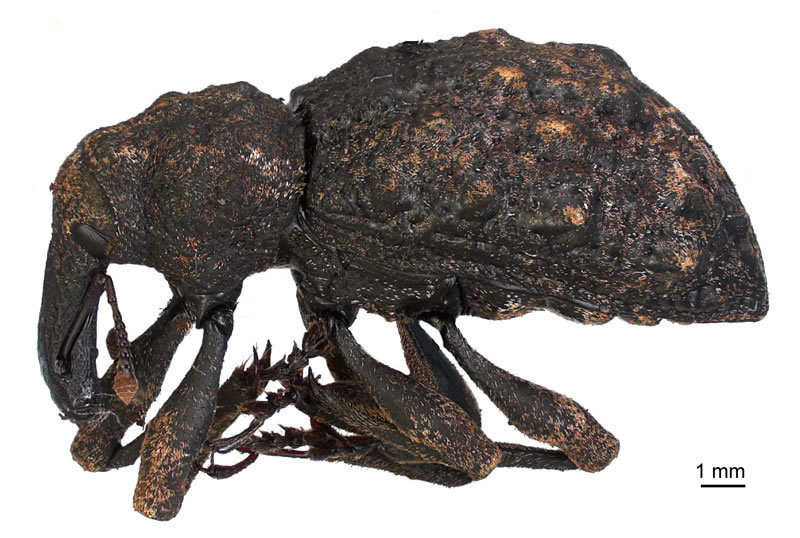
Knobbled Weevil
Hadramphus stilbocarpae
Hadramphus stilbocarpae, commonly known as the knobbled weevil, is a species of weevil endemic to New Zealand. It was first described by Guillermo Kuschel in 1971. H. stilbocarpae occur on Snares Island, Stewart Island a few islands in Fiordland. As larvae, they feed on the rhizomes of plants such as those in the Azorella genus. Under the New Zealand Threat Classification System, this species is listed as "Relict" with the qualifiers of "Range Restricted". They are threatened by predation from introduced rats.
From the article Hadramphus stilbocarpae on Wikipedia (CC BY-SA), quoted section by section
Description
The adults of Hadramphus stilbocarpaeare 15.5-21.7mm in length. The body is dark brown and covered in dark brown to greyish brown scales. The upper surface of the pronotum has pale lines running down the middle and along the margins. The elytra has an oval shape with tubercules on the third, fourth, fifth and seventh intervals. As larvae, H. stilbocarpae reach a maximum size of 17.5mm in length. The head is coloured blackish brown and has easily visible anterior ocelli (but the posterior ocelli are indistinct). When they pupate, H. stilbocarpae can reach up to 17mm in length. They are quite similar to Lyperobius.
Range & habitat
This species is endemic to New Zealand. They are only known from the subantarctic Snares Island, Stewart Island and Resolution island in the Fiordland region. In 1991, a population was translocated to Breaksea Island, also in Fiordland. They are known to occur in vegetation along the coast.
Wikipedia: “Distribution and habitat”
What it does
The larvae of Hadramphus stilbocarpae feed on the rhizomes of plants. They have been recorded feeding on Anisotome lyallii, Azorella lyallii, and Azorella robusta. As adults, they are often observed feeding on leaves of plants.
Wikipedia: “Diet”
Listen
Looking for field recordings…
Where it lives
Recorded sightings
—
geo-referenced records in GBIF, from museums, herbaria and field observers.
Drag the globe to turn it. Dots are where records exist, not a range map; darker means more records.
In the stacks
Searching the stacks…
Every page naming Hadramphus stilbocarpae in the Biodiversity Heritage Library →
This page is assembled live from iNaturalist, GBIF, Wikipedia, the Source Library and the Internet Archive. It is not yet part of the hand-edited codex. iNaturalist taxon 390136.