On eBird ↗
Bristle-thighed Curlew
Live sightings near you, the range map, bar charts of when it is seen, and Macaulay Library photos and recordings.
Bristle-thighed Curlew
Numenius tahitiensis
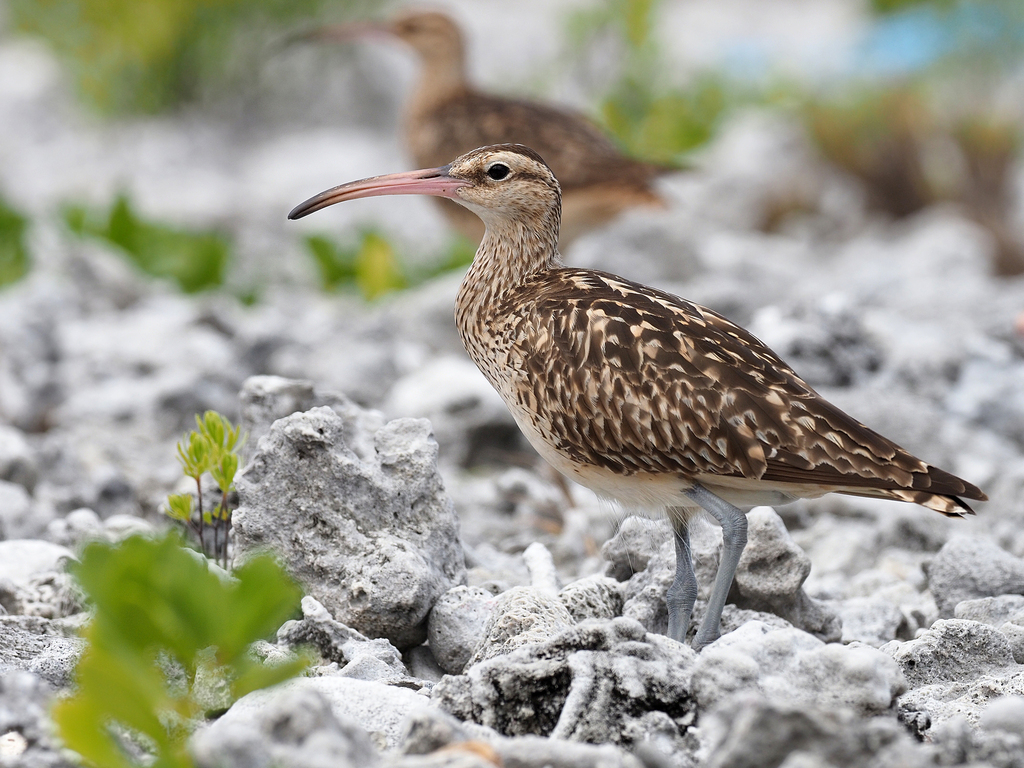
The bristle-thighed curlew (Numenius tahitiensis) is a medium-sized shorebird that breeds in Alaska and winters on tropical Pacific islands. It has a long, decurved bill and bristled feathers at the base of the legs. Its length is about 40–44 cm and wingspan about 84 cm (females averaging bigger than males). The size and shape are the same as the whimbrel's, and the plumage is similar, spotted brown on their upper body with a light belly and rust-colored or...
From the article Bristle-thighed curlew on Wikipedia (CC BY-SA), quoted section by section
Description
The bristle-thighed curlew has a long, decurved bill and bristled feathers at the base of the legs. Its length is about 40–44 cm (16–17 in) and wingspan about 84 cm (33 in) (females averaging bigger than males). The size and shape are the same as the whimbrel's, and the plumage is similar, spotted brown on their upper body with a light belly and rust-colored or buffy tail. The bigger buff spots on the upper body, unmarked light belly and barely marked flanks, tail color, and pale buffy-orange rump distinguish it from both whimbrels.
Range & habitat
Its winter habitat is tropical Oceania, and includes Micronesia, Fiji, Tuvalu, Tonga, Hawaiian Islands, Samoa, French Polynesia and Tongareva (Penrhyn atoll). There is concern over encroachment and introduced predators in their winter habitat. Although it was described after James Cook's visits to Tahiti in the 18th century, its breeding area was not identified until 1948. Nesting grounds are on the lower Yukon River and Seward Peninsula, with the birds preferring low-lying tundra near the shoreline. The bird is rarely seen near populated land masses, with only a handful of sightings in Canada, California and Oregon.
Wikipedia: “Distribution and habitat”
What it does
Bristle-thighed curlews feed on a wide variety of vegetation such as flowers and berries and on insects, sea life, and other bird's eggs, which they break open with rocks—the only tool use among shorebirds.
Wikipedia: “Food and feeding”
Listen
Looking for field recordings…
Where it lives
Recorded sightings
—
geo-referenced records in GBIF, from museums, herbaria and field observers.
Drag the globe to turn it. Dots are where records exist, not a range map; darker means more records.
In the stacks
Searching the stacks…
Every page naming Numenius tahitiensis in the Biodiversity Heritage Library →
This page is assembled live from iNaturalist, GBIF, Wikipedia, the Source Library and the Internet Archive. It is not yet part of the hand-edited codex. iNaturalist taxon 3909.