On eBird ↗
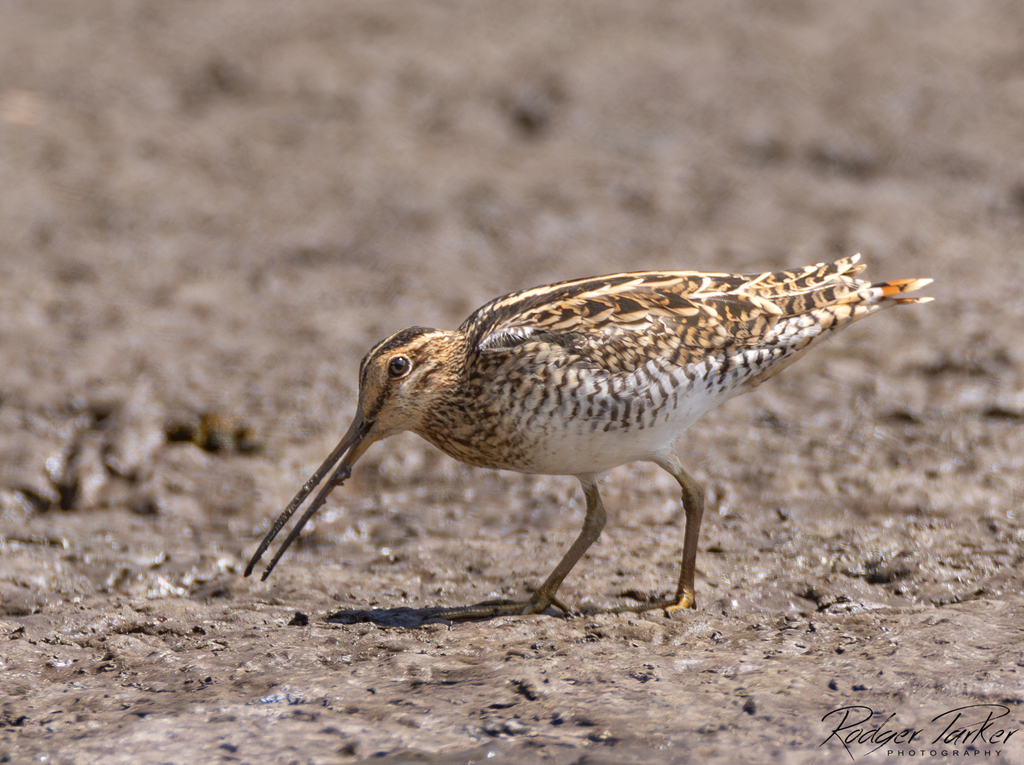
Latham's Snipe
Live sightings near you, the range map, bar charts of when it is seen, and Macaulay Library photos and recordings.
Latham's Snipe
Gallinago hardwickii
Latham's snipe (Gallinago hardwickii), also Japanese snipe is a medium-sized, long-billed, migratory snipe of the East Asian–Australasian Flyway. The origin of the bird's common name is not clear. John Latham was a well-known English physician and ornithologist in the late 18th and early 19th centuries, and had a great interest in Australasian birds. However, he had no apparent connection with the snipe named after him.
From the article Latham's snipe on Wikipedia (CC BY-SA), quoted section by section
Range & habitat
The snipe breeds mainly in Hokkaidō in northern Japan, with smaller numbers on Honshū, the eastern Russian mainland and Sakhalin and, historically, the Kurile Islands. The entire population migrates and spends the non-breeding season principally in eastern Australia, where it is the commonest Gallinago snipe. It has been recorded on migration in Taiwan, the Philippines and New Guinea, and is a rare straggler to New Zealand. The snipe's breeding habitat in Asia includes alpine moorland, grasslands, rough pasture, young tree plantations and cultivated areas. Its non-breeding habitat in Australia is shallow freshwater wetlands of various kinds, with bare mud or shallow water for feeding, and nearby vegetation cover for shelter.
Wikipedia: “Distribution and habitat”
What it does
Latham's snipe is an omnivorous species that feeds on seeds and other plant material (mainly from species in families such as Cyperaceae, Poaceae, Juncaceae, Polygonaceae, Ranunculaceae and Fabaceae), and on invertebrates including insects (mainly flies and beetles), earthworms, spiders and occasionally molluscs, isopods and centipedes.
Wikipedia: “Feeding”
Listen
Looking for field recordings…
Where it lives
Recorded sightings
—
geo-referenced records in GBIF, from museums, herbaria and field observers.
Drag the globe to turn it. Dots are where records exist, not a range map; darker means more records.
In the stacks
Searching the stacks…
Every page naming Gallinago hardwickii in the Biodiversity Heritage Library →
This page is assembled live from iNaturalist, GBIF, Wikipedia, the Source Library and the Internet Archive. It is not yet part of the hand-edited codex. iNaturalist taxon 3914.