- Animals
- ›Arthropods
- ›Hexapods
- ›Insects
- ›Winged and Once-winged Insects
- ›Flies
- ›Nematoceran Flies
- ›Crane Flies
- ›Typical Crane Flies
- ›Large Crane Flies
- ›Tipulinae
- ›Leptotarsus
- ›Macromastix
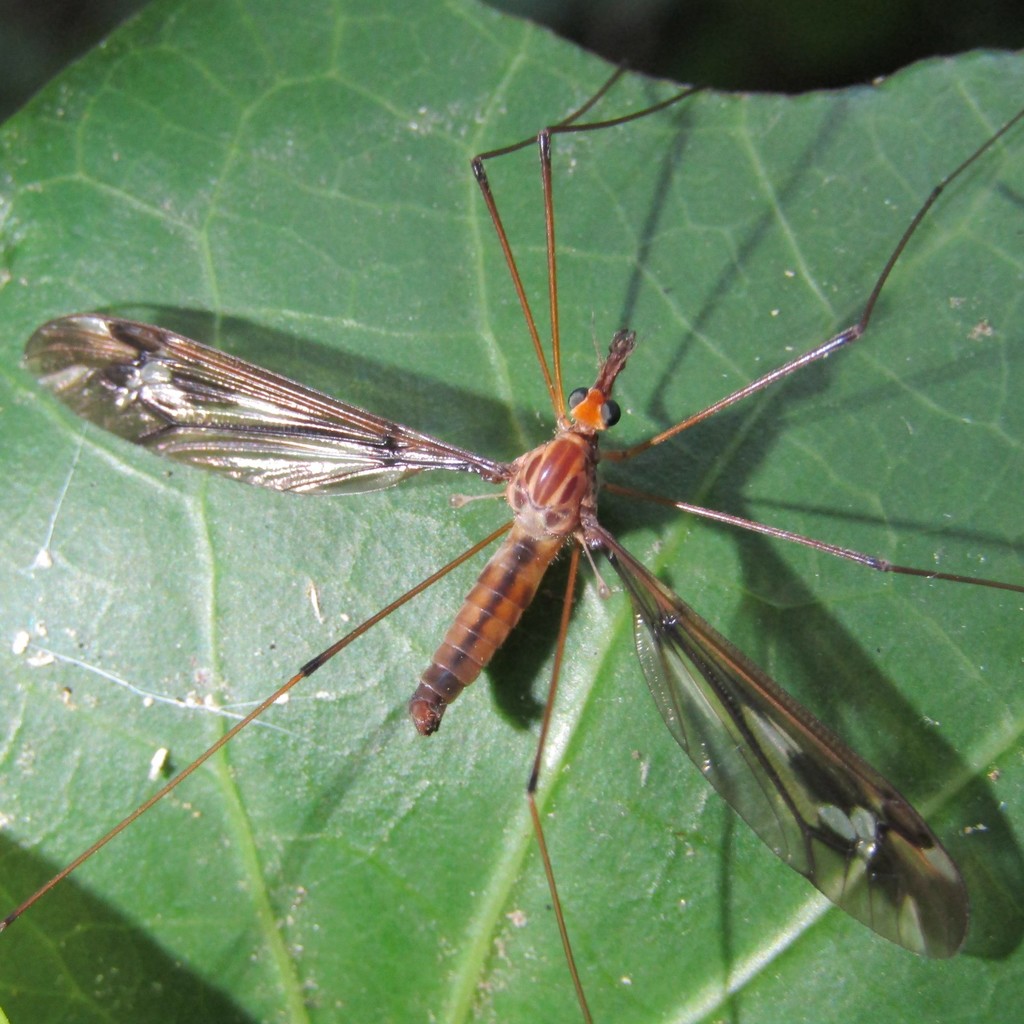
Leptotarsus huttoni
Leptotarsus huttoni is a species of crane fly in the family Tipulidae. First described as Macromastix huttoni by Frederick Wallace Edwards in 1923, the species is endemic to New Zealand, living near rotting wood on both the North Island and the South Island.
From the article Leptotarsus huttoni on Wikipedia (CC BY-SA), quoted section by section
Description
Edwards described the species as follows:
Head dull dark ochreous, scarcely any darker in middle, with some ochreous-grey dusting round eyes. Front about one-quarter as broad as head, tubercle moderate. Rostrum slightly longer than head, rather darker than vertex; nasus with long hairs at tip, which is not bifid. Palpi blackish. Antennae rather dark brown, alike in both sexes; shorter than thorax, first scapal joint slender. First flagellar joint slightly shorter than second, third, or fourth; fifth and sixth shorter; last five thinner and indistinctly separated. Thorax resembling that of M. lunata, but much less hairy, and area above blackish pleural spot is not conspicuously pale. Abdomen much as in M. lunata, but without conspicuous grey dusting on any part; the blackish dorsal line is narrower, especially on second segment. Legs, especially tarsi, distinctly longer and more slender than in M. lunata; femora and tibiae brown with black tips; tarsi-darker. Wings resembling those of M. lunata, but there is a small white streak before humeral cross-vein, and a whitish mark in cell M1; the stem of this cell is shorter (one-fifth to one-eighth as long as the cell). Length of body, 9–10 mm (0.35–0.39 in).; wing, 14–16 mm (0.55–0.63 in).; hind leg, ♂ 38–42 mm (1.5–1.7 in).
Range & habitat
The species is endemic to New Zealand, found on both the North Island and South Island. It tends to live in rotting wood.
Wikipedia: “Distribution and habitat”
Listen
Looking for field recordings…
Where it lives
Recorded sightings
—
geo-referenced records in GBIF, from museums, herbaria and field observers.
Drag the globe to turn it. Dots are where records exist, not a range map; darker means more records.
In the stacks
Searching the stacks…
Every page naming Leptotarsus huttoni in the Biodiversity Heritage Library →
This page is assembled live from iNaturalist, GBIF, Wikipedia, the Source Library and the Internet Archive. It is not yet part of the hand-edited codex. iNaturalist taxon 391541.