- Animals
- ›Arthropods
- ›Hexapods
- ›Insects
- ›Winged and Once-winged Insects
- ›Beetles
- ›Ground and Water Beetles
- ›Ground beetles and allies
- ›Ground Beetles
- ›Broscinae
- ›Broscini
- ›Nothobroscina
- ›Mecodema
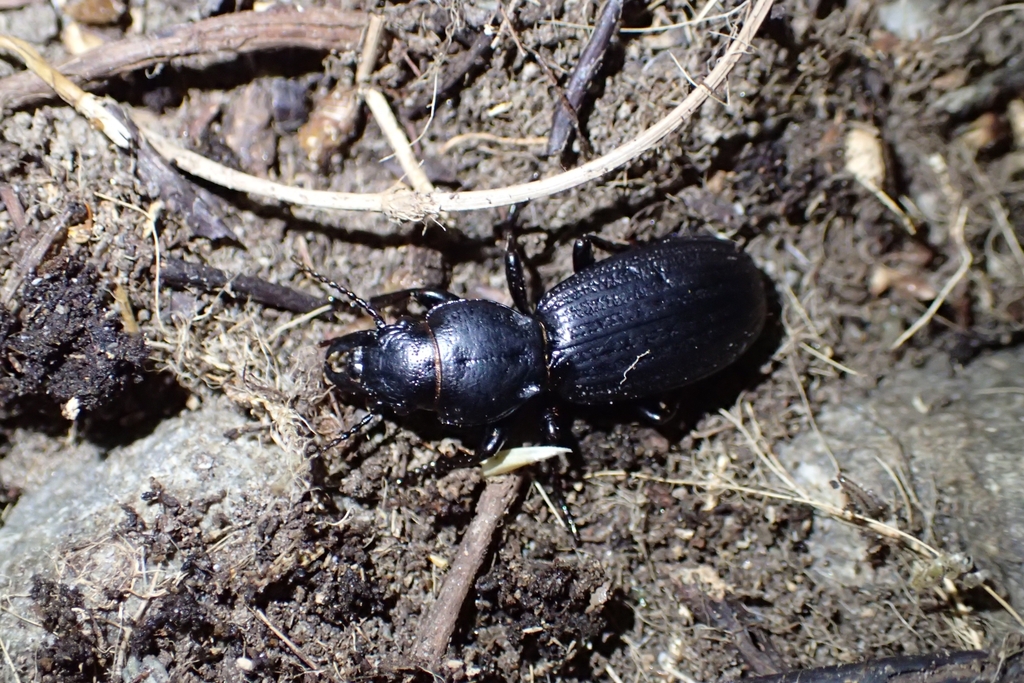
Mecodema rectolineatum
Mecodema howittii is a species of ground beetle in the family Carabidae, endemic to New Zealand. It is restricted to Banks Peninsula in the Canterbury Region of the South Island, where it is the largest carabid species. Due to a contraction of its historical range, it is currently classified as a species in decline under the New Zealand Threat Classification System (NZTCS). M. howittii is nocturnal and predatory, most commonly found beneath logs in forest and grassland habitats during spring and summer.
From the article Mecodema howittii on Wikipedia (CC BY-SA), quoted section by section
Description
M. howittii measures between 26–31 mm (1.02–1.22 in) in length, making it the largest of the ten endemic ground beetle species found on Banks Peninsula. Its body is uniformly black, with a smooth and slightly depressed head vertex, and faint or absent punctures. The labium bears three punctures on either side at the base. The pronotum has 10–12 punctures along the lateral margins. The elytra exhibit flattened third and fifth intervals, while the other intervals vary in smoothness and punctation.
Range & habitat
This species is restricted to the central and eastern parts of Banks Peninsula, occurring across both lowland and higher altitude sites. Historical records indicate that M. howittii once extended west to the Port Hills, but by the 1980s populations there had disappeared, possibly due to extensive nineteenth-century deforestation and predation by introduced mammals such as rats and mice. M. howittii inhabits remnants of podocarp and hardwood forest, as well as grassland and even in heavily modified habitats such as pasture. It is frequently found beneath logs, which provide microhabitats that retain moisture and shelter. Populations in pastures are believed to persist in relictual microhabitats where fallen wood remains. Although it was once very common in high ridges where forest had been cleared and logs left to lie in pasture, it disappears when the logs rot away or are burned.
Wikipedia: “Distribution and habitat”
What it does
M. howittii is nocturnal, emerging at night to hunt small invertebrates. It preys on larvae of other beetles, such as Holcaspis suteri, as well as crane flies and (in captivity) mealworms. Activity levels decrease when soil temperatures fall below 6.5 °C (43.7 °F). Females brooding eggs have been observed between December and January, suggesting breeding occurs during spring and early summer. Like other Mecodema, the species is flightless and lives in burrows or under debris on the forest floor.
Wikipedia: “Behaviour and ecology”
Listen
Looking for field recordings…
Where it lives
Recorded sightings
—
geo-referenced records in GBIF, from museums, herbaria and field observers.
Drag the globe to turn it. Dots are where records exist, not a range map; darker means more records.
In the stacks
Searching the stacks…
Every page naming Mecodema rectolineatum in the Biodiversity Heritage Library →
This page is assembled live from iNaturalist, GBIF, Wikipedia, the Source Library and the Internet Archive. It is not yet part of the hand-edited codex. iNaturalist taxon 392268.