- Animals
- ›Molluscs
- ›Bivalves
- ›Autobranchia
- ›Pteriomorphia
- ›Mytilida
- ›True Mussels
- ›mussels
- ›Crenellinae
- ›Perna
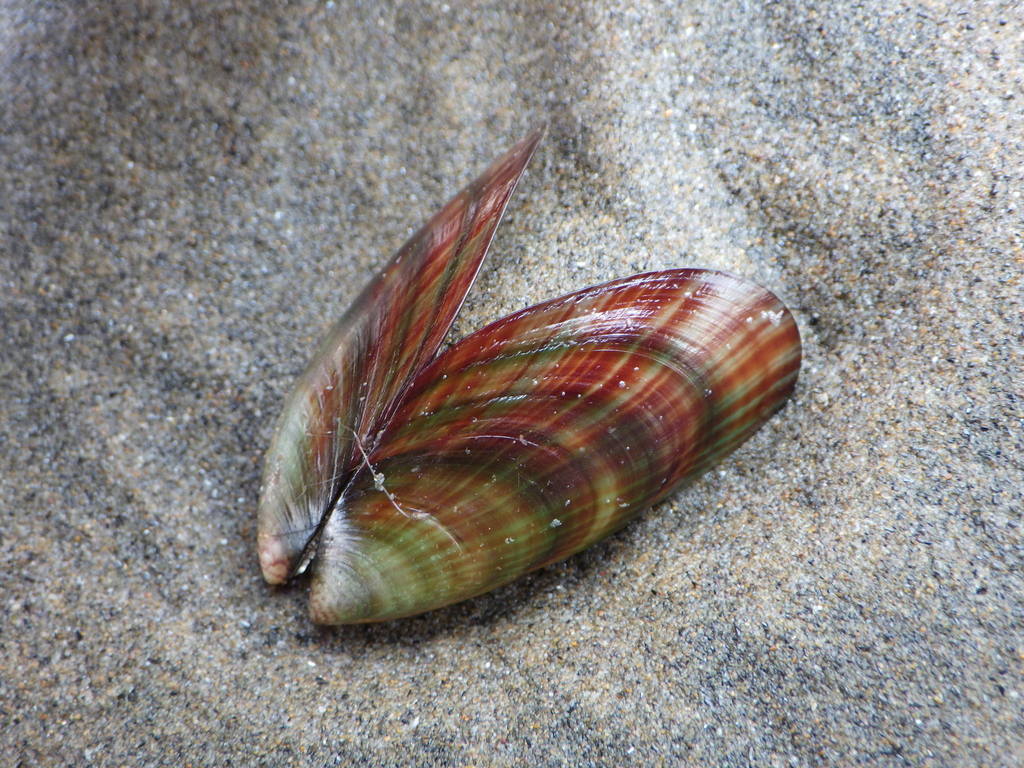
New Zealand Green-lipped Mussel
Perna canaliculus
The New Zealand green-lipped mussel (Perna canaliculus), also known as the New Zealand mussel, the greenshell mussel, kuku, and kutai, is a bivalve mollusc in the family Mytilidae (the true mussels). P. canaliculus has economic importance as a cultivated species in New Zealand.
From the article Perna canaliculus on Wikipedia (CC BY-SA), quoted section by section
Description
This shellfish is economically important to New Zealand. It differs from other mussel species in that it has dark brown/green shells with green lips around the edges, and has only one adductor muscle. It is also one of the largest mussel species, reaching 240 millimetres (9 in) in length.
Range & habitat
Perna canaliculus occurs around all of New Zealand's mainland. It is usually found below the intertidal zone, but it can occur in the intertidal zone. P. canaliculus feeds on various types of phytoplankton.
Wikipedia: “Distribution”
In medicine
Perna canaliculus inhibits the 5-lipoxygenase pathway, which leads to the formation of leukotrienes. Many of the products of these pathways have inflammation-supporting properties. However, a 2006 systematic review of scientific research on supplementation with green-lipped mussel found "little consistent and compelling evidence" of any benefit for rheumatoid or osteoarthritis. However, subsequent placebo-controlled trials have shown that green-lipped mussels do show promise as an alternative therapy for joint issues. Another study on canines shows that a diet rich in green-lipped mussels yielded an improvement in pain and functioning in Osteoarthritic Dogs. A lipid extract from this shellfish is sold under the brand name Lyprinol. A 2011 literature review found weak evidence of anti-inflammatory effects similar to fish oil, but noted that clinical trials to date had been limited. In 2000, two companies were successfully prosecuted and fined in New Zealand for making medicinal claims about Lyprinol without proof, including that it could act as a cancer cure. TVNZ was also found to have breached broadcasting standards by publishing the claims in a news story.
Wikipedia: “Medicinal effects”
In human culture
P. canaliculus is endemic to New Zealand. When grown for aquaculture there, it is marketed under the trademark name Greenshell. This industry produces over 140,000 metric tons (150,000 short tons) annually and in 2009 was valued in excess of NZ$250 million. The aquaculture of the New Zealand greenshell mussel relies heavily on the production of mussel seed, or spat, by wild mussel populations. Around 270 tonnes of wild spat which is attached to beach-cast seaweed are collected from Ninety Mile Beach in northern New Zealand each year to supply the aquaculture industry. Nowhere else in the country are such large quantities of mussel-covered seaweed washed ashore. The density of spat varies from 200 to 2,000,000 per kilogram (91 to 907,185 per pound) of seaweed. This single beach provides around 80% of the seed mussels required for this aquaculture industry. The remaining 20% is caught using fibrous ropes which are suspended in the sea near mussel farms. Even with this industry's heavy dependency on wild spat, the biological and environmental processes by which the spat arrives on Ninety Mile Beach and on spat collection ropes are largely unknown. Furthermore, the amount of mussel spat that lands on Ninety Mile Beach is highly variable. …
Wikipedia: “Aquaculture”
Where it lives
Recorded sightings
—
geo-referenced records in GBIF, from museums, herbaria and field observers.
Drag the globe to turn it. Dots are where records exist, not a range map; darker means more records.
In the stacks
Searching the stacks…
Every page naming Perna canaliculus in the Biodiversity Heritage Library →
This page is assembled live from iNaturalist, GBIF, Wikipedia, the Source Library and the Internet Archive. It is not yet part of the hand-edited codex. iNaturalist taxon 394900.