- Animals
- ›Arthropods
- ›Hexapods
- ›Insects
- ›Winged and Once-winged Insects
- ›Caddisflies
- ›Brevitentoria
- ›Conoesucidae
- ›Pycnocentrodes
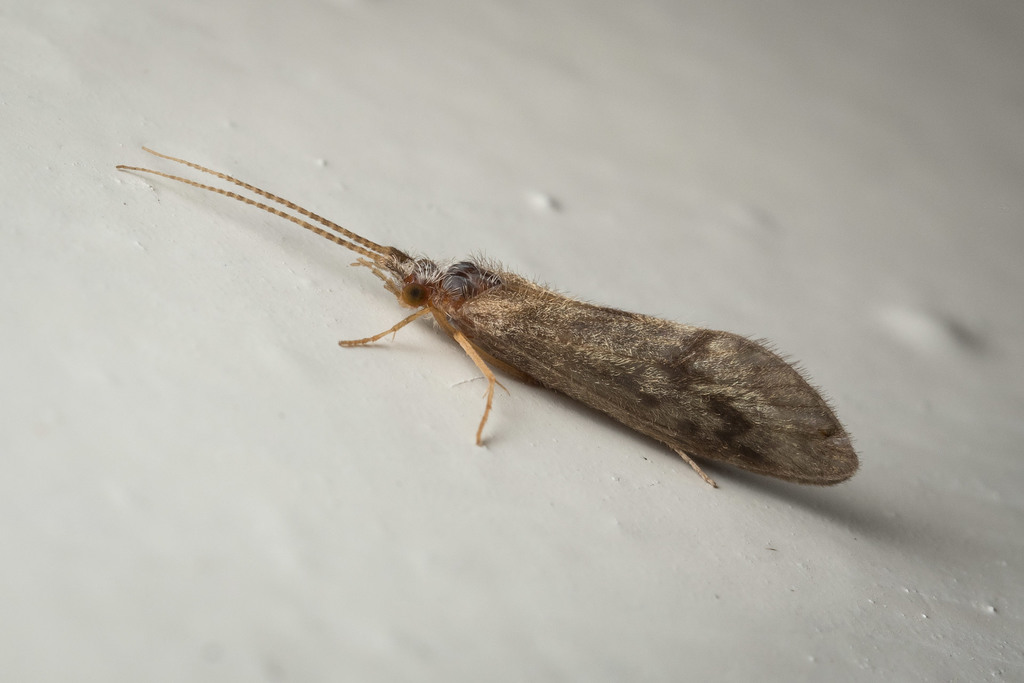
Common Stony-cased Caddisfly
Pycnocentrodes aeris
Pycnocentrodes aeris, also known as the common stony-cased caddisfly, is a species of caddisfly belonging to the family Conoesucidae. The species was first described by Keith Arthur John Wise in 1958, and is endemic to New Zealand.
From the article Pycnocentrodes aeris on Wikipedia (CC BY-SA), quoted section by section
Description
Wise's original text (the type description) reads as follows:
ANTERIOR WING almost colourless, markings pale testaceous being two elongate transverse dots near base and two parallel transverse lines arising where Sc and R1 meet the costa and finishing at two-thirds where they join abruptly and continue as a single line almost to the dorsum just before the tornus. POSTERIOR WING almost colourless. WING VENATION. Differs mainly from P. aureola (McLachlan) in the posterior wing where R2 and R3 arise separately, as in P. chiltoni
Tillyard, and from P. chiltoni in the anterior wing where apical fork 3 is fully formed, as in P. aureola. Length of anterior wing, 7–10 mm (0.28–0.39 in). Genitalia♂. Very close to P. aureola except that the spurs of the penis arise from its apex which is truncate and slightly bifid above. The spurs are moderately long, straight, and lie along each side of the penis.. Wise noted that the species could be differentiated from other Pycnocentrodes due to the colour and pattern of its anterior wings. Specimens have an average forewing length of 8 mm (0.31 in) and hind wing length of 5.6 mm (0.22 in).
Range & habitat
The species is endemic to New Zealand, and is the most widespread Pycnocentrodes in the country, found across both the North Island and South Island.
Wikipedia: “Distribution and habitat”
What it does
P. aeris larvae form cases by binding together sand particles and silk, and occasionally repair damaged cases.
Wikipedia: “Behaviour”
Listen
Looking for field recordings…
Where it lives
Recorded sightings
—
geo-referenced records in GBIF, from museums, herbaria and field observers.
Drag the globe to turn it. Dots are where records exist, not a range map; darker means more records.
In the stacks
Searching the stacks…
Every page naming Pycnocentrodes aeris in the Biodiversity Heritage Library →
This page is assembled live from iNaturalist, GBIF, Wikipedia, the Source Library and the Internet Archive. It is not yet part of the hand-edited codex. iNaturalist taxon 396044.