- Animals
- ›Chordates
- ›Vertebrates
- ›Reptiles
- ›Turtles and Tortoises
- ›Sea Turtles
- ›Typical Sea Turtles
- ›Hawksbill, Loggerhead, and Ridley Sea Turtles
- ›Lepidochelys
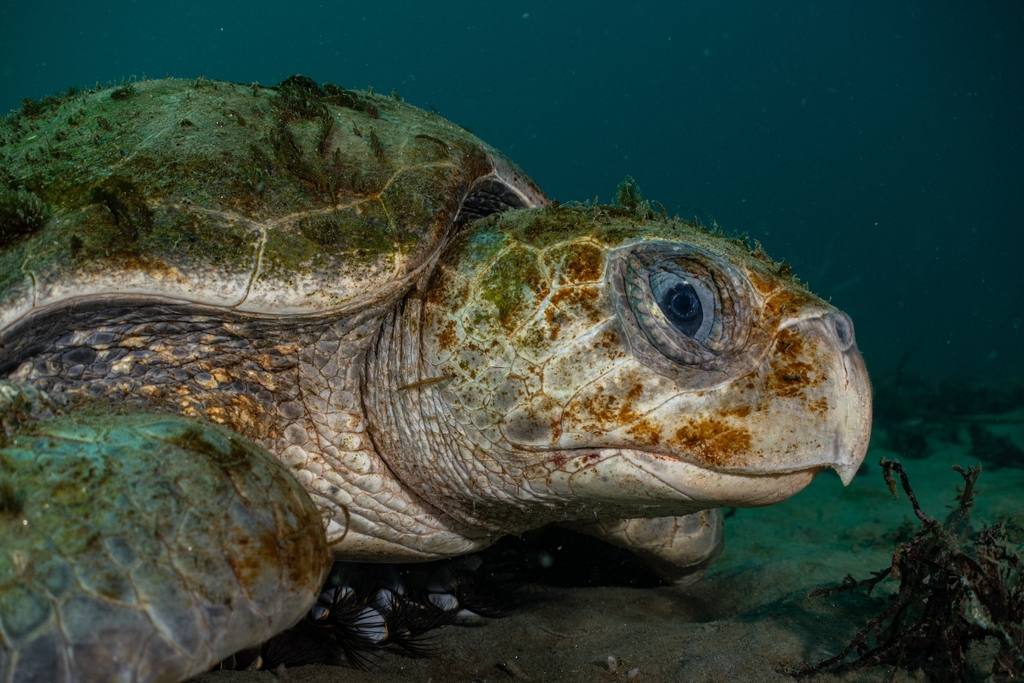
Olive Ridley Sea Turtle
Lepidochelys olivacea
The olive ridley sea turtle (Lepidochelys olivacea), also known commonly as the Pacific ridley sea turtle, is a species of turtle in the family Cheloniidae. The species is the second-smallest and most abundant of all sea turtles found in the world. L. olivacea is found in warm and tropical waters, primarily in the Pacific and Indian Oceans, but also in the warm waters of the Atlantic Ocean.
This turtle and the related Kemp's ridley sea turtle are best known for their unique synchronised mass nestings called arribadas, where thousands of females come together on the same beach to lay eggs.
From the article Olive ridley sea turtle on Wikipedia (CC BY-SA), quoted section by section
Description
Growing to about 61 cm (2 ft) in carapace length (measured along the curve), the olive ridley sea turtle gets its common name from its olive-colored carapace, which is heart-shaped and rounded. Males and females grow to the same size, but females have a slightly more rounded carapace as compared to males. The heart-shaped carapace is characterized by four pairs of pore-bearing inframarginal scutes on the bridge, two pairs of prefrontals, and up to nine lateral scutes per side. L. olivacea is unique in that it can have variable and asymmetrical lateral scute counts, ranging from five to nine plates on each side, with six to eight being most commonly observed. Each side of the carapace has 12–14 marginal scutes. The carapace is flattened dorsally and highest anterior to the bridge. It has a medium-sized, broad head that appears triangular from above. The head's concave sides are most obvious on the upper part of the short snout. It has paddle-like fore limbs, each having two anterior claws. The upper parts are grayish-green to olive in color, but sometimes appear reddish due to algae growing on the carapace. The bridge and hingeless plastron of an adult vary from greenish white in younger individuals to a creamy yellow in older specimens (maximum age is up to 50 years).
Hatchlings are dark gray with a pale yolk scar, but appear all black when wet. …
Range & habitat
The olive ridley turtle has a circumtropical distribution, living in tropical and warm waters of the Pacific and Indian Oceans from India, Arabia, Japan, and Micronesia south to southern Africa, Australia, and New Zealand. In the Atlantic Ocean, it has been observed off the western coast of Africa and the coasts of northern Brazil, Suriname, Guyana, French Guiana, and Venezuela. Additionally, the olive ridley has been recorded in the Caribbean Sea as far north as Puerto Rico. A female was found alive on an Irish Sea beach on the Isle of Anglesey, Wales, in November 2016, giving this species its northernmost appearance. It was taken in by the nearby Anglesey Sea Zoo, while its health was assessed. A juvenile female was found off the coast of Sussex in 2020. The olive ridley is also found in the eastern Pacific Ocean from the Galápagos Islands and Chile north to the Gulf of California, and along the Pacific coast to at least Oregon. Migratory movements have been studied less intensely in olive ridleys than other species of marine turtles, but they are believed to use the coastal waters of over 80 countries. Historically, this species has been widely regarded as the most abundant sea turtle in the world. …
Wikipedia: “Distribution”
What it does
Mating is often assumed to occur in the vicinity of nesting beaches, but copulating pairs have been reported over 1,000 km from the nearest beach. Research from Costa Rica revealed the number of copulating pairs observed near the beach could not be responsible for the fertilization of the tens of thousands of gravid females, so a significant amount of mating is believed to have occurred elsewhere at other times of the year. The Gahirmatha Beach in Kendrapara district of Odisha (India), which is now a part of the Bhitarkanika Wildlife Sanctuary, is the largest breeding ground for these turtles. The Gahirmatha Marine Wildlife Sanctuary, which bounds the Bhitarkanika Wildlife Sanctuary to the east, was created in September 1997, and encompasses Gahirmatha Beach and an adjacent portion of the Bay of Bengal. Bhitarkanika mangroves were designated a Ramsar Wetland of International Importance in 2002. It is the world's largest known rookery of olive ridley sea turtles. Apart from Gahirmatha rookery, two other mass nesting beaches have been located, which are on the mouth of rivers Rushikulya and Devi. …
Wikipedia: “Reproduction”
Where it lives
Recorded sightings
—
geo-referenced records in GBIF, from museums, herbaria and field observers.
Drag the globe to turn it. Dots are where records exist, not a range map; darker means more records.
In the stacks
Searching the stacks…
Every page naming Lepidochelys olivacea in the Biodiversity Heritage Library →
This page is assembled live from iNaturalist, GBIF, Wikipedia, the Source Library and the Internet Archive. It is not yet part of the hand-edited codex. iNaturalist taxon 39670.