 NL·0414
Herbarium of the Nature Library
- Name
- Dermochelys coriacea
- Family
- Dermochelyidae
- Native to
- All tropical and temperate oceans; nests on tropical beaches, forages north to Norway and Alaska and south to Chile and New Zealand
- Habitat
- Open ocean, Sandy beaches
Leatherback sea turtle
Dermochelys coriacea
Also calledTortuga laúd / Baula (Spanish) · Tartaruga-de-couro (Portuguese) · Tortue luth (French) · Penyu belimbing (Malay) · Oshi-game オサガメ (Japanese)
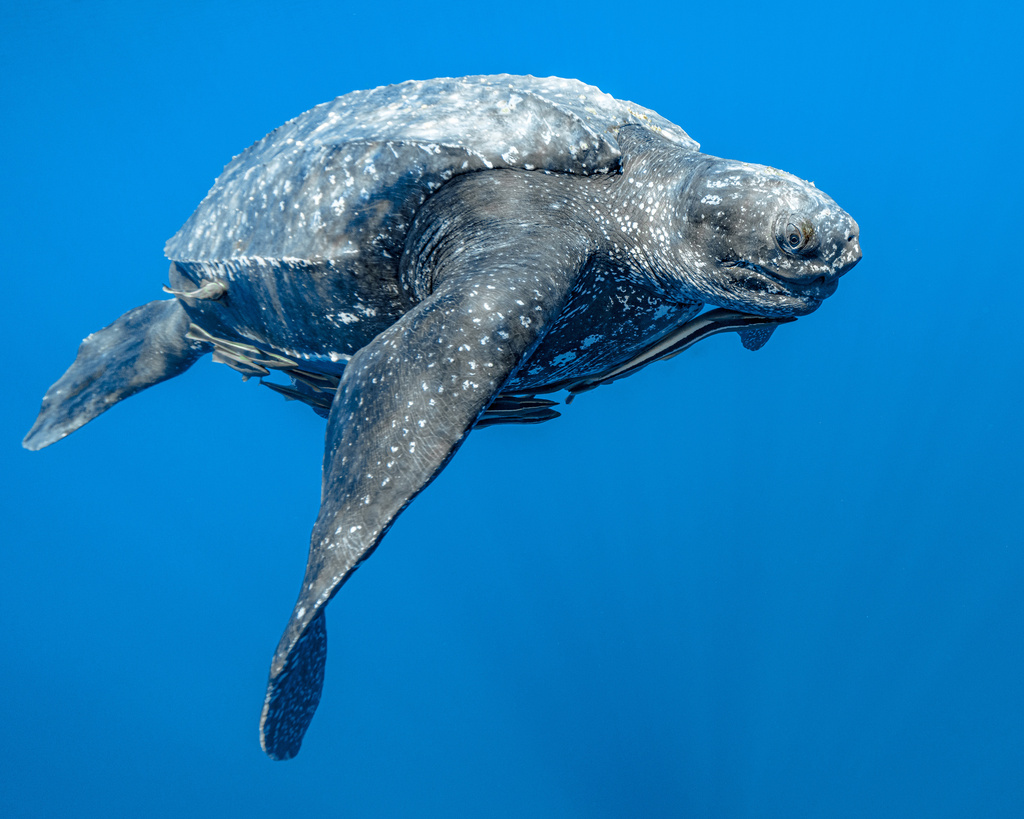
The largest living turtle and the only one without a hard shell. Its back is a leathery skin over a mosaic of small bones. It dives deeper than 1,000 m, crosses whole oceans to feed on jellyfish, and stays warm in cold northern seas.
The leatherback sea turtle, sometimes called the lute turtle, leathery turtle or simply the luth, is a large species of sea turtle. The largest of all living turtles and the heaviest non-crocodilian reptile, it reaches lengths of up to 2.7 metres and weights of 500 kilograms (1,100 lb). It is the only living species in the genus Dermochelys and family Dermochelyidae. It can easily be differentiated from other modern sea turtles by its lack of a bony shell; instead, its carapace is covered by oily flesh and flexible, leather-like skin, for which it is named. Leatherback turtles have a global range, although there are multiple distinct subpopulations. The species as a whole is considered vulnerable, and some of its subpopulations are critically endangered. Wikipedia
What it can do
- iDives to over 1,000 m, deeper than any other turtle
- iiKeeps its body warmer than the surrounding water through its size, insulating fat and heat-exchanging blood vessels in its flippers
- iiiMigrates thousands of kilometres between nesting beaches and jellyfish feeding grounds
- ivIts throat is lined with backward-pointing spines that stop slippery jellyfish escaping
In the field
Field marks
- aHuge, dark blue-black turtle with white spots and no scutes
- bSeven ridges running the length of the back
- cVery long front flippers
- dNotched upper jaw with two tooth-like points
- Not to be confused with
- No other turtle has a ridged, leathery back without plates. Large loggerheads and green turtles have hard shells of plates (scutes).
- Where to see it
- Nesting beaches at Grande Riviere and Matura (Trinidad), Awala-Yalimapo (French Guiana), Gabon, Tortuguero (Costa Rica), Jamursba Medi (West Papua); feeding at sea off Nova Scotia and California
- When
- Nesting March–July in the Caribbean and Atlantic; Nov–Feb on some Pacific beaches
Life & habits
- Diet
- Jellyfish, salps and other soft-bodied animals
- Habitat
- Open ocean; comes ashore only to nest
- Size
- Shell up to ~1.8 m; weight usually 300–600 kg, exceptionally over 900 kg
- Lifespan
- Probably 30–50 years or more
Females haul out at night several times in a season to dig nests and lay about 80 eggs. They return to nest every two to three years. Plastic bags in the sea, which look like jellyfish, are a serious hazard.
Where it lives
Recorded sightings
—
geo-referenced records in GBIF, from museums, herbaria and field observers.
Native range
All tropical and temperate oceans; nests on tropical beaches, forages north to Norway and Alaska and south to Chile and New Zealand
Drag the globe to turn it. Dots are where records exist, not a range map; darker means more records.
In the stacks
Searching the stacks…
Every page naming Dermochelys coriacea in the Biodiversity Heritage Library →
Marginalia
In September 1988 a dead male leatherback washed ashore at Harlech, Wales, and weighed 916 kg, the heaviest turtle ever recorded. It was displayed in the National Museum Cardiff.
Curiosity
The leatherback's lineage split from other living sea turtles more than 100 million years ago.
Kinship




Photographs: iNaturalist contributors under the licences shown. Records: GBIF.org. Historical plates: Source Library (CC BY-SA 4.0; originals public domain). Summary text: Nature Library editors and Wikipedia (CC BY-SA). Medicinal and edibility notes are historical and educational, not advice. iNaturalist taxon 39677.