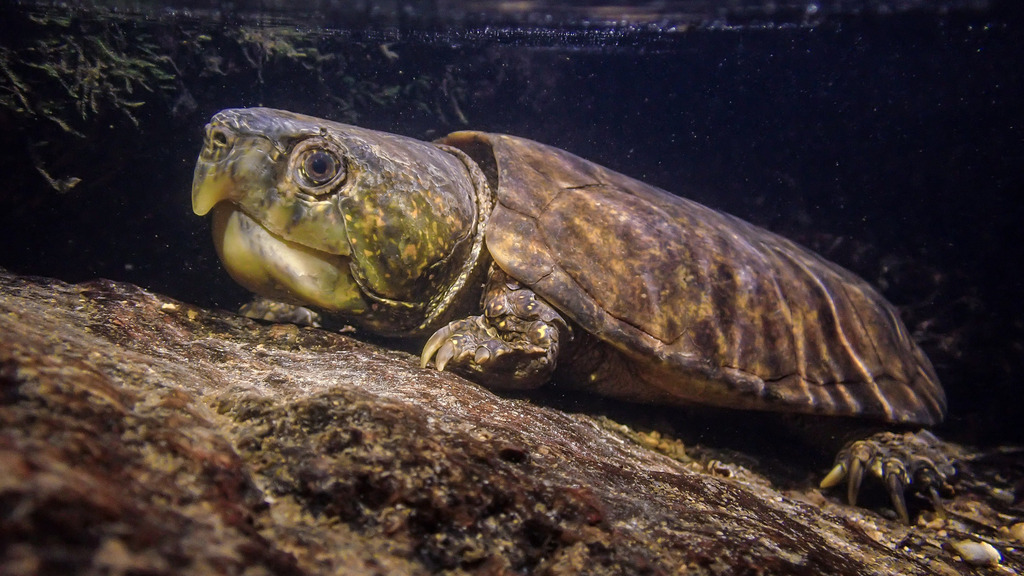
big-headed turtle
Platysternon megacephalum
The big-headed turtle (Platysternon megacephalum) is a species of turtle in the family Platysternidae from Southeast Asia and southern China. For Madagascar see Madagascan big-headed turtle.
From the article Big-headed turtle on Wikipedia (CC BY-SA), quoted section by section
Range & habitat
The big-headed turtle is found in Cambodia, China, Laos, Myanmar, Thailand, and Vietnam. It is commonly found in fast flowing streams and waterfalls in rocky areas. [1]
Wikipedia: “Distribution”
What it does
The big-headed turtle is known to readily climb over obstacles in and around rivers and fast streams, using its tail as a prop to extend the reach of its strong claws. It also uses its beak to assist in climbing. It has been reported to climb trees and bushes. These turtles generally move more during the night, and are not prone to moving long distances. They have a general daily range of 0-89.6m and males tend to move further than the females in this species. They are not strong swimmers, and when swimming, this species occasionally arches its tail in the manner of a scorpion. The big-headed turtle cannot pull its head in its shell. That being the case, it will not hesitate to use its powerful jaws to defend itself. Its diet consists of fish, snails and worms. It also tends to eat fruits like the Machilus spp., as well as insects, crabs and mollusks.
Wikipedia: “Behaviour”
Where it lives
Recorded sightings
—
geo-referenced records in GBIF, from museums, herbaria and field observers.
Drag the globe to turn it. Dots are where records exist, not a range map; darker means more records.
In the stacks
Searching the stacks…
Every page naming Platysternon megacephalum in the Biodiversity Heritage Library →
This page is assembled live from iNaturalist, GBIF, Wikipedia, the Source Library and the Internet Archive. It is not yet part of the hand-edited codex. iNaturalist taxon 39688.