- Animals
- ›Chordates
- ›Vertebrates
- ›Reptiles
- ›Turtles and Tortoises
- ›American Mud and Musk Turtles
- ›Kinosternine Turtles
- ›Kinosternon
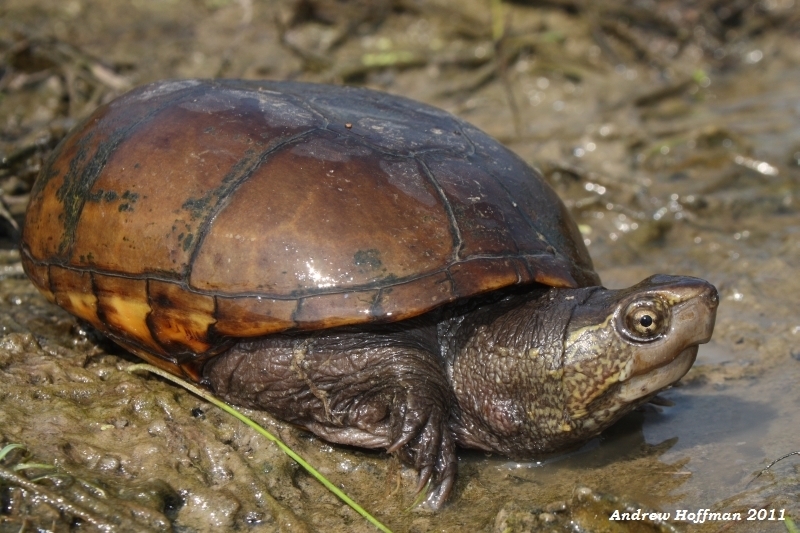
Eastern Mud Turtle
Kinosternon subrubrum
The eastern mud turtle (Kinosternon subrubrum) or common mud turtle is a common species of turtle in the family Kinosternidae. The species is endemic to the United States. There are two recognized subspecies.
From the article Eastern mud turtle on Wikipedia (CC BY-SA), quoted section by section
Description
The eastern mud turtle is a small and often hard to identify species. It measures 3–4 in (7.6–10.2 cm) in carapace length. The carapace is keelless, lacks any pattern, and varies in color from yellowish to black. The plastron is large and double hinged, and can be yellowish to brown, and may sometimes have a dark pattern. The chin and throat are a yellowish grey, streaked and mottled with brown, while the limbs and tail are grayish. The eye, or iris, of the eastern mud turtle is yellow with dark clouding, and its feet are webbed.
Range & habitat
Mud turtles (genus Kinosternon) are fresh water turtles that are found in the Southeastern and Northeastern United States. They live in rivers, lakes, ponds, ditches and swamps. Mud turtles prefer ponds that have a lot of vegetation. These animals can generally be found in spring-fed streams, and they prefer clean, oxygenated water. The Eastern mud turtle rarely basks, but in the instance they do, they will bask on rocks or debris floating on the surface of the water. In the wild, they also prefer sandy and muddy areas, as they will hibernate by burrowing into the mud. The Eastern Mud Turtle prefers hibernacula sites about 70 meters from wetlands and that have a large amount of leaf and pine litter and not too much tree cover. They will burrow at the wetland edges at a minimum depth of 1.3 cm below the soil surface to a maximum depth of 3 cm. The leaf litter helps to keep the soil moisture and the temperature consistent, while a more open canopy exposes turtles to higher temperatures before emergence. Mud turtles can tolerate brackish water so they may be found near salt marshes and on coastal islands. They can also persist in degraded or polluted habitats despite contamination.
Wikipedia: “Habitat”
What it does
The eastern mud turtle is omnivorous and feeds on insects, crustaceans, mollusks, amphibians, carrion, and aquatic vegetation. Smaller eastern mud turtles prey on small aquatic insects, algae, and carrion, whereas larger ones can feed on any type of food that they can fit in their mouth.
Wikipedia: “Diet”
In human culture
The specific name, subrubrum, meaning "under red", refers to the red-orange plastron of hatchlings.
Wikipedia: “Etymology”
Where it lives
Recorded sightings
—
geo-referenced records in GBIF, from museums, herbaria and field observers.
Drag the globe to turn it. Dots are where records exist, not a range map; darker means more records.
In the stacks
Searching the stacks…
Every page naming Kinosternon subrubrum in the Biodiversity Heritage Library →
This page is assembled live from iNaturalist, GBIF, Wikipedia, the Source Library and the Internet Archive. It is not yet part of the hand-edited codex. iNaturalist taxon 39713.