- Animals
- ›Chordates
- ›Vertebrates
- ›Reptiles
- ›Turtles and Tortoises
- ›American Mud and Musk Turtles
- ›Kinosternine Turtles
- ›Kinosternon
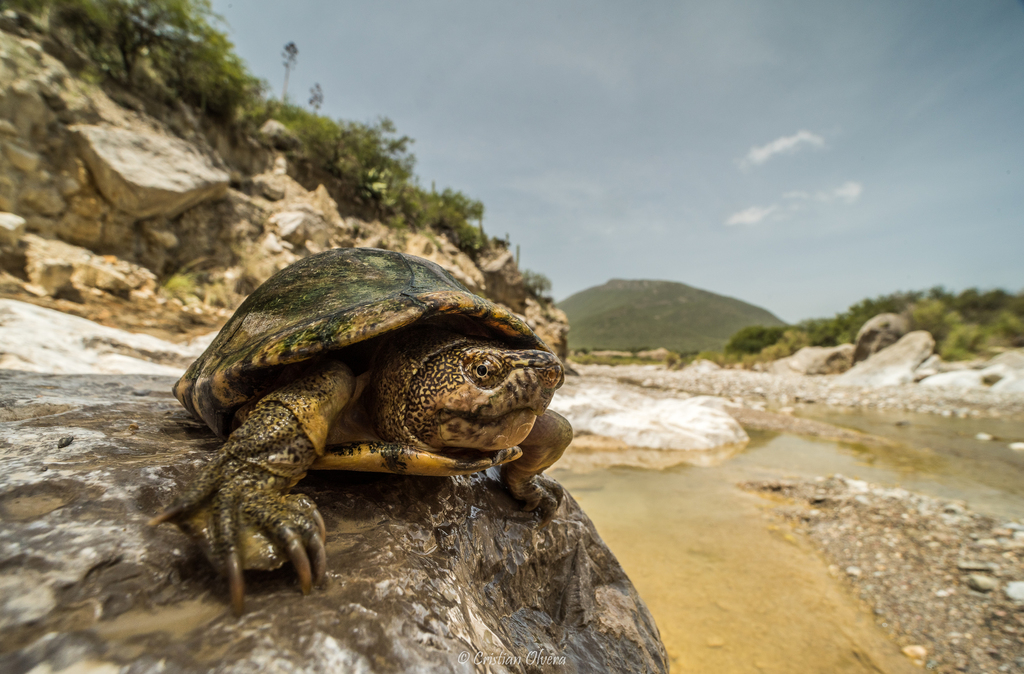
Mexican Mud Turtle
Kinosternon integrum
Mexican mud turtle (Kinosternon integrum), or Guanajuato mud turtle, is a species of mud turtle in the Kinosternidae family. Endemic to Mexico, it is found in Aguascalientes, Colima, Durango, Guanajuato, Guerrero, Hidalgo, Jalisco, Michoacán, Morelos, Nayarit, Oaxaca, Puebla, San Luis Potosí, Sinaloa, Sonora, Tamaulipas and Zacatecas.
From the article Mexican mud turtle on Wikipedia (CC BY-SA), quoted section by section
Range & habitat
In Mexico, it is found in Aguascalientes, Colima, Durango, Guanajuato, Guerrero, Hidalgo, Jalisco, Michoacán, México, Morelos, Nayarit, Oaxaca, Puebla, Queretaro, San Luis Potosí, Sinaloa, Sonora, Tamaulipas and Zacatecas.
Wikipedia: “Distribution”
What it does
The Mexican mud turtle's nesting season lasts from early May to September, beginning just prior to the summer rainy season. A typical clutch size for each female is 2 to 4 eggs, but can range between 1 and 8. Another distinctive feature within the species is the nostrils on male and female turtles. The females have a more rounded nostril and the nostril is more brownish as to yellow like the male. The Mexican mud turtle is an organism that "bet hedges" meaning that its organism fitness varies depending on the condition it is in. When in a relaxed, every-day state, its fitness levels are low, however when stressed its fitness level increases. Bet hedging affects this organism's reproductive window as well, allowing it to only reproduce every two to three seasons.
Wikipedia: “Reproduction”
Where it lives
Recorded sightings
—
geo-referenced records in GBIF, from museums, herbaria and field observers.
Drag the globe to turn it. Dots are where records exist, not a range map; darker means more records.
In the stacks
Searching the stacks…
Every page naming Kinosternon integrum in the Biodiversity Heritage Library →
This page is assembled live from iNaturalist, GBIF, Wikipedia, the Source Library and the Internet Archive. It is not yet part of the hand-edited codex. iNaturalist taxon 39730.