On eBird ↗
Common Sandpiper
Live sightings near you, the range map, bar charts of when it is seen, and Macaulay Library photos and recordings.
Common Sandpiper
Actitis hypoleucos
The common sandpiper (Actitis hypoleucos) is a small Palearctic wader. This bird and its American sister species, the spotted sandpiper (A. macularia), make up the genus Actitis. They are parapatric and replace each other geographically; stray birds of either species may settle down with breeders of the other and hybridize. Hybridization has also been reported between the common sandpiper and the green sandpiper, a basal species of the closely related shank genus Tringa.
From the article Common sandpiper on Wikipedia (CC BY-SA), quoted section by section
Description
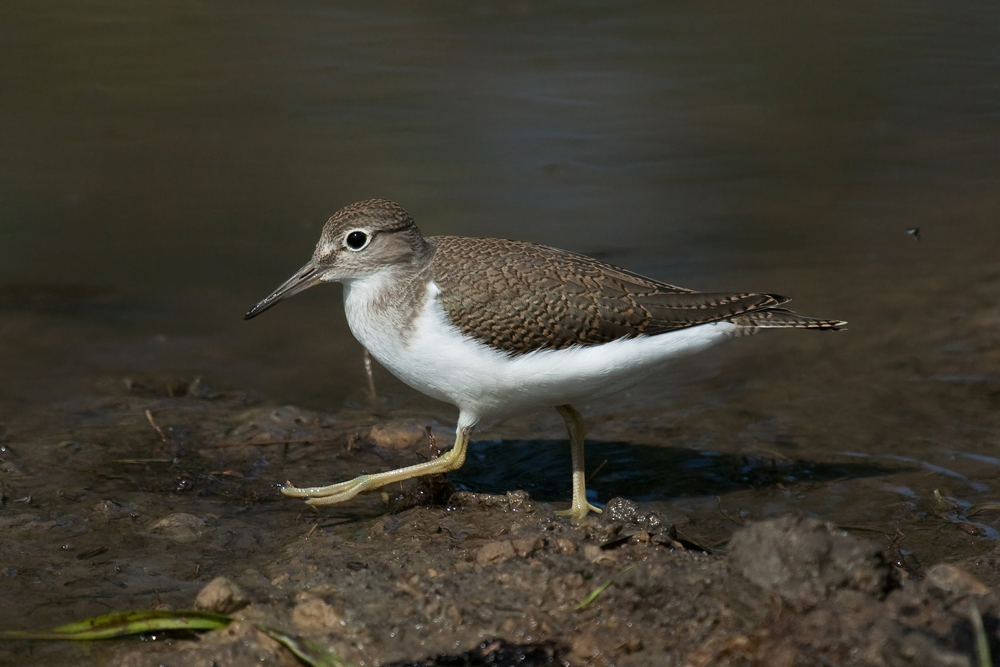
The adult is 18–20 cm (7.1–7.9 in) long with a 32–35 cm (13–14 in) wingspan. It has greyish-brown upperparts, white underparts, short dark-yellowish legs and feet, and a bill with a pale base and dark tip. In winter plumage, they are duller and have more conspicuous barring on the wings, though this is still only visible at close range. Juveniles are more heavily barred above and have buff edges to the wing feathers. This species is very similar to the slightly larger spotted sandpiper (A. macularia) in non-breeding plumage. But its darker legs and feet and the crisper wing pattern (visible in flight) tend to give it away, and of course they are only rarely found in the same location.
Range & habitat
The common sandpiper breeds across most of temperate and subtropical Europe and Asia, and migrates to Africa, southern Asia and Australia in winter. The eastern edge of its migration route passes by Palau in Micronesia, where hundreds of birds may gather for a stop-over. They depart the Palau region for their breeding quarters around the last week of April to the first week of May.
Wikipedia: “Distribution and migration”
What it does
The Common Sandpiper is usually encountered alone, occasionally in small groups, although larger flocks are sometimes formed around migration or at breeding season roosts. It seldom joins multispecies flocks. This species has a distinctive stiff-winged flight, low over the water.
Breeding. It nests on the ground near freshwater. When threatened, the young may cling to their parent's body to be flown away to safety.
Feeding. The common sandpiper forages by sight on the ground or in shallow water, picking up small food items such as insects, crustaceans and other invertebrates; it may even catch insects in flight.
Wikipedia: “Behaviour and ecology”
Listen
Looking for field recordings…
Where it lives
Recorded sightings
—
geo-referenced records in GBIF, from museums, herbaria and field observers.
Drag the globe to turn it. Dots are where records exist, not a range map; darker means more records.
In the stacks
Searching the stacks…
Every page naming Actitis hypoleucos in the Biodiversity Heritage Library →
This page is assembled live from iNaturalist, GBIF, Wikipedia, the Source Library and the Internet Archive. It is not yet part of the hand-edited codex. iNaturalist taxon 3978.