- Animals
- ›Chordates
- ›Vertebrates
- ›Reptiles
- ›Turtles and Tortoises
- ›Pond and Box Turtles
- ›Emydine Turtles
- ›Terrapene
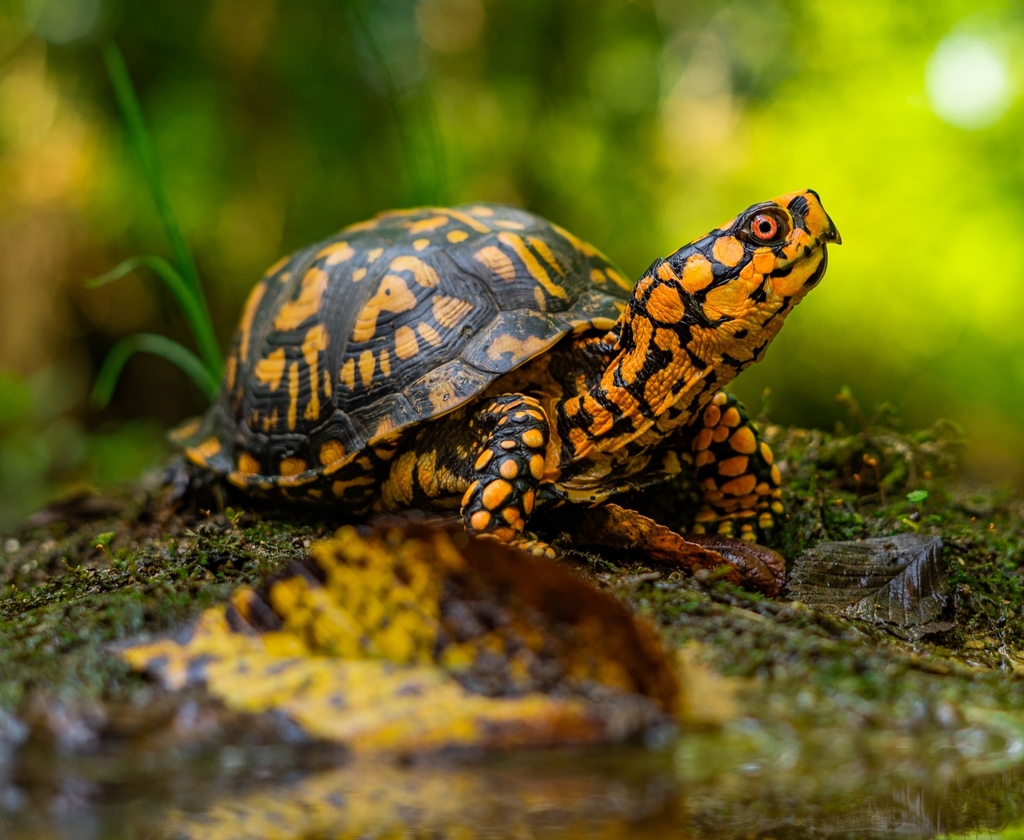
Common Box Turtle
Terrapene carolina
The common box turtle (Terrapene carolina) is a species of box turtle with five existing subspecies. It is found throughout the Eastern United States and Mexico. The box turtle has a distinctive hinged lower shell that allows it to completely enclose itself, like a box. Its upper jaw is hooked.
The turtle is primarily terrestrial and eats a wide variety of plants and animals. The females lay their eggs in the summer. Turtles in the northern part of their range hibernate over the winter.
From the article Common box turtle on Wikipedia (CC BY-SA), quoted section by section
Description
The common box turtle (Terrapene carolina) gets its common name from the structure of its shell which consists of a high domed carapace (upper shell), and large, hinged plastron (lower shell) which allows the turtle to close the shell, sealing its vulnerable head and limbs safely within an impregnable box. The carapace is brown, often adorned with a variable pattern of orange or yellow lines, spots, bars or blotches. The plastron is dark brown and may be uniformly coloured, or show darker blotches or smudges. The common box turtle has a small to moderately sized head and a distinctive hooked upper jaw. The majority of adult male common box turtles have red irises, while those of the female are yellowish-brown. Males also differ from females by possessing shorter, stockier and more curved claws on their hind feet, and longer and thicker tails. There are five living subspecies of the common box turtle, each differing slightly in appearance, namely in the colour and patterning of the carapace, and the possession of either three or four toes on each hind foot.
Range & habitat
The common box turtle inhabits open woodlands, marshy meadows, floodplains, scrub forests and brushy grasslands in much of the eastern United States, from Maine and Michigan to eastern Texas and south Florida. It was once found in Canada in southern Ontario and is still found in Mexico along the Gulf Coast and in the Yucatán Peninsula. The species range is not continuous as the two Mexican subspecies, T. c. mexicana (Mexican box turtle) and T. c. yucatana (Yucatán box turtle), are separated from the US subspecies by a gap in western Texas. Three of the US subspecies; T. c. carolina (eastern box turtle), T. c. major (Gulf Coast box turtle) and T. c. bauri (Florida box turtle); occur roughly in the areas indicated by their names. The species has become extirpated from Ontario and Canada.
Wikipedia: “Distribution”
What it does
Common box turtles are predominantly terrestrial reptiles that are often seen early in the day, or after rain, when they emerge from the shelter of rotting leaves, logs, or a mammal burrow to forage. These turtles have an incredibly varied diet of animal and plant matter, including earthworms, snails, slugs, insects, wild berries, roots, flowers, fungi, fish, frogs, salamanders, snakes, birds, eggs, and sometimes even animal carrion (in the form of dead ducks, amphibians, assorted small mammals, and even a dead cow). In the warmer summer months, common box turtles are more likely to be seen near the edges of swamps or marshlands, possibly in an effort to stay cool. If common box turtles do become too hot, (when their body temperature rises to around 32 °C), they smear saliva over their legs and head; as the saliva evaporates it leaves them comfortably cooler. Similarly, the turtle may urinate on its hind limbs to cool the body parts it is unable to cover with saliva. Courtship in the common box turtle, which usually takes place in spring, begins with a "circling, biting and shoving" phase. These acts are carried out by the male on the female. Following some pushing and shell-biting, the male grips the back of the female's shell with his hind feet to enable him to lean back, slightly beyond the vertical, and mate with the female. …
Wikipedia: “Behavior”
Where it lives
Recorded sightings
—
geo-referenced records in GBIF, from museums, herbaria and field observers.
Drag the globe to turn it. Dots are where records exist, not a range map; darker means more records.
In the stacks
Searching the stacks…
Every page naming Terrapene carolina in the Biodiversity Heritage Library →
This page is assembled live from iNaturalist, GBIF, Wikipedia, the Source Library and the Internet Archive. It is not yet part of the hand-edited codex. iNaturalist taxon 39814.