- Animals
- ›Chordates
- ›Vertebrates
- ›Reptiles
- ›Turtles and Tortoises
- ›Pond and Box Turtles
- ›Deirochelyine Turtles
- ›Graptemys
Black-knobbed Map Turtle
Graptemys nigrinoda
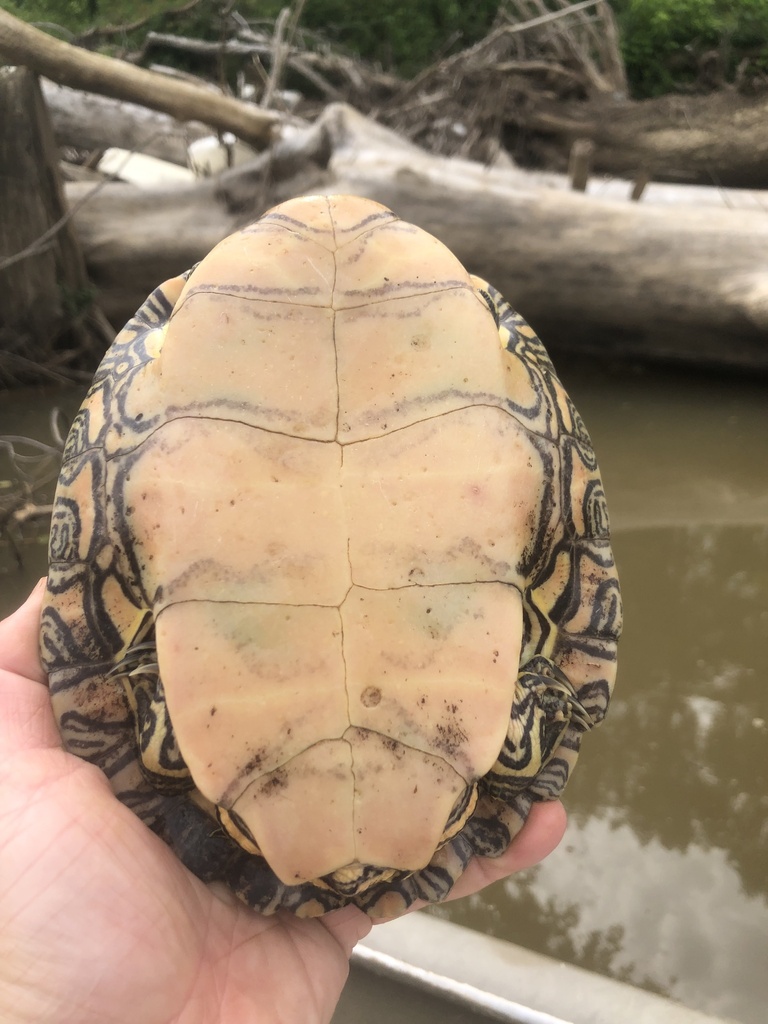
The black-knobbed map turtle (Graptemys nigrinoda), formerly known as the black-knobbed sawback, is a small to medium-sized aquatic turtle with light gray skin. Some of the most distinguishing characteristics of the black-knobbed map turtle, and the Graptemys genus, are the protruding "spikes" on the turtle's carapace. This species inhabits mainly the fall lines of rivers in the Mobile Bay drainage, in Alabama and Mississippi.
From the article Black-knobbed map turtle on Wikipedia (CC BY-SA), quoted section by section
Description
The carapace of G. nigrinoda is slightly domed with the first four vertebrae possessing backward-projecting, knob-like processes, which are black in color. The second and third processes are more dominant in size compared to the first and fourth. With aging females, the knobs are reduced to small swellings. The carapace is dark olive-brown in color. Within each pleural, or "plate", of the shell are yellow-green circular rings which are outlined in black. Hatchlings are similar in color to adults, but the colors tend to be more vibrant and contrasting. The knob-like processes are compressed laterally. The head is small, and is dark brown with yellow stripes, with yellow crescents behind the eye facing towards the posterior end of the turtle. These stripes continue on the legs of the turtle also, with the underside of the leg being lighter than the dorsal surface. Sexual dimorphism is evident in this species. Females are roughly twice the size of males. Also, females' carapaces tend to be higher than those of males, though the males have longer tails than the females. Sizes (carapace lengths) have been recorded as ranging from 7.6 to 10.2 cm (3.0 to 4.0 in) in males and 10.2–19.1 cm (4.0–7.5 in) in females.
Range & habitat
The black-knobbed map turtle is endemic to the southeastern United States. In Alabama, they are found in the Mobile Bay drainage. In Mississippi, they are found in the Tombigbee River system and in the Black Warrior River as far north as Jefferson County, Alabama. They are only able to survive in fresh water, thus they are only found within freshwater river systems.
Wikipedia: “Distribution”
What it does
Black-knobbed map turtles are seasonally active from April to late November. Basking is a routine part of their day, occurring in the early morning and early afternoon. Thermoregulation is thought to be the reason for basking, along with the removal of parasites and algal growth. When approached, the turtles jump into the nearby water. Once in the water, they seek protection between the branches of fallen trees on the river bottom. Most of the riverbeds where they live have sand and clay bottoms with moderate currents. Hatchlings prefer more sluggish waters off the main channel. Little is known about foraging behavior. However, this species has been observed to consume beetles and dragonflies that have fallen into the river. Upon examination of both female and male stomach matter, Lahanas found a distinction of food material percentages. Males had roughly 58% animal matter and 40% plant matter, while females had 70% animal matter and 29% plant matter. The three primary sources of animal matter came from freshwater sponges, bryozoans, and molluscs. The only plant matter found was a freshwater alga. Males reach sexual maturity around 3–4 years and females reach it around 7–8 years. Females have a clutch size of roughly five eggs and can lay three or four clutches in a year. Nesting occurs from May to August, and occurs nocturnally on a sandbank. …
Wikipedia: “Habitat and ecology”
Where it lives
Recorded sightings
—
geo-referenced records in GBIF, from museums, herbaria and field observers.
Drag the globe to turn it. Dots are where records exist, not a range map; darker means more records.
In the stacks
Searching the stacks…
Every page naming Graptemys nigrinoda in the Biodiversity Heritage Library →
This page is assembled live from iNaturalist, GBIF, Wikipedia, the Source Library and the Internet Archive. It is not yet part of the hand-edited codex. iNaturalist taxon 39855.