- Animals
- ›Chordates
- ›Vertebrates
- ›Reptiles
- ›Turtles and Tortoises
- ›Pond and Box Turtles
- ›Deirochelyine Turtles
- ›Graptemys
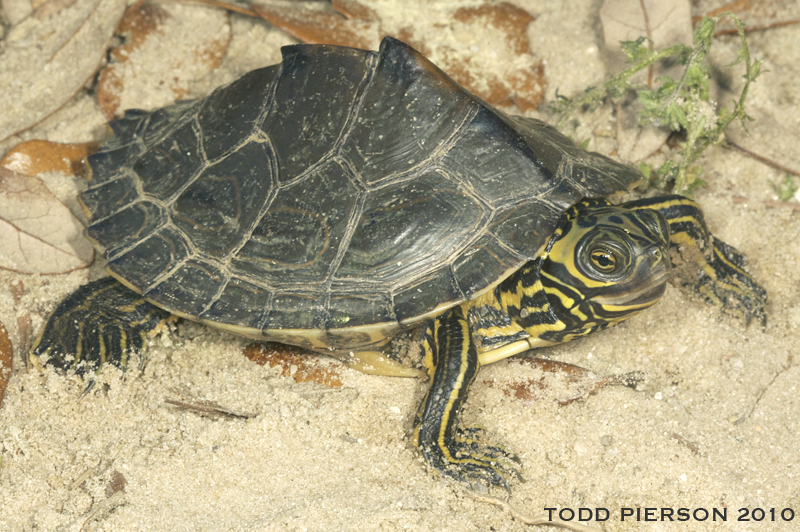
Barbour's Map Turtle
Graptemys barbouri
Barbour's map turtle (Graptemys barbouri ) is a species of turtle in the family Emydidae. The species is endemic to the southeastern United States.
From the article Barbour's map turtle on Wikipedia (CC BY-SA), quoted section by section
Description
Adult male Barbour's map turtles are on average 3.5 to 5.5 in (8.9 to 14.0 cm) in straight-line carapace length. Adult females are much larger and can vary from 6 to 12.5 in (15 to 32 cm) in straight-line carapace length. "Females attain really imposing dimensions, and their heads are enormously enlarged". G. barbouri possesses black-tipped spines on the second, third, and fourth vertebral scutes. These spines are very noticeable in males, and resemble a dorsal fin.
Range & habitat
G. barbouri is found in rivers located in southeastern Alabama, the western panhandle of Florida, and southwestern Georgia.
Wikipedia: “Geographic range”
What it does
Barbour's map turtle mainly consumes mollusks, insects, and small fish found in rivers.
Wikipedia: “Diet”
In human culture
The specific name or epithet, barbouri, is in honor of American herpetologist Thomas Barbour.
Wikipedia: “Etymology”
Where it lives
Recorded sightings
—
geo-referenced records in GBIF, from museums, herbaria and field observers.
Drag the globe to turn it. Dots are where records exist, not a range map; darker means more records.
In the stacks
Searching the stacks…
Every page naming Graptemys barbouri in the Biodiversity Heritage Library →
This page is assembled live from iNaturalist, GBIF, Wikipedia, the Source Library and the Internet Archive. It is not yet part of the hand-edited codex. iNaturalist taxon 39862.