- Animals
- ›Chordates
- ›Vertebrates
- ›Reptiles
- ›Turtles and Tortoises
- ›Pond and Box Turtles
- ›Emydine Turtles
- ›Emys
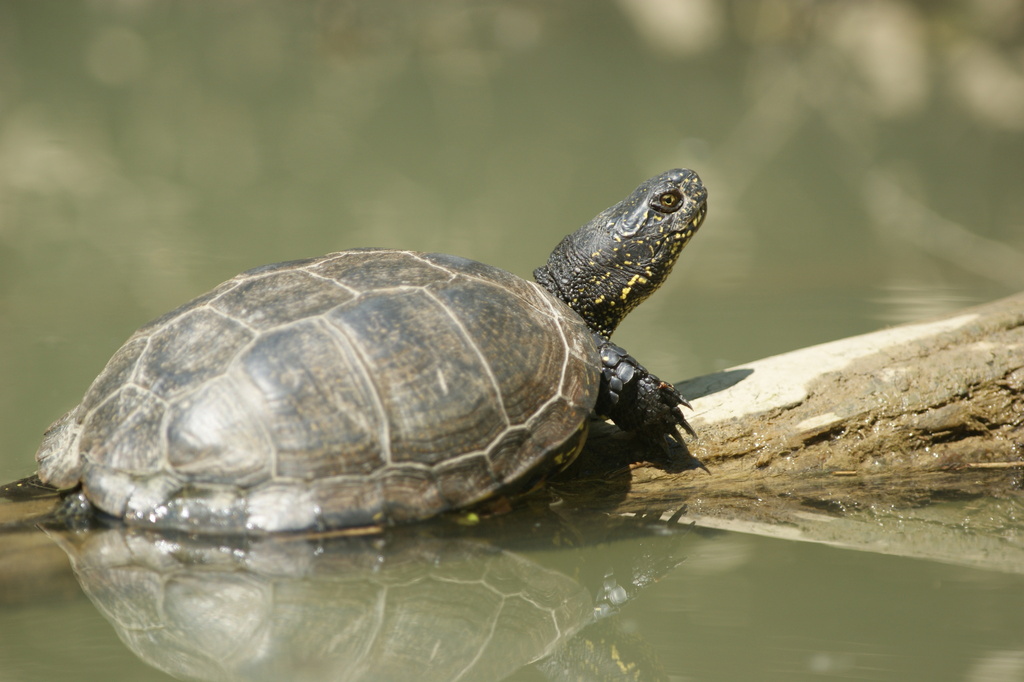
European Pond Turtle
Emys orbicularis
The European pond turtle (Emys orbicularis), also called commonly the European pond terrapin and the European pond tortoise, is a species of long-living freshwater turtle in the family Emydidae. The species is endemic to the Western Palearctic.
From the article European pond turtle on Wikipedia (CC BY-SA), quoted section by section
Description
The European pond turtle is a medium-sized turtle, and its straight carapace length varies quite a bit across its geographic range, from 12 to 38 cm (4.7 to 15.0 in). The carapace is dark brown to blackish, with a hint of green. The head and legs are spotted with yellow. The plastron is yellowish. An important factor that affects the development of E. orbicularis is temperature and thermal conditions. It has been reported that differential growth rates of the same species occur, including variation of body size and clutch size, because of varying temperatures in certain areas. Due to evident patterns of sexual dimorphism, E. orbicularis adult males are always found to be smaller than females. In males, smaller plastra offer them a wider mobility compared to females. In females, due to their differential diet and foraging habits, there may be a correlation to an adaptive effect on their skull and head morphology.
Wikipedia: “Morphology”
Range & habitat
E. orbicularis is found in southern, central, and eastern Europe, West Asia and parts of Mediterranean North Africa. In France, there are six remaining populations of significant size; however, they appear to be in decline. This turtle species is the most endangered reptile of the country. In Switzerland, the European pond turtle was extinct at the beginning of the twentieth century but reintroduced in 2010. In the early post-glacial period, the European pond turtle had a much wider distribution, being found as far north as southern Sweden and Great Britain, where a reintroduction has been proposed by the Staffordshire-based Celtic Reptile & Amphibian, a group specialising in the care, research, and rehabilitation of native European and British herpetiles. A trial reintroduction has been initiated, restoring the species back to its Holocene-native East Anglian Fens, Brecks and Broads. In 2004, the European pond turtle was found in the Setomaa region of Estonia. Fossil evidence shows that E. orbicularis and Testudo hermanni were both present in Sardinia during the Pleistocene, but molecular evidence suggests the extant populations of both species on the island were introduced in modern times.
E. orbicularis prefers to live in wetlands that are surrounded by an abundance of lush, wooded landscape. They also feed in upland environments. …
Wikipedia: “Range and habitat”
What it does
E. orbicularis eats a mixed diet of plants and animal matter that can increase the efficiency of its digestive process. It has been reported that an adult's diet starts from a carnivorous diet and progresses to a more herbivorous diet as it ages and grows in size. This is similar to other omnivore emydid turtles. As E. orbicularis grows in age and becomes an adult, the amount of plant material consumption increases during the post breeding period. E. orbicularis may prefer less energetic food after the breeding season, a period of time where most of its energy is spent to recover from reproduction.
Wikipedia: “Diet”
In human culture
The subspecific name eiselti is in honor of Viennese herpetologist Josef Eiselt (1912–2001). The subspecific name fritzjuergenobsti is in honor of German herpetologist Fritz Jürgen Obst (1939–2018). The subspecific name lanzai is in honor of Italian herpetologist Benedetto Lanza.
Wikipedia: “Etymology”
Where it lives
Recorded sightings
—
geo-referenced records in GBIF, from museums, herbaria and field observers.
Drag the globe to turn it. Dots are where records exist, not a range map; darker means more records.
In the old herbals & bestiaries

In the stacks
Searching the stacks…
Every page naming Emys orbicularis in the Biodiversity Heritage Library →
This page is assembled live from iNaturalist, GBIF, Wikipedia, the Source Library and the Internet Archive. It is not yet part of the hand-edited codex. iNaturalist taxon 39867.