- Animals
- ›Chordates
- ›Vertebrates
- ›Birds
- ›Cranes, Rails, and Allies
- ›Rails, Gallinules, and Coots
- ›Gallirallus
On eBird ↗
Tahiti Rail
Live sightings near you, the range map, bar charts of when it is seen, and Macaulay Library photos and recordings.
Tahiti Rail
Gallirallus pacificus
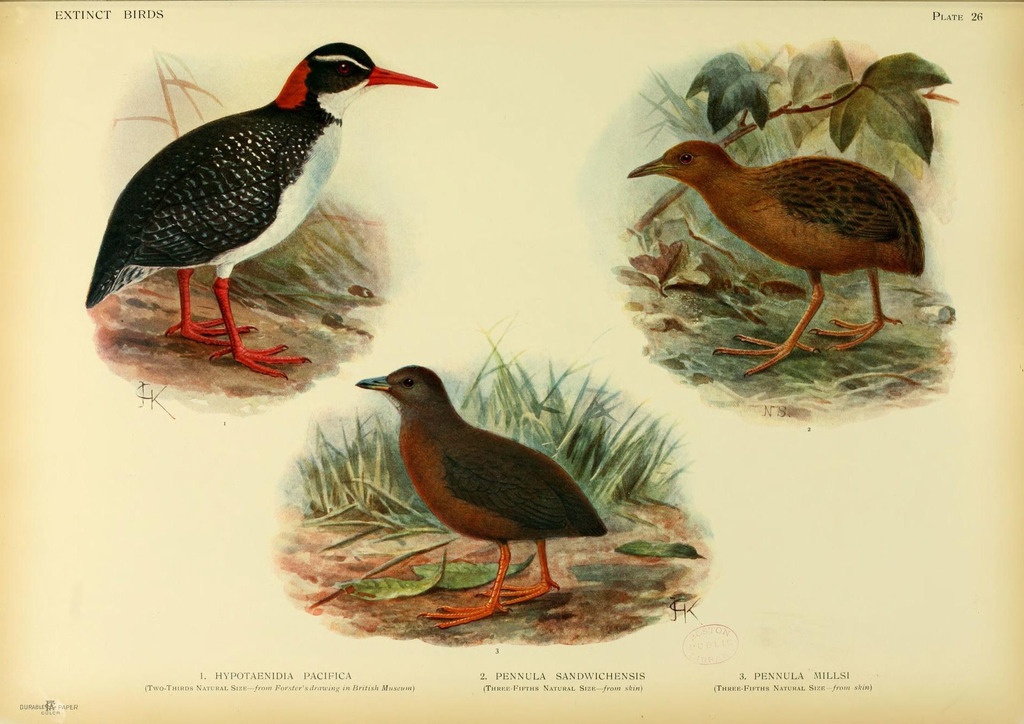
The Tahiti rail, Tahitian red-billed rail, or Pacific red-billed rail (Gallirallus pacificus) is an extinct species of rail that lived on Tahiti. It was first recorded during James Cook's second voyage around the world (1772–1775), on which it was illustrated by Georg Forster and described by Johann Reinhold Forster. No specimens have been preserved. As well as the documentation by the Forsters, there have been claims that the bird also existed on the nearby island of Mehetia. The Tahiti rail appears to have been closely related to, and perhaps derived from, the buff-banded rail, and has also been historically confused with the Tongan subspecies of that bird.
The Tahiti rail was 9 inches (23 centimetres) long, and its colouration was unusual for a rail. The underparts, throat, and eyebrow-like supercilium were white, and the upper parts were black with white dots and bands. The nape (or hind neck) was ferruginous (rust-coloured), the breast was grey, and it had a black band across the lower throat. The bill and iris were red, and the legs were fleshy pink. The Tahiti rail was supposedly flightless and nested on the ground. It is said to have been seen in open areas, marshes, and in coconut plantations. Its diet appears to have consisted mainly of insects and occasionally copra (coconut meat). The extinction of the Tahiti rail was probably due to predation by humans and introduced cats and rats. It appears to have become extinct some time after 1844 on Tahiti, and perhaps as late as the 1930s on Mehetia.
From the article Tahiti rail on Wikipedia (CC BY-SA), quoted section by section
Description
J. R. Forster stated the Tahiti rail was 9 inches (23 cm) long, which is small for a member of its genus. Its colouration was also striking and unusual for a rail and it was described as being an attractive bird. The upper parts were black with white dots and bands (also referred to as spots and bars), and the underparts, throat, and eyebrow-like supercilium were white. The nape (or hind neck) was ferruginous (rust-coloured), the breast was grey, and it had a black band across the lower throat. The bill and iris were red, and the legs were fleshy pink. The sexes were presumably similar, and the immature and juvenile were not described.
Forster's original description of the bird follows below, in a translation from Latin published by the English naturalist Walter Rothschild in 1907:
Black with white spots or bars; abdomen, throat, and eyebrow white; hind neck ferruginous; breast grey; bill blood-red; iris red. Bill straight, compressed, narrowed at the top, thicker at the base, and blood-red. The mandibles subequal, pointed; the upper slightly curved, with the tip pale fuscous; gape medium. Nostrils almost at the base of bill, linear. Eyes placed above the gape of the mouth. Iris blood-red. Feet four-toed, split, built for running, flesh-coloured. Femora semi-bare, slender, of medium length. Tibiae slightly compressed, shorter than the femora. …
What it does
The Tahiti rail was supposedly flightless, and nested on the ground. Its social behaviour is unknown. Bruner claimed to have gained information about the behaviour of the species from "the few people who still remember the bird". According to Bruner, the call of the bird was described as similar to that of other rails, though it differed in ending in a high-pitched whistle. It was said to have been seen in open areas, sometimes with other rails in marshes, and in coconut plantations. Its diet appears to have consisted mainly of insects found in grass, and it occasionally fed on copra (coconut meat). Its broken colour pattern was said to make it blend well with its surroundings, and it lacked "shyness".
Wikipedia: “Behaviour and ecology”
Listen
Looking for field recordings…
Where it lives
Recorded sightings
—
geo-referenced records in GBIF, from museums, herbaria and field observers.
Drag the globe to turn it. Dots are where records exist, not a range map; darker means more records.
In the stacks
Searching the stacks…
Every page naming Gallirallus pacificus in the Biodiversity Heritage Library →
This page is assembled live from iNaturalist, GBIF, Wikipedia, the Source Library and the Internet Archive. It is not yet part of the hand-edited codex. iNaturalist taxon 399.