- Plants
- ›Vascular Plants
- ›flowering plants
- ›Dicots
- ›Heathers, Balsams, Primroses, and Allies
- ›heath family
- ›Epacrids, Styphelias and Allies
- ›Styphelieae
- ›Acrothamnus
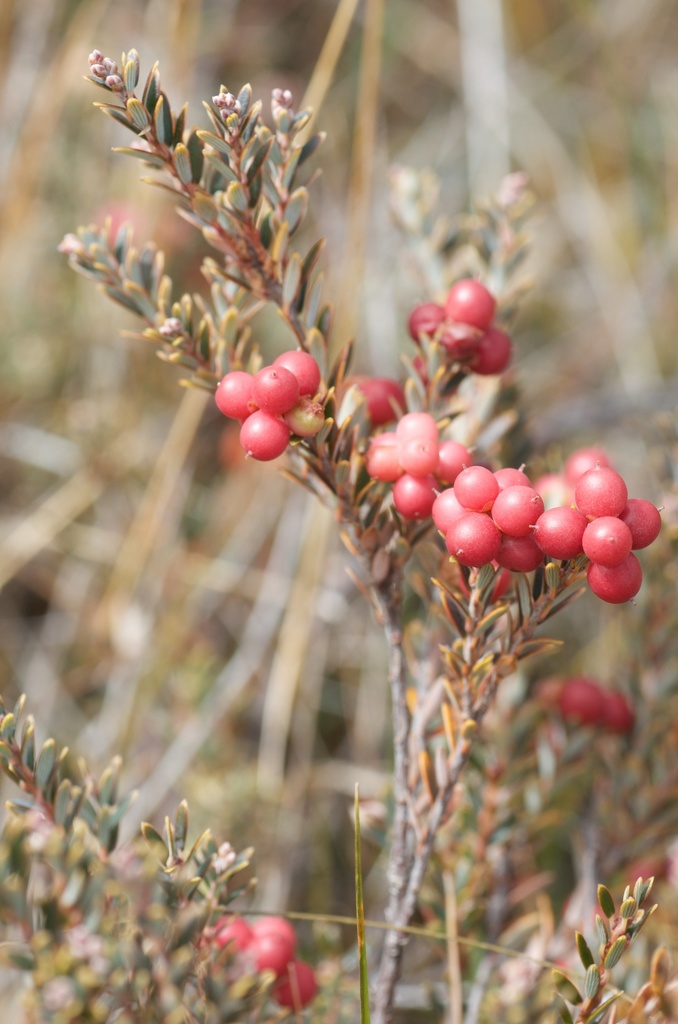
Colenso's mingimingi
Acrothamnus colensoi
Acrothamnus colensoi, also known as Colenso's mingimingi or mountain heath, is a species of plant in the family Ericaceae endemic to New Zealand. It is a small shrub that grow to approximately 50 cm tall, and can spread to form mounds of up to 2 m across. Fruit are round and are white, pink or dark red in colour. It can be found in both the lower North and eastern South Islands, in scrubland, tussock grassland, and rocky fellfield.
From the article Acrothamnus colensoi on Wikipedia (CC BY-SA), quoted section by section
Description
The species is a low-growing or prostrate shrub that is sprawling and branched, usually 40 cm tall by 60 cm across but sometimes forming patches 2 m across. The leaves are sessile or subsessile and are pinkish green to red-brown. The branches are ascending to erect, weakly ribbed and a grey-brown colour. Its berries are 4–5 mm in diameter, globose, fleshy, and glossy; colours range between white, pink, red, and crimson to almost black. Their thin flesh conceals 5 hard seeds. Its leaves are 5–10 by 1–4 mm, alternate and spreading with greenish veins and white interveinal grooves; they have 3–5 prominent parallel veins and can have a white stripe on the underside. Leaf margins are distinctively finely hairy when young, but mostly glabrous, and rolled downwards and inwards. The leaves are distinctively lozenge shaped: oblong, then narrowing to a fine point. Its honey-scented flowers are white to yellowish, and produced in clusters of 2–5 at the tips of the branches. They are subtended by two keeled bracteoles and a bract which is up to 2.5 mm long and pinkish green to red in colour. This is glaucescent, broadly ovulate, obtuse and ciliolate. The bracteoles are very similar but smaller and distinctly keeled. The sepals are up to 4 mm long and imbricate with stomata only on the adaxial surface. …
Range & habitat
A. colensoi is endemic to New Zealand. It is found in both main islands, from the central North Island to Otago. In the South Island it can be found in drier eastern mountains of Marlborough and Canterbury, locally in Otago and rarely in northern Southland. Its habitat is generally montane to low-alpine (600–1600 m), extending to lower altitudes in the southern part of its range. It prefers well-drained sites in shrubland, tussock grassland, and rocky outcrops.
Wikipedia: “Distribution and habitat”
What it does
This species flowers from September to February and begins fruiting in November, ending in June. The berries are fleshy and eaten by birds, reptiles and invertebrates (although hardly palatable to humans); the leaves and flowers are very rarely eaten.
Wikipedia: “Ecology”
Where it lives
Recorded sightings
—
geo-referenced records in GBIF, from museums, herbaria and field observers.
Drag the globe to turn it. Dots are where records exist, not a range map; darker means more records.
In the stacks
Searching the stacks…
Every page naming Acrothamnus colensoi in the Biodiversity Heritage Library →
This page is assembled live from iNaturalist, GBIF, Wikipedia, the Source Library and the Internet Archive. It is not yet part of the hand-edited codex. iNaturalist taxon 399383.