- Animals
- ›Chordates
- ›Vertebrates
- ›Reptiles
- ›Turtles and Tortoises
- ›Eurasian Pond, River, and Neotropical Wood Turtles
- ›Geoemydinae
- ›Morenia
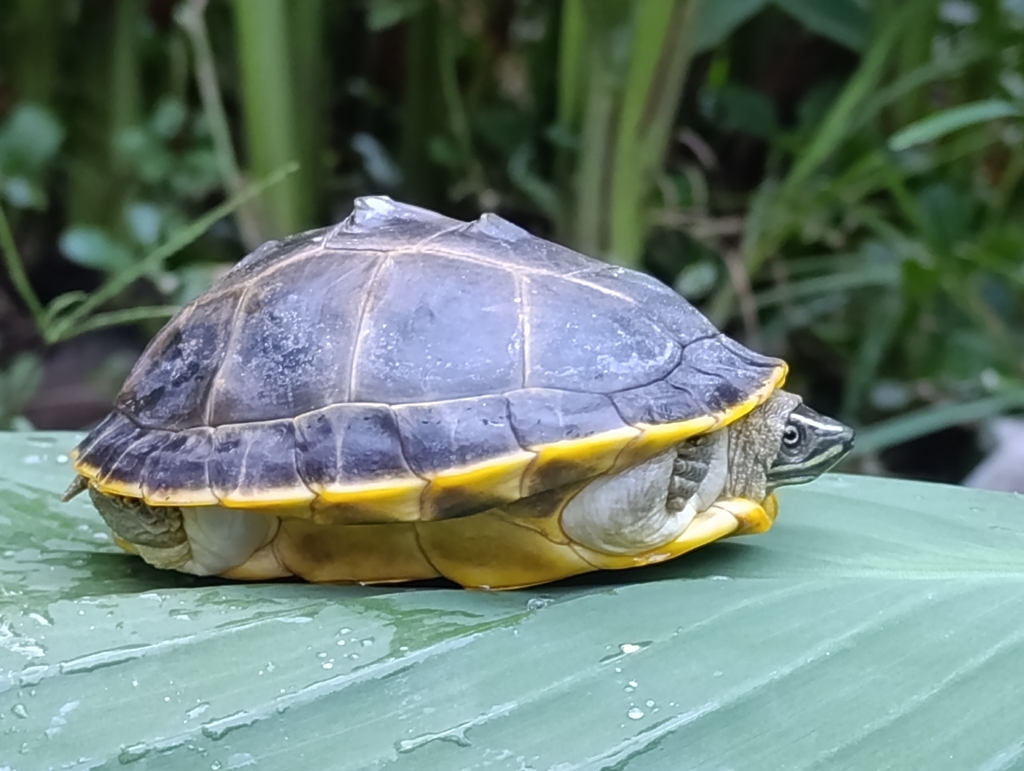
Indian Eyed Turtle
Morenia petersi
The Indian eyed turtle (Morenia petersi) is a species of turtle in the family Geoemydidae. The species is endemic to South Asia.
From the article Indian eyed turtle on Wikipedia (CC BY-SA), quoted section by section
Description
M. petersi is very closely allied to Morenia ocellata. The snout is much more pointed and relatively longer. The suture between the pectorals is not shorter than the suture between the abdominals. The carapace is black. Each vertebral has a narrow yellowish mesial line. The last four vertebrals have a yellowish linear horseshoe mark with both ends directed forward. All costals have an ocellus placed rather low and formed by a narrow yellowish line, above which are some irregular looped lines of similar colour. The nuchal and each marginal have a narrow, vertical yellowish mesial streak. The plastron is yellow. Three yellow streaks are on each side of the head, the lower one extending from below the nostril to the angle of the mouth. Males can achieve a carapace length up to 5 in (about 12 cm); females can achieve a shell length up to 8 in (about 20 cm). Type locality: Huzurapur (Jessore District), Faridpur, and Dhaka, Bangladesh
Range & habitat
M. petersi is found in northeastern India (as far west as Bihar) and in Bangladesh.
Wikipedia: “Geographic range”
What it does
Mating of M. petersi occurs in the winter months, and nesting follows in April–May. A clutch is made up of two eggs 34.6–35 mm x 22 mm (1.4 in x 0.9 in).
Wikipedia: “Reproduction”
In human culture
The specific name, petersi, is in honour of German herpetologist Wilhelm Peters (1815–1883).
Wikipedia: “Etymology”
Where it lives
Recorded sightings
—
geo-referenced records in GBIF, from museums, herbaria and field observers.
Drag the globe to turn it. Dots are where records exist, not a range map; darker means more records.
In the stacks
Searching the stacks…
Every page naming Morenia petersi in the Biodiversity Heritage Library →
This page is assembled live from iNaturalist, GBIF, Wikipedia, the Source Library and the Internet Archive. It is not yet part of the hand-edited codex. iNaturalist taxon 39956.