- Plants
- ›Vascular Plants
- ›flowering plants
- ›monocots
- ›grasses, sedges, cattails, and allies
- ›grasses
- ›Pooideae
- ›Poeae
- ›Anthoxanthinae
- ›Anthoxanthum
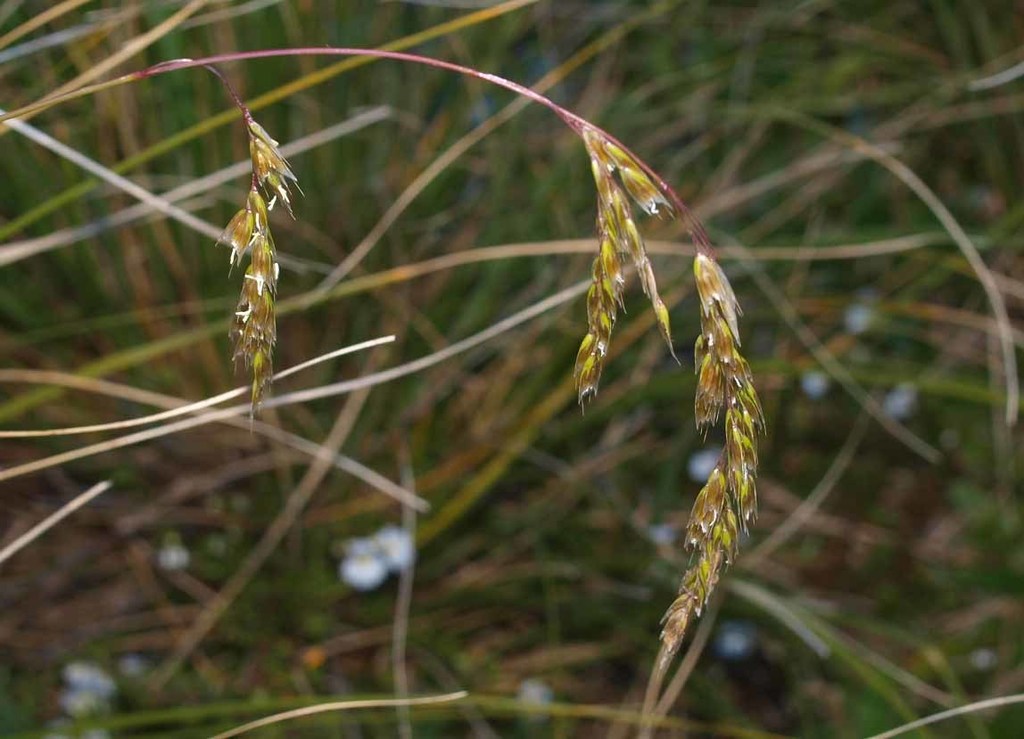
Karetu
Anthoxanthum redolens
Anthoxanthum redolens, also known as holy grass, kāretu (Te Reo Māori), and cinnamon grass (Falkland Islands), is a species of grass native mostly to the Southern Hemisphere, as well as Ecuador. It was originally described as Holcus redolens by Martin Vahl in 1791 from a specimen collected in Tierra del Fuego.
From the article Anthoxanthum redolens on Wikipedia (CC BY-SA), quoted section by section
Description
A. redolens is a perennial, tufted grass with 8-45 cm long, 5-12 mm wide aromatic leaf-blades. The culms are 36-100 cm tall bearing compound panicle inflorescences. The spikelets are solitary on 1-7 mm pedicels. Plants in New Zealand differ from plants in South America, the Falklands, and Tierra del Fuego. In all cases, the spikelets are 3-flowered. In New Zealand, they comprise an upper hermaphrodite floret, surrounded by two male florets. However, in South American plants, this upper floret is female, with two pollen-sterile anthers. From other native New Zealand Anthoxanthum species, A. redolens differs in that the hermaphrodite floret is normally awned. The awns of the male florets are inserted near the lemma base and are normally straight.
Range & habitat
A. redolens is indigenous to New Zealand, Australia, New Guinea, Argentina, Chile, the Falkland Islands, Bolivia, Peru, and Ecuador.
New Zealand. In New Zealand, it is found in the North, South, Three Kings, Campbell, and Chatham Islands.
Australia. In Australia, it is found in New South Wales, Victoria, and Tasmania. Peru, Bolivia, and Ecuador In Peru, it is found at 3,300-4,400 metres above sea level in the Andes and the Puna. However, some authors regard plants from Peru, Bolivia, and Ecuador as not fitting with the southern South American plants, possibly warranting recognition as separate species.
Wikipedia: “Distribution”
What it does
In New Zealand, A. redolens sometimes grows on the 'trunks' produced by the large wetland sedge Carex secta.
Parasites. A. redolens is a host to numerous species of fungi and virus. It hosts fungi such as the rusts Uredo karetu and Puccinia graminis; the leaf-spot fungus Lophodermium gramineum; and sac fungi Mycosphaerella recutita and Pyrenophora chaetomioides. It also hosts a previously undiscovered Luteovirus. Of these, Uredo karetu is so far known only on A. redolens.
Herbivores. Prior to the evacuation of kakapō from the mainland South Island, A. redolens was recorded as one of its food plants, with kakapō eating its shoots. A. redolens is also eaten by cattle and sheep. Other A. redolens is used by Magellanic penguins on Martillo Island, Argentina for lining nesting burrows, producing bare pedestals made of tufts where leaves have been removed. The species epithet redolens may be a transliteration of its common name in Chile, ratonera, which translates to "mousetrap", which comes from larger plants being used by rodents as nests.
Wikipedia: “Ecology”
In human culture
Anthoxanthum - From the Greek anthos meaning flower and xanthum meaning yellow, referring to the colour of the panicles. redolens: from the Latin redoleo, meaning to give off odour. Or possibly as a transliteration of its common name in Chile, ratonera, which translates to "mousetrap", which comes from larger plants being used by rodents as nests.
== References ==
Wikipedia: “Etymology”
Where it lives
Recorded sightings
—
geo-referenced records in GBIF, from museums, herbaria and field observers.
Drag the globe to turn it. Dots are where records exist, not a range map; darker means more records.
In the stacks
Searching the stacks…
Every page naming Anthoxanthum redolens in the Biodiversity Heritage Library →
This page is assembled live from iNaturalist, GBIF, Wikipedia, the Source Library and the Internet Archive. It is not yet part of the hand-edited codex. iNaturalist taxon 399605.