- Plants
- ›Vascular Plants
- ›flowering plants
- ›Dicots
- ›Heathers, Balsams, Primroses, and Allies
- ›heath family
- ›Epacrids, Styphelias and Allies
- ›Archerieae
- ›Archeria
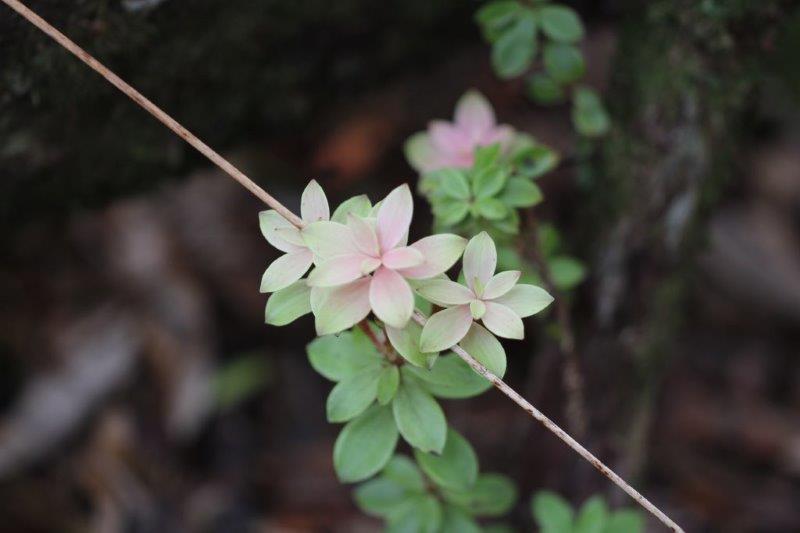
Archeria racemosa
Archeria racemosa is a species of shrub in the heath family (Ericaceae).
From the article Archeria racemosa on Wikipedia (CC BY-SA), quoted section by section
Description
Habit An erect shrub, to 5 m tall but often much shorter. It has spreading branches, with leaves that tend to cluster towards the ends of the branches. The bark is dark brown to black in colour. Leaves Broad leathery leaves that are obovate to elliptic-oblong in shape, often with sharp tips (acute to apiculate). The base of the leaf is rigid and nearly sessile, attached to the stem with a short and flat petiole. Dimensions are roughly 25–40 mm long and 8–12 mm wide. Leaf margins are entire, and flat to slightly recurved. Prominent venation can be seen on the abaxial sides of some leaves (3-5 veined), but this is indistinct on others. When crushed the leaves have an almost pungent smell at times. Inflorescence A solitary terminal raceme, with 10-20(30) flowers, ranging from 25 to 45 mm in length. The axis is pubescent, with short curved pedicels. Bracts are light red to pinkish, ciliolate, and caducous. Flowers & Fruits The flowers are perfect, small, urn shaped, and white to bright pink in colour (often lighter at the base and darkening towards the corolla lobes). The sepals are almost free, roughly 2–3 mm long, oblong-lanceolate, and blunt with ciliolate margins. The corolla is around 6 mm long, with the tube making up 4 mm and the lobes the other 2 mm. Ovary is deeply 5-lobed, with a stout persistent style. Capsules are 2–3 mm in diameter, subglobose, with 3-5 locules. …
Wikipedia: “Morphology”
Range & habitat
A. racemosa currently occupies a rather restricted range in northern New Zealand (where it is endemic), being found scattered throughout Little Barrier Island, Great Barrier Island, the Coromandel Peninsula, and from the Bay of Plenty across to East Cape.
Wikipedia: “Distribution”
What it does
It is largely found in shrublands and forest margins, at lowland to montane altitudes. Flowering takes place from December to January, and fruiting from February to April.
Wikipedia: “Ecology”
In human culture
The phylogeny of the genus remains unknown, but morphologically A. racemosa appears to most closely resemble A. traversii, the only other New Zealand species in the genus.
Wikipedia: “Evolutionary history”
Where it lives
Recorded sightings
—
geo-referenced records in GBIF, from museums, herbaria and field observers.
Drag the globe to turn it. Dots are where records exist, not a range map; darker means more records.
In the stacks
Searching the stacks…
Every page naming Archeria racemosa in the Biodiversity Heritage Library →
This page is assembled live from iNaturalist, GBIF, Wikipedia, the Source Library and the Internet Archive. It is not yet part of the hand-edited codex. iNaturalist taxon 399620.