- Plants
- ›Vascular Plants
- ›flowering plants
- ›Dicots
- ›Roses, Elms, Figs, and Allies
- ›Nettle Family
- ›Boehmeria
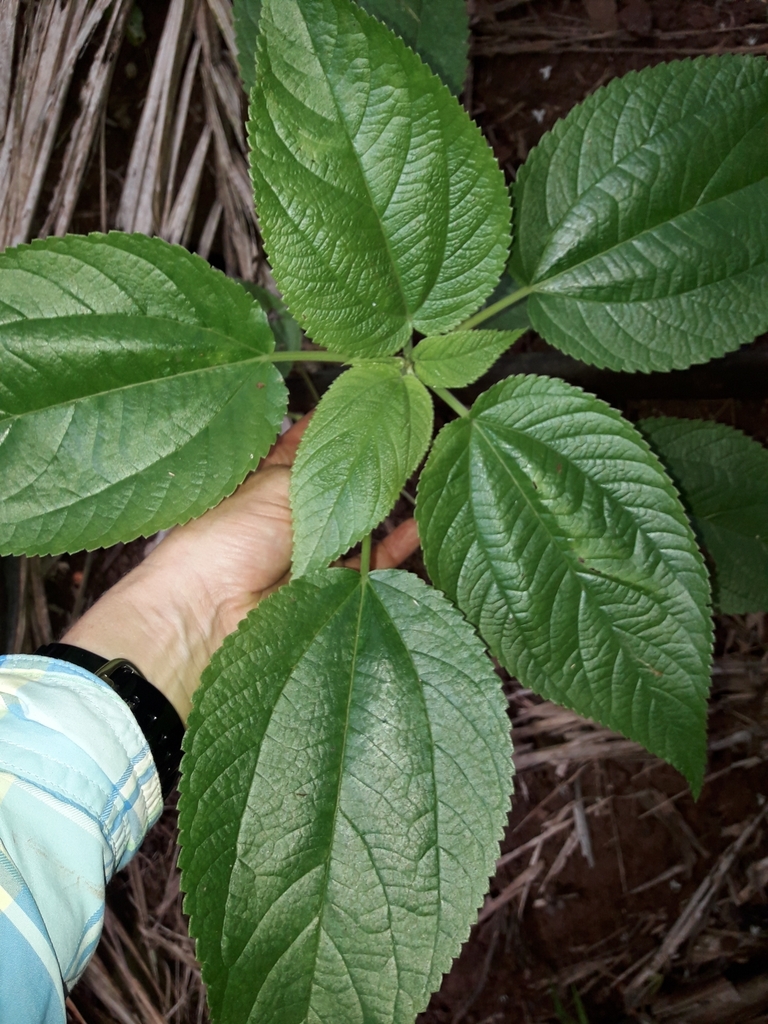
Nettle Tree
Boehmeria australis
Pouzolzia australis, synonyms including Boehmeria australis and Boehmeria calophleba, is a species of large shrub or small tree in the plant family Urticaceae. It is endemic to small islands belonging to Australia and New Zealand – Norfolk Island, Lord Howe Island, and the Kermadec Islands. The population on Norfolk island, sometimes treated as a distinct subspecies, is critically endangered. In the Kermadec Islands, it was described in 2018 as "threatened – nationally endangered".
From the article Pouzolzia australis on Wikipedia (CC BY-SA), quoted section by section
Description
Pouzolzia australis is a shrub or small tree 1–8 m (3–26 ft) tall, densely branched and with a spreading crown. The leaves are alternate, typically 6–20 mm (0.2–0.8 in) long by 3–10 mm (0.1–0.4 in) wide, with a relatively long petiole. The leaves may be of two distinct sizes, with the larger leaves about 1.5 times as long as the smaller ones. The upper surface of the leaves is glabrous or with only scattered hairs, the lower surface has dense white or greyish tomentum, absent from the main veins and often even from smaller ones. Fine short hairs project through the tomentum. The inflorescences consist of axillary clusters up to 10 mm (0.4 in) across, each with a few or more than 50 small flowers; the clusters may be almost continuous along the stem. Each flower is either male or female; the clusters of flowers may have only one kind of flower or be mixed. Male flowers have parts in fours. Female flowers are larger, about 1.3–2 mm (0.05–0.08 in) long by 0.3–0.6 mm (0.01–0.02 in) wide. The style is 2–8 mm (0.1–0.3 in) long, persisting into fruiting. The fruits are flattened ovoids with a long beak, and marginal wings up to a third of the width of the fruit. The seeds are shiny light brown, easily detaching when mature. Plants found on Lord Howe Island can be distinguished from those found on Norfolk Island. …
Range & habitat
In 2003, only about 33 mature plants were known from Norfolk Island, where it is regarded as "critically endangered". Plants grow rapidly and have a short lifespan. In the Kermadec Islands, it is now known only from Raoul Island and Macauley Island, and in 2018 was described as "threatened – nationally endangered". On Lord Howe Island, the species is generally uncommon, but is locally abundant in the moist forests of the southern parts of the island, where it forms an association with Piper species on the north-western slopes of Mount Lidgbird.
Wikipedia: “Distribution and conservation”
Where it lives
Recorded sightings
—
geo-referenced records in GBIF, from museums, herbaria and field observers.
Drag the globe to turn it. Dots are where records exist, not a range map; darker means more records.
In the stacks
Searching the stacks…
Every page naming Boehmeria australis in the Biodiversity Heritage Library →
This page is assembled live from iNaturalist, GBIF, Wikipedia, the Source Library and the Internet Archive. It is not yet part of the hand-edited codex. iNaturalist taxon 400044.