- Animals
- ›Chordates
- ›Vertebrates
- ›Reptiles
- ›Turtles and Tortoises
- ›Eurasian Pond, River, and Neotropical Wood Turtles
- ›Geoemydinae
- ›Heosemys
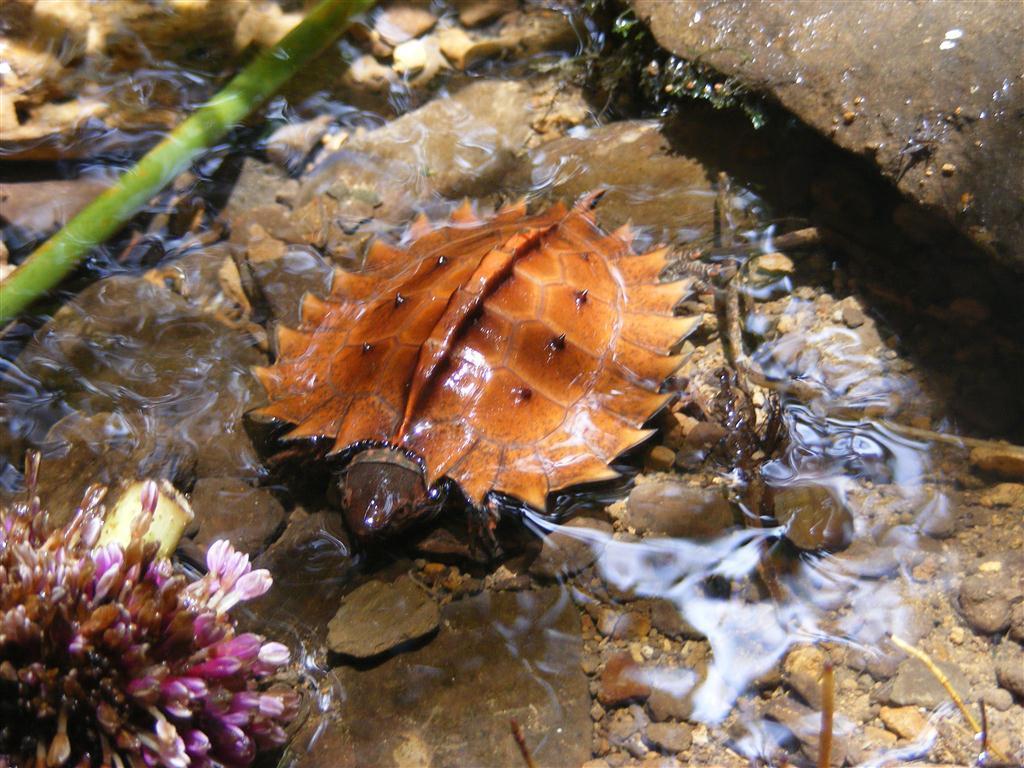
Spiny Terrapin
Heosemys spinosa
The spiny turtle (Heosemys spinosa) is a South-East Asian turtle species. It inhabits lowland and hill rainforest, usually dwelling in the vicinity of small streams in hill areas up to 1,000 m above sea level. It is found in Brunei, Indonesia, Malaysia, Myanmar, India, the Philippines, Singapore, and Thailand.
From the article Spiny turtle on Wikipedia (CC BY-SA), quoted section by section
Description
The spiny turtle is a medium-sized tortoise with a brown shell and red-spotted head. Also known as the "cog-wheel turtle," it derives its name from its spiky-edged carapace, marginal scutes, and spiny keel. As juvenile spiny turtles become adults, the black striped and yellow underside of their shell fades in color. In addition, the juveniles' serrations, or jagged edges, at the carapace margin decrease in size and become restricted to the carapace's rear margin. These changes of the spine and carapace serve as evolutionary adaptations attempting to prevent predators from preying on juvenile turtles.
Range & habitat
The spiny turtle is known from Brunei, Indonesia, Malaysia, Myanmar, the Philippines, Singapore, and Thailand. It lives along brooks in forested areas, usually in mountains with altitudes of 170 m to 1,000 m above sea level.
Wikipedia: “Distribution”
What it does
The spiny turtle buries itself in leaf litter to camouflage during the day and only emerges at night, foraging for food.
While often portrayed as a herbivore, the spiny turtle also eats carrion and insects alongside fruits and plants. Fruit from the yin-ngan tree is especially important for the turtle, and in Myanmar, the turtle often dwells beneath these trees when the trees are fruiting. Similarly, captive juvenile spiny turtles consume fruit salads multiple times a week, particularly those containing tomatoes. At the Kubah National Park in Sarawak, analysis of fecal content revealed the turtles' role as seed dispersal agents, for their fecal matter contained five different seed types. Arthropods and hair were also found in the samples, suggesting consumption of mammals and other animals.
Wikipedia: “Behavior”
Where it lives
Recorded sightings
—
geo-referenced records in GBIF, from museums, herbaria and field observers.
Drag the globe to turn it. Dots are where records exist, not a range map; darker means more records.
In the stacks
Searching the stacks…
Every page naming Heosemys spinosa in the Biodiversity Heritage Library →
This page is assembled live from iNaturalist, GBIF, Wikipedia, the Source Library and the Internet Archive. It is not yet part of the hand-edited codex. iNaturalist taxon 40005.