- Plants
- ›Vascular Plants
- ›flowering plants
- ›Dicots
- ›Sunflowers, Bellflowers, Fanflowers, and Allies
- ›Sunflowers, Daisies, Asters, and Allies
- ›Asteroideae
- ›asters and allies
- ›Celmisiinae
- ›Celmisia
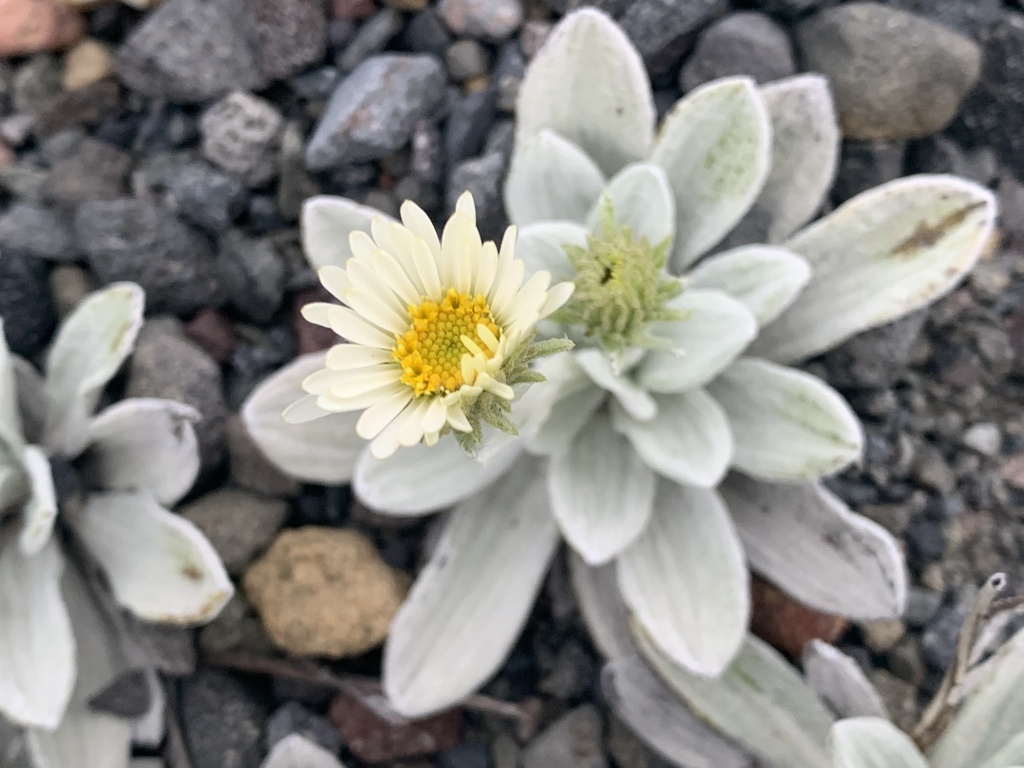
White Mountain Daisy
Celmisia incana
Celmisia incana, commonly known as white mountain daisy, is a species of perennial alpine plant of the family Asteraceae, and is native to New Zealand.
From the article Celmisia incana on Wikipedia (CC BY-SA), quoted section by section
Description
Celmisia incana is a perennial plant with stout woody stems up to about 100 mm (3.9 in) in diameter, with leathery, egg-shaped to oblong leaves 20–40 mm (0.79–1.57 in) long and 10–15 mm (0.39–0.59 in) wide on a petiole up to 5 mm (0.20 in) wide, arranged in close rosettes. The leaves are densely covered with woolly white hairs pressed against the surface. The flowers are borne on a slender scape up to 120 mm (4.7 in) long and densely covered with woolly hairs. The heads or daisy-like "flowers" are 25–35 mm (0.98–1.38 in) in diameter with many linear to tapering involucral bracts 10–15 mm (0.39–0.59 in) long at the base. Each head has narrow white ray florets, up to about 12 mm (0.47 in) long, surrounding funnel shaped disc florets 7–8 mm (0.28–0.31 in) long. Flowering occurs from September to March and the fruit is a flattened cylindrical achene 3.0–3.5 mm (0.12–0.14 in) long with narrowly triangular teeth, the pappus white 7–8 mm (0.28–0.31 in) long with minute barbed hairs.
Range & habitat
White mountain daisy grows in montane to alpine grassland from the Moehau Range on the Coromandel Peninsula of the North Island to Otago on the South Island of New Zealand.
== References ==
Wikipedia: “Distribution and habitat”
Where it lives
Recorded sightings
—
geo-referenced records in GBIF, from museums, herbaria and field observers.
Drag the globe to turn it. Dots are where records exist, not a range map; darker means more records.
In the stacks
Searching the stacks…
Every page naming Celmisia incana in the Biodiversity Heritage Library →
This page is assembled live from iNaturalist, GBIF, Wikipedia, the Source Library and the Internet Archive. It is not yet part of the hand-edited codex. iNaturalist taxon 400573.