- Plants
- ›Vascular Plants
- ›flowering plants
- ›Dicots
- ›pinks, cactuses, and allies
- ›four o'clock family
- ›Ceodes
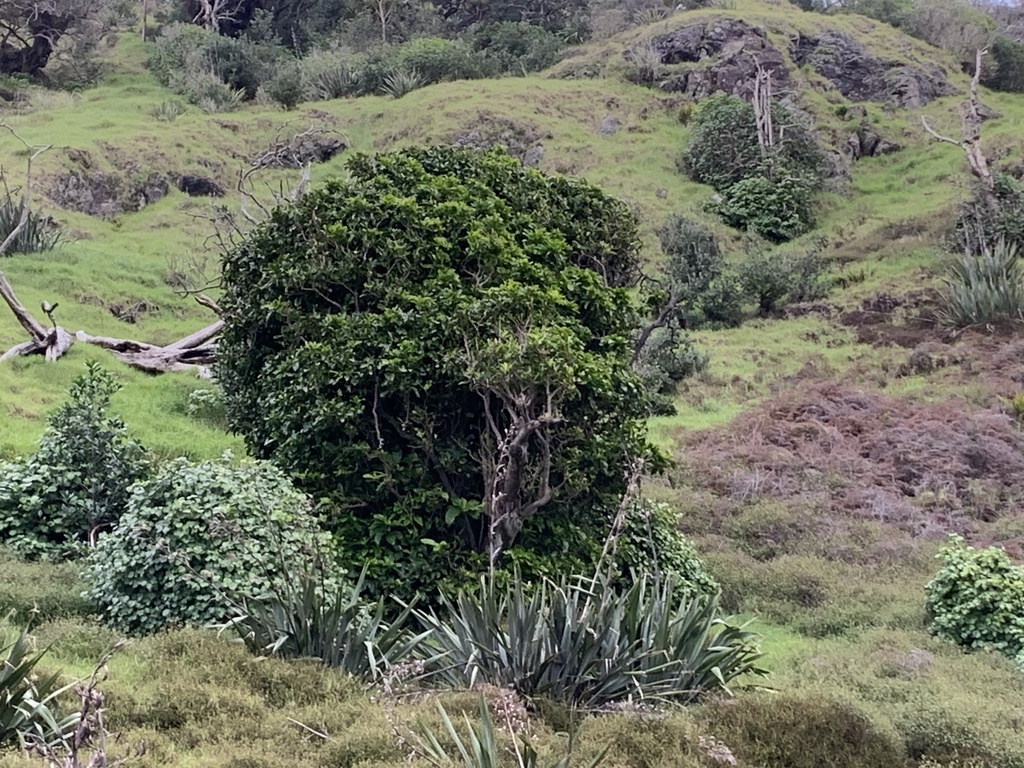
Bird Catcher Tree
Ceodes brunoniana
Ceodes brunoniana (synonym Pisonia brunoniana) is a species of flowering tree in the family Nyctaginaceae that is native to northern New Zealand, Australia's Lord Howe Island, and the Hawaiian Islands. The common names in New Zealand are parapara or birdcatcher tree. The plant is named after the botanist Robert Brown.
From the article Ceodes brunoniana on Wikipedia (CC BY-SA), quoted section by section
Description
Ceodes brunoniana is a small tree, spreading to 6 metres (20 ft) or more tall. The wood is soft and the branches are brittle. The large leaves are opposite or ternate, glabrous, and glossy, entire (simple with smooth margins), and obtuse to rounded at apex. The inflorescence is paniculate, many-flowered, and the flowers are unisexual. The very sticky fruits, in which small birds are often trapped, are narrowly ellipsoidal, and 2–3 centimetres (0.79–1.18 in) long, having five ribs. In the Seychelles, the sticky seeds of a related species, Pisonia grandis, regularly causes seabird deaths, and research suggests that the seeds evolved to be transferred on the plumage of seabirds to distant islands, enabling the long-distance dispersal of the species. The situation may be similar with P. brunoniana.
Range & habitat
In New Zealand, Ceodes brunoniana grows in coastal forest on Raoul Island in the Kermadec group, on the Three Kings Islands, and in the North Island in scattered locations from Whangape Harbour to Mangawhai. Historically, it grew near Auckland, on the Coromandel Peninsula and at East Cape. It is now mainly found on offshore islands, especially rodent-free islands, where it often forms an important understorey component of mixed-broadleaf forest. The plant is almost extinct in the North Island, partly because the large leaves of C. brunoniana are eagerly eaten by browsing animals such as possums, goats and feral cattle. The plant is reasonably common in cultivation as a decorative tree in New Zealand, especially in the northern North Island. Two variegated cultivars are sold as C. brunoniana in New Zealand nurseries, although one of these, which has leaves extensively marbled with white, may in fact be C. umbellifera, a similar species which occurs throughout the tropical Indo-Pacific.
Wikipedia: “Distribution in New Zealand”
Where it lives
Recorded sightings
—
geo-referenced records in GBIF, from museums, herbaria and field observers.
Drag the globe to turn it. Dots are where records exist, not a range map; darker means more records.
In the stacks
Searching the stacks…
Every page naming Ceodes brunoniana in the Biodiversity Heritage Library →
This page is assembled live from iNaturalist, GBIF, Wikipedia, the Source Library and the Internet Archive. It is not yet part of the hand-edited codex. iNaturalist taxon 400629.