- Plants
- ›Vascular Plants
- ›flowering plants
- ›monocots
- ›Agaves, Orchids, Irises, and Allies
- ›Aloe family
- ›daylilies and allies
- ›Dianella
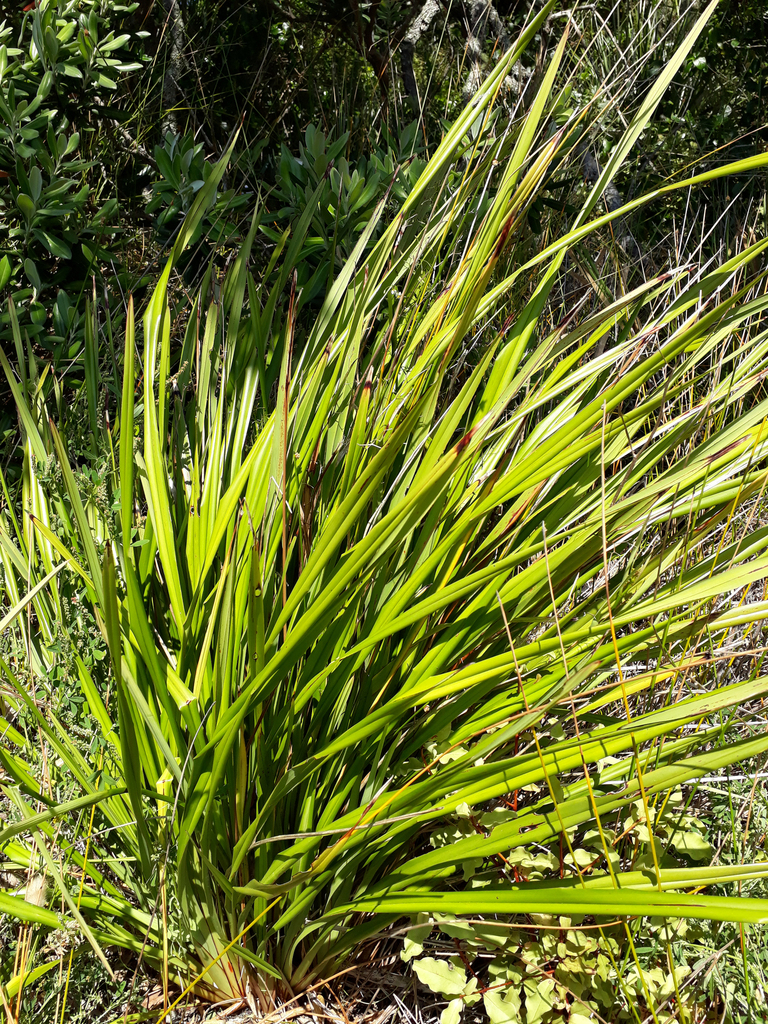
Dianella latissima
Dianella latissima, commonly known as blueberry and ink berry, is a species of flowering plant in the family Asphodelaceae. It is endemic to New Zealand; its range mainly covers the northern North Island. It grows in coastal to montane environments. The species was first described in 2007 by Peter de Lange and Peter Brian Heenan. A perennial herb, the species has long leaves and exposed inflorescences (flower clusters). The conservation status of D. latissima was assessed by the New Zealand Threat Classification System in 2023 as "Not Threatened".
From the article Dianella latissima on Wikipedia (CC BY-SA), quoted section by section
Description
Dianella latissima is a species of perennial herb in the family Asphodelaceae and the subfamily Hemerocallidoideae. It is evergreen, dense, tussock-like with horizontal rhizomes up to 100 mm long. Leaves are 0.5–1.2 metres (1 foot 8 inches – 3 feet 11 inches) long and 15–35 millimetres (0.59–1.38 inches) wide. They are green to light green, curved and hanging, with smooth, glossy blades. Leaf bases are pale green to yellow-green in colour. The inflorescences (flower clusters) can rise 1–1.5 m (3 ft 3 in – 4 ft 11 in) above the foliage. The panicles are 500–800 mm (20–31 in) long. Flowers are 9–11 mm in diameter. The sepals are 4.4–4.5 × 1.6–1.7 mm long. The glossy berries are 8–20 × 7–10 mm long, initially coloured grey-white or dull, then ripening to a violet-blue colour. The typically violet-blue colour of the berries of the Dianella genus is attributed to the anthocyanins and pigments in them. D. latissima's seeds are about 1.8–2.1 × 2.3–3.0 mm long.
Range & habitat
Dianella latissima is endemic to New Zealand. It is mainly found in the northern North Island, but also occurs on some offshore islands, such as the Hen and Chickens Islands, and islands in the Hauraki Gulf such as Little Barrier, Great Barrier, Ponui, and Pakihi. The conservation status of D. latissima was assessed by the New Zealand Threat Classification System in 2023 as "Not Threatened".
Habitat. Dianella latissima is found in coastal to montane environments. It commonly associates with kauri (Agathis australis).
Wikipedia: “Distribution”
What it does
Dianella latissima's pollination strategy is unknown, but its relative D. tasminca has a cleistogamy pollination strategy, and the flowers are capable of self-pollinating. The berries of D. latissima are dispersed by fruit-eating animals (frugivores).
Wikipedia: “Ecology”
In human culture
The etymology (word origin) of D. latissima's genus name, Dianella, refers to the Roman goddess of the chase Diana. The specific epithet (second part of the scientific name), latissima, refers to the wide leaves which are the largest of the New Zealand species. The species is commonly known as blueberry and inkberry.
Wikipedia: “Etymology”
Where it lives
Recorded sightings
—
geo-referenced records in GBIF, from museums, herbaria and field observers.
Drag the globe to turn it. Dots are where records exist, not a range map; darker means more records.
In the stacks
Searching the stacks…
Every page naming Dianella latissima in the Biodiversity Heritage Library →
This page is assembled live from iNaturalist, GBIF, Wikipedia, the Source Library and the Internet Archive. It is not yet part of the hand-edited codex. iNaturalist taxon 401349.