- Plants
- ›Vascular Plants
- ›flowering plants
- ›Dicots
- ›Sunflowers, Bellflowers, Fanflowers, and Allies
- ›Sunflowers, Daisies, Asters, and Allies
- ›Asteroideae
- ›Chamomiles, yarrows, and allies
- ›Cotulinae
- ›Leptinella
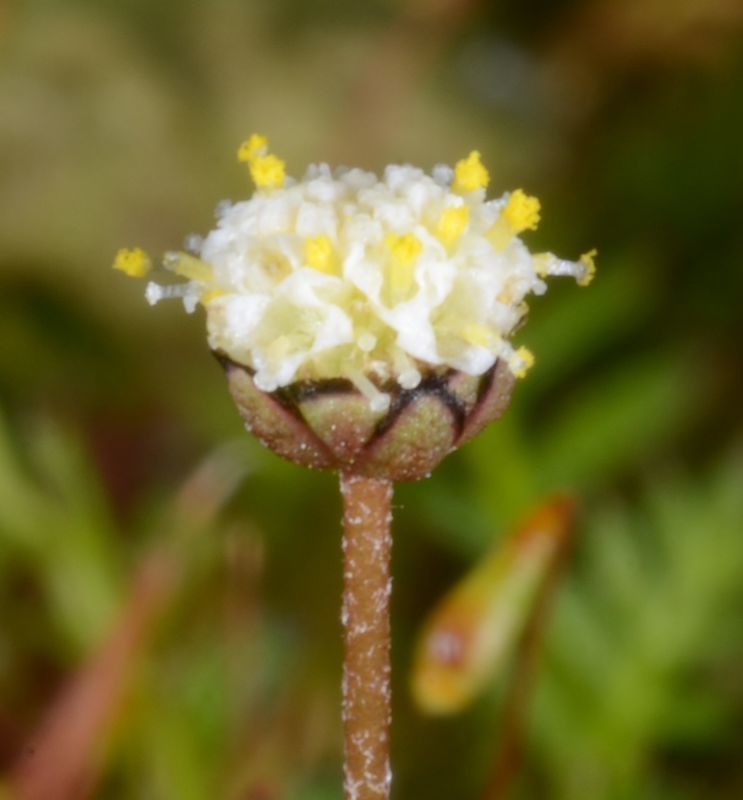
Leptinella filiformis
Leptinella filiformis, or slender button daisy, is a species of flowering plant in the daisy family, found only in the north-eastern part of the South Island of New Zealand. Thought to be extinct by the 1980s, it was rediscovered growing on a Hanmer Springs hotel lawn in 1998, and in the wild in 2015.
From the article Leptinella filiformis on Wikipedia (CC BY-SA), quoted section by section
Description
A creeping perennial, L. filiformis forms a low mat, spreading indefinitely via thin rhizomes on the soil surface. It has small green or brown feathery leaves, up to 2 cm (0.8 in) long. Its flowers are small (2–3 mm (0.08–0.12 in)) white button-shaped inflorescences on thin stalks.
Range & habitat
This species is known only from Marlborough and Canterbury in the northeast South Island. Although initially recorded from the Canterbury Plains, no further specimens were collected there. In 1919, Cockayne wrote: Cotula filiformis until a year or two ago had been seen by no living New Zealand botanist, though it was known that Haast collected it on the Canterbury Plain. Thanks, however, to its rediscovery by Mr C.E. Christensen [in 1912], it has since proved to be fairly common on the Hanmer Plain. L. filiformis had around the same time been found by Cockayne in the Awatere Valley, Marlborough. Subsequent collections were from these two areas: the plain in the Hanmer Valley, Canterbury (and one specimen from Culverden, 40 km (25 mi) away), and the Awatere Valley around Molesworth Station. This species prefers open bare ground with little other vegetation. It grows in grassland and open shrub land on basins, plains, and dry alluvial river terraces up to 600 m (2,000 ft) above sea level. Field observations suggested it grew best in areas of bare ground created by excessive numbers of rabbits; when rabbits were removed, L. filiformis was swamped by returning vegetation.
Wikipedia: “Distribution and habitat”
Where it lives
Recorded sightings
—
geo-referenced records in GBIF, from museums, herbaria and field observers.
Drag the globe to turn it. Dots are where records exist, not a range map; darker means more records.
In the stacks
Searching the stacks…
Every page naming Leptinella filiformis in the Biodiversity Heritage Library →
This page is assembled live from iNaturalist, GBIF, Wikipedia, the Source Library and the Internet Archive. It is not yet part of the hand-edited codex. iNaturalist taxon 403338.