- Plants
- ›Vascular Plants
- ›flowering plants
- ›Dicots
- ›borages
- ›borage family
- ›Cynoglossoideae
- ›Myosotideae
- ›Myosotis
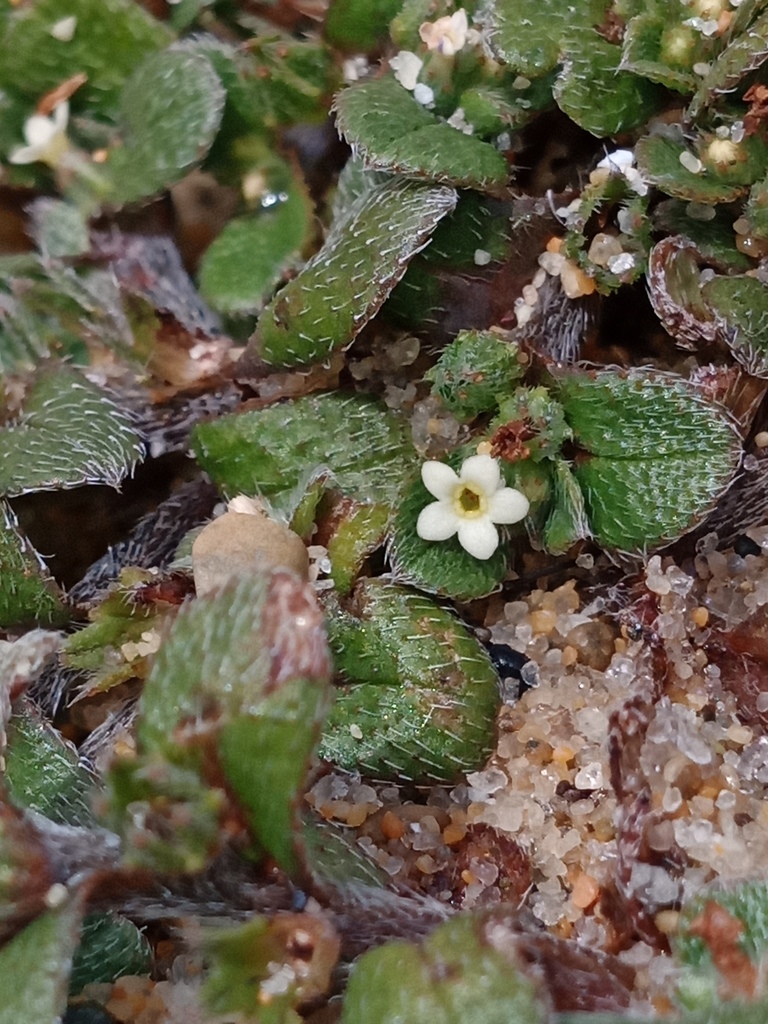
Myosotis antarctica
Myosotis antarctica is a species of flowering plant in the family Boraginaceae, native to mainland New Zealand, Campbell Island and southern Chile. Joseph Dalton Hooker described the species in his 19th century work Flora Antarctica. Plants of this species of forget-me-not are perennial with a prostrate habit, bracteate inflorescences, and white or blue corollas. It is one of two native species of Myosotis in the New Zealand subantarctic islands, the other being M. capitata, which also has blue corollas.
From the article Myosotis antarctica on Wikipedia (CC BY-SA), quoted section by section
Description
Myosotis antarctica plants are single rosettes. The rosette leaves have petioles 1–20 mm long. The rosette leaf blades are 3–26 mm long by 1–11 mm wide (length: width ratio usually 1.0–4.0: 1), narrowly oblanceolate to very broadly obovate, widest at or above the middle, green or brown, with an obtuse apex. The upper surface of the leaf is densely covered in curved or flexuous, patent to erect, evenly-distributed antrorse (forward-facing) hairs, whereas the lower surface of the leaf is similar but with fewer hairs (ranging from glabrous to with sparsely distributed hairs). The hairs on the leaf edges are appressed to spreading. Each rosette has multiple prostrate, bracteate inflorescences that are usually up to 15 cm long (rarely up to 31 cm long). The cauline leaves are similar in size and shape to the rosette leaves and usually sessile. Each inflorescence has up to 46 flowers, each borne on a very short pedicel, with a bract. The calyx is 1–4 mm long at flowering and 2–7 mm long at fruiting, lobed to one-third to three-quarters its length, and hairs that are sometimes of two different lengths and types. The corolla is white, cream, or blue, up to 4 mm in diameter, with a cylindrical tube, and small yellow scales alternating with the petals. The anthers are very short (usually < 0.3 mm long) and fully included. …
Range & habitat
Myosotis antarctica is a forget-me-not native to New Zealand, Campbell Island, and southern Chile (Magallanes) from 0–2200 m ASL. In mainland New Zealand, it is found in the following islands and ecological districts: North Island (Auckland, Taranaki, Gisborne, Volcanic Plateau, Southern North Island), South Island (Western Nelson, Sounds-Nelson, Marlborough, Westland, Canterbury, Otago, Southland, Fiordland) and Stewart Island (Rakiura). M. antarctica is found in habitats ranging from coastal to subalpine, including on turfs, dunes, fellfields, scree, cliff faces, and terraces.
Wikipedia: “Distribution and habitat”
In human culture
Myosotis antarctica Hook.f. is in the family Boraginaceae and was described in 1844 by Joseph Dalton Hooker from the New Zealand subantarctic islands. After its original description, others expanded the circumscription of M. antarctica to include plants from mainland New Zealand. In 1961, Lucy Moore's treatment in the Flora of New Zealand circumscribed M. antarctica to include only plants from Campbell Island and Chile. Since then, common usage of the name M. antarctica has largely followed Moore's treatment, and morphologically similar mainland plants have been referred to as M. drucei, M. pygmaea, M. glauca and M. brevis. These species constitute the "pygmy subgroup" of New Zealand Myosotis, and the latest taxonomic revision of this subgroup from 2022 recognizes three species: M. antarctica (with two subspecies), M. brevis, and M. glauca. In that treatment, M. antarctica has an expanded circumscription to include plants from Campbell Island and Chile, as well as those from mainland New Zealand previously called M. drucei and M. pygmaea, and two subspecies are recognized. The two subspecies of M. antarctica are M. antarctica subsp. antarctica (previously M. antarctica and M. drucei) and M. antarctica subsp. traillii (previously M. pygmaea). …
Wikipedia: “Taxonomy and etymology”
Where it lives
Recorded sightings
—
geo-referenced records in GBIF, from museums, herbaria and field observers.
Drag the globe to turn it. Dots are where records exist, not a range map; darker means more records.
In the stacks
Searching the stacks…
Every page naming Myosotis antarctica in the Biodiversity Heritage Library →
This page is assembled live from iNaturalist, GBIF, Wikipedia, the Source Library and the Internet Archive. It is not yet part of the hand-edited codex. iNaturalist taxon 404004.