- Plants
- ›Vascular Plants
- ›flowering plants
- ›Dicots
- ›borages
- ›borage family
- ›Cynoglossoideae
- ›Myosotideae
- ›Myosotis
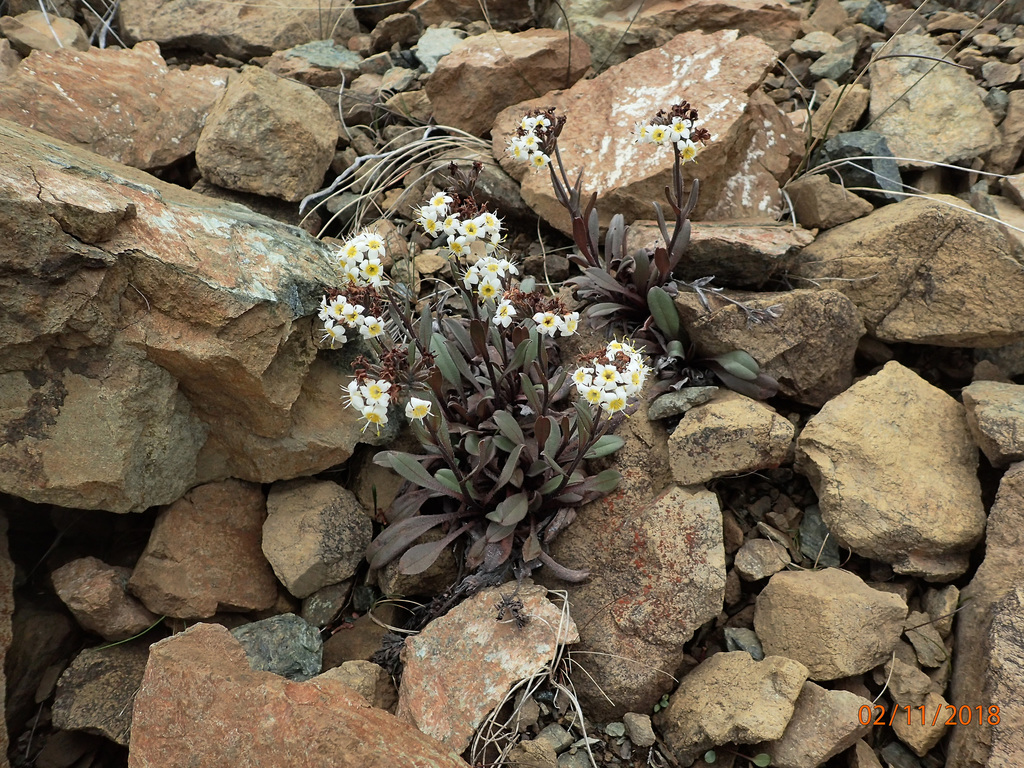
Myosotis monroi
Myosotis monroi is a species of flowering plant in the family Boraginaceae endemic to the South Island of New Zealand. The species was described by Thomas Cheeseman. Plants of this species of forget-me-not are perennial and erect, and have ebracteate inflorescences with cream or white corollas.
From the article Myosotis monroi on Wikipedia (CC BY-SA), quoted section by section
Description
Myosotis monroi plants are small rosettes that often cluster together into tufts or loose clumps. The rosette leaves have petioles 3–56 mm long. The rosette leaf blades are 10–50 mm long by 4–13 mm wide (length: width ratio 1.7–5.2: 1), oblanceolate or narrowly obovate, widest at or above the middle, with an obtuse, often apiculate apex. The upper surface of the leaf is densely covered in straight, appressed, antrorse (forward-facing) hairs that are oriented parallel to the mid vein, while lower surface is usually glabrous except for a few isolated hairs. Each rosette has 1–6 erect, branched, forked, ebracteate inflorescences that are up to 22 cm long. The cauline leaves on the lower part of the inflorescence are similar to the rosette leaves, and decrease in size toward the tip. There can be up to 28 flowers in each inflorescence. Although the flowers are borne on short pedicels, they do not have bracts. The calyx is 3–6 mm long at flowering and 3–8 mm long at fruiting, lobed to about half of its length, and densely covered in short to long, forward-facing hairs, some of which are hooked. The corolla is cream or white (or yellow), 4–7 mm in diameter, with a cylindrical tube, petals that are rounded and flat, and small yellow scales alternating with the petals. The anthers are fully exserted, extending past the scales. …
Range & habitat
Myosotis monroi is a forget-me-not endemic to the northern part of South Island, New Zealand in the ecological provinces of Sounds-Nelson and Western Nelson, from 700–1640 m elevation. It is locally common on ultramafic soils in rocky areas in fell field, scrub or tussuckland in Red Hills, Wairau Valley, and at Dun Mountain.
Wikipedia: “Distribution and habitat”
In human culture
Myosotis monroi Cheeseman is in the plant family Boraginaceae. It was originally described in 1906 by Thomas Cheeseman in his Manual of the New Zealand Flora. The new species was also illustrated by Matilda Smith in 1914, drawn from specimens gathered by Frederick Gibbs on Dun Mountain, Nelson, at an altitude of nearly 4,000 feet (1,220 m). Cheeseman wrote that, 'This attractive little plant was originally discovered by Sir David Monro about the year 1854 on Dun Mountain, Nelson... Monro's plant, however, has proved to be comparatively abundant on the Dun Mountain Range, and has been gathered by most New Zealand botanists...' Myosotis monroi is morphologically most similar to two other South Island ebracteate-erect species, M. albosericea and M. goyenii, but can be distinguished from them by its hooked trichomes on the calyx, fully exserted anthers, filaments that are usually >2 mm long, and obtuse rosette leaf apex. M. monroi also shares some morphological characters with M. …
Wikipedia: “Taxonomy and etymology”
Where it lives
Recorded sightings
—
geo-referenced records in GBIF, from museums, herbaria and field observers.
Drag the globe to turn it. Dots are where records exist, not a range map; darker means more records.
In the stacks
Searching the stacks…
Every page naming Myosotis monroi in the Biodiversity Heritage Library →
This page is assembled live from iNaturalist, GBIF, Wikipedia, the Source Library and the Internet Archive. It is not yet part of the hand-edited codex. iNaturalist taxon 404037.