- Plants
- ›Vascular Plants
- ›flowering plants
- ›Dicots
- ›Mints, Plantains, Olives, and Allies
- ›Plantain Family
- ›Angelonieae
- ›Ourisia
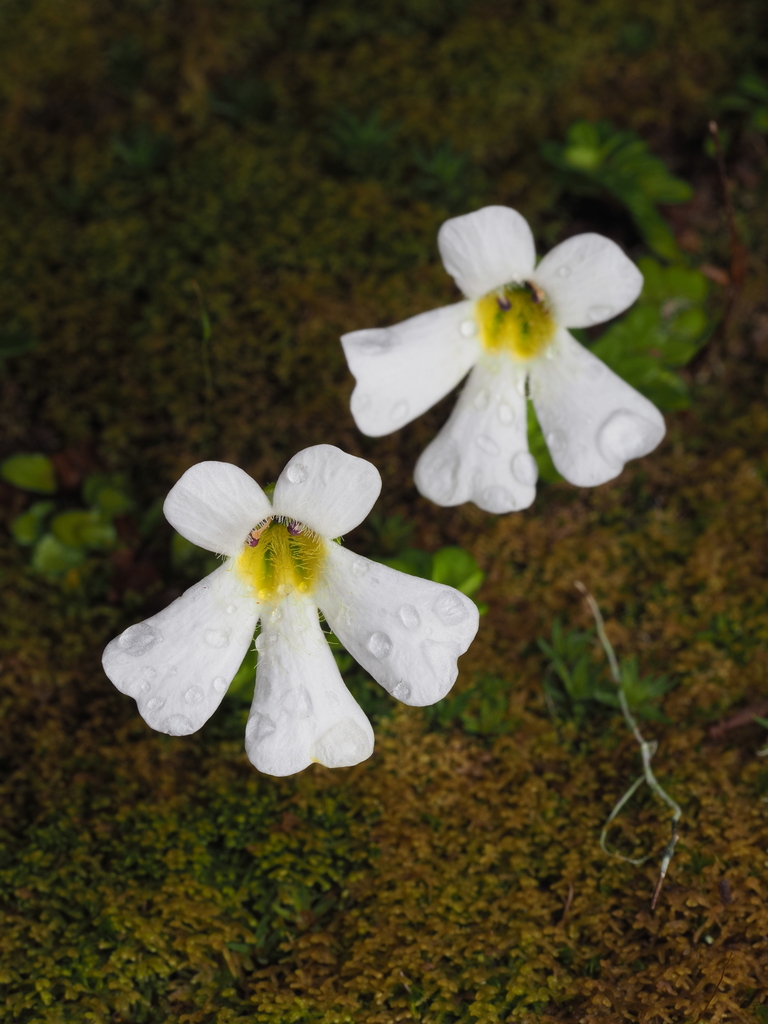
creeping mountain foxglove
Ourisia caespitosa
Ourisia caespitosa, or creeping mountain foxglove, is a species of flowering plant in the family Plantaginaceae that is endemic to New Zealand. Joseph Dalton Hooker described O. caespitosa in 1853. Plants of this species of New Zealand foxglove are perennial herbs that are mostly glabrous (hairless), with trilobed or irregularly notched leaves that are tightly packed along a creeping stem. It is listed as Not Threatened.
From the article Ourisia caespitosa on Wikipedia (CC BY-SA), quoted section by section
Description
Ourisia caespitosa plants are perennial herbs. The stems are creeping, many-branched, and densely packed with repent, opposite leaves. Leaf petioles are 0.8–9.4 mm long. Leaf blades are 1.9–9.4 mm long by 1.1–6.3 mm wide (length: width ratio 1.2–2.0: 1), usually narrowly to broadly ovate or obovate, widest below or above the middle, with a rounded apex, cuneate base, and trilobed or with up to 4 irregular notches or teeth. Leaves mostly glabrous, and on the lower surface densely punctate. Inflorescences are erect, glabrous racemes up to 125 mm (4.9 in) long, with 1–3 flowering nodes and up to 6 total flowers per raceme. Each flowering node 1–2 flowers and 2 sessile, clasping bracts that are usually narrowly to broadly ovate or obovate. The lowest bracts are similar to the leaves, 3.1–8.2 mm long and 1.4–6.3 mm wide, and become smaller toward the tip of the raceme. The flowers are borne on a glabrous pedicel up to 32 mm long. The calyx is 4.3–7.4 mm long, irregular, with 3 lobes divided to about one-quarter the length of the calyx and 2 divided to near the base, and usually glabrous. The corolla is 11.3–19.3 mm long (including the 3.9–9.7 mm long corolla tube), white, bilabiate, tubular-funnelform, glabrous on the outside, with 3 lines of yellow hairs on the inside. The corolla lobes are 3.5–10.9 mm long, spreading, and obovate to obcordate. …
Range & habitat
Ourisia caespitosa is a New Zealand foxglove that is endemic to the North, South and Stewart Islands of New Zealand. It is widespread and common in most high-elevation areas. In the North Island, it is found in the Gisborne, Volcanic Plateau and Southern North Island regions, whereas on the South Island it widespread throughout all regions. On Stewart Island, it is known from Mount Anglem / Hananui. It grows in herbfields, grasslands and scrub above the bush line, often in damp places, on shingle, scree, rocks, crevices, outcrops and cliffs from 540 to 2,000 metres (1,770 to 6,560 ft) above sea level.
Wikipedia: “Distribution and habitat”
Where it lives
Recorded sightings
—
geo-referenced records in GBIF, from museums, herbaria and field observers.
Drag the globe to turn it. Dots are where records exist, not a range map; darker means more records.
In the stacks
Searching the stacks…
Every page naming Ourisia caespitosa in the Biodiversity Heritage Library →
This page is assembled live from iNaturalist, GBIF, Wikipedia, the Source Library and the Internet Archive. It is not yet part of the hand-edited codex. iNaturalist taxon 404417.